‘You have to take care’: behind the painstaking restoration of a rare early Art Nouveau house in Brussels
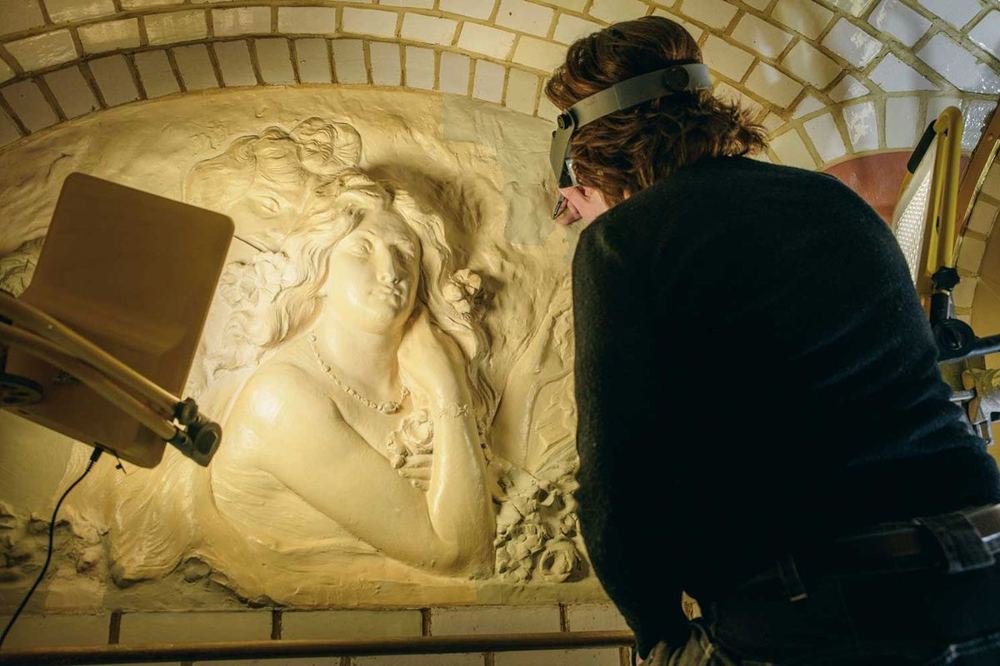
Visitors to the architect Victor Horta’s home can see the restoration in progress
In the heart of Brussels’s leafy Saint-Gilles district, scaffolding surrounds the pale yellow mansion with ornate wooden doors that houses the Horta Museum. Expressive curves of wrought iron twist along the outlines of the windows and terraces.
Completed in 1901, the house was once the home and studio of the renowned Belgian architect Victor Horta, and is one of the rare surviving examples of early Art Nouveau architecture. In February, the Saint-Gilles municipality invested €800,000 in a renewal programme that will inject new life into his vision.
The house remains open to the public while the renovations continue, allowing visitors to glimpse the meticulous work required to preserve the early-20th-century masterpiece.
“Victor Horta used his house as a personal manifesto, or calling card, to show what he was able to do,” says Elisabeth Horth, the head of historical heritage at the museum, who is overseeing the restoration.
Horta had a distinctive style that combined early industrial elements, like iron and brickwork more typical of the era’s railway stations, with organic floral shapes and elements of Congolese arts that had made their way into a Belgian colonial aesthetic.
In his own home, Horta included his signature features, like decorative curvilinear motifs that meandered gracefully from the mosaic floors to silk wallpaper, and carved rare woods. The central four-storey staircase winds upwards like a conch shell towards a domed skylight, framed by wrought iron and mirrors to soften the natural light.
Every part of the restoration requires a specialist: carpentry, glasswork and furniture restoration. On a recent afternoon, Delphine Mesmaeker, a sculpture and plaster conservator, sits high up on a scaffold under the eaves of the vaulted dining-room ceiling while removing grey paint from a bas-relief to reveal the buttery yellow paint layer below.
Mesmaeker, one of five sculpture restorers, is using a scalpel to restore one of the six arched reliefs by the sculptor Pieter Braecke in the dining room, some of which depict scenes from different stages of a woman’s life: childhood, marriage, childbirth and old age. It took three months to remove the overpainting of three reliefs on one side of the dining wall, Mesmaeker says, and now she and a colleague are working on the other three. Using a minimal amount of natural solvent on the paint, she is chipping away the top paint layer with the scalpel, working millimetre by millimetre.
“It’s like a rediscovery of the original bas-relief,” Mesmaeker says. “The challenge is to really understand the composition of the different layers and then to remove the right layer without damaging the plaster.”
This slow, painstaking work requires so much concentration that Mesmaeker and her colleagues take a month every two months to focus on something else, so as not to “become crazy”, Horth says. This phase of the work is expected to finish in November.
Horta, who was born in Ghent, purchased two adjacent plots of land on the Rue Américaine in Brussels in 1898, at the height of his career, for his maison-atelier . He designed everything inside, including furniture, the flower-shaped lamps, an indoor winter garden and a fully equipped bathroom with a flush toilet, a rare household amenity for the time.
After Germany invaded Belgium during the First World War, Horta fled to London and then the US with his wife, Julia Carlsson, where he gave lectures on architecture and they both lectured on German war atrocities, according to Tom Packet, an art historian who runs the museum’s archive. Horta abandoned his house, and when he returned four years later he sold it.
Although he was a celebrated figure of his era and his designs and aesthetic influence can be found all over Brussels, Horta’s architectural style was out of fashion for decades, considered too elaborate, and his buildings were threatened with destruction.
In 1961, the municipality of Saint-Gilles purchased the house, which opened as a museum in 1969. More recently, there has been a reappraisal of the Art Nouveau style. Four of Horta’s celebrated townhouses were designated as Unesco World Heritage Sites in 2000, and in 2023, Brussels hosted a year-long festival celebrating Art Nouveau, marking 130 years since Horta completed his first townhouse, Hôtel Tassel. Another Horta townhouse, Hôtel Solvay, was also salvaged and underwent a major façade renovation from 2022 to 2024.
At the Horta Museum, Camille Meslay, a mosaic and fresco conservator, is sitting on the floor of the living room, listening to opera, while leaning over to clean the mortar between the tiny tiles. “It’s a very old mosaic technique used by the ancient Romans,” she says. “It uses Roman mortar, made of lime and sand. The tradition continued in Italy, and the craftsmen in the 19th-century here who made floors like this were from Italy.”
A date for the full completion of the renovations has not yet been set. For Horth, however, even when that does happen the job of maintaining the mansion will continue. “It’s like an old lady, so you have to take care,” she says.