In the rush to buy drones, make sure not to stockpile obsolescence
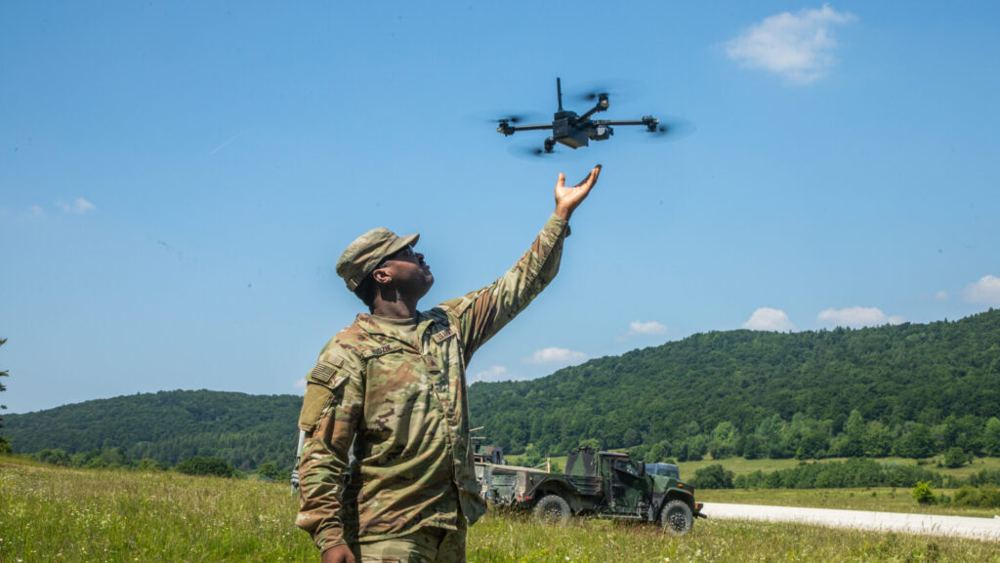
In this op-ed, the commander of the Pentagon’s Unmanned Systems – Experimental Command (US-X) warns that unit cost can’t be the driver when looking at small drones.
Imagine the Pentagon purchases 100,000 drones for $1,000 each, and stores them in a warehouse for future combat. It sounds like an exceptional achievement of mass production, exactly the kind of push needed in the wake of conflicts in Ukraine and the Gulf
But what happens when only 30,000 drones are used before the adversary develops a countermeasure that makes the remaining 70,000 drones operationally ineffective? Suddenly, the cost per useful unit is going to be much higher, with the military either forced to throw out the hardware or invest in upgrades. This breaks the long-standing assumption that lower unit cost reliably translates into lower cost per unit of combat value. And it means as the department pushes towards a future heavily leveraged on small drones, we need to be planning for the very real cost of obsolescence.
The Industrial Revolution taught us that we can scale products and services by using four concepts: Standardization, Specialization, Synchronization, and Certification. If parts could be standardized, they could easily be replaced. This idea expanded to tooling, processes, and even people. Next, specialized tools needed to be created for specific parts. This concept also applied to processes and people. Then, all parts, tools, and processes needed to be synchronized in time to have the maximum effect. Finally, each part, each tool, each process, and each person needed to be certified so we can trust them with the lowest oversight possible.
Together, these principles maximize repeatability to create large volumes of parts and products. It costs a lot to establish the standards, specialized tools, synchronized processes, and certifications that make this repeatability possible. But once a product, process, and workforce have been standardized, specialized, synchronized, and certified, it becomes extremely inexpensive to replicate another unit.
For most of the Industrial Age, implementation of these concepts significantly lowered unit costs. With lower unit cost, more tanks, bombs, trucks, or aircraft were able to be purchased. Therefore, unit cost became a proxy for greater combat power per dollar spent. However, that is no longer the case.
We are entering a new manufacturing revolution defined by artificial intelligence (AI), design-independent tools, modelling and simulation, and digital engineering. AI-assisted tools allow for the design of small aircraft in minutes. Design-independent tools, like 3D printers, robotic arms, and CNC (Computer Numerical Control) machines no longer need to be specialized for specific designs like traditional manufacturing. They can form a nearly infinite number of shapes and then put the AI-generated designs into immediate physical form. Finally, digital engineering helps to synchronize the quick design changes made by AI to all the other parts of the design and manufacturing processes.
Put together, they create the ability to design, build, verify, and field in days or weeks instead of years. This means that in the next significant war, the ability to change and adapt will become a significant warfighting capability.
A decorated combat aviator and biotech CEO advocates preparing for novel viral threats before the next crisis.
But Ukraine shows us that just as these technologies allow us to adapt faster, they allow our adversaries to adapt faster, as well. And as adversaries adapt faster, the useful life of a fixed design will shrink. Therefore, a new warfighting question is beginning to emerge: How do we protect ourselves from fielding obsolete equipment, and how do we push our adversaries into obsolescence?
Game of Drones has begun to show how that speed can become operationally useful. In a “competition-style” event, airframers, payload manufacturers, and algorithm developers compete and cooperate to solve current operational problems. Recently, a company that makes sensors for Nintendo controllers was paired with an aircraft design company and demonstrated that they could map the magnetic field of the Earth to create a new type of navigation tool in a GPS-denied environment.
Additionally, more operational exercises, like the Rim of the Pacific international maritime exercise ( RIMPAC 2026 ), are already demonstrating the capability for rapid, in-theater drone manufacturing. The Navy has touted this as the largest advanced manufacturing demonstration in Department of War history. The tools for adaptive manufacturing are already beginning to enter war planning and concepts of operations.
Operational obsolescence stems from changes in the threat, technology, or tactics that reduce the combat value of a system. In the 100,000-drone example, the remaining 70,000 drones might still fly, but if they can no longer accomplish the mission they were purchased to perform, then the military has paid for combat value it can no longer use. To make matters worse, obsolescence includes more than just the cost of discarded hardware; it also includes the cost of logistics, storage, manufacturing capacity, and lost opportunity for those 70,000 obsolete drones.
We must stop asking, “How cheaply can we build another drone?” Instead, we must ask, “How much combat value will this production lot deliver before it needs to be redesigned?”
While mass production remains essential for components where repeatability provides the greatest advantage (like micro-electronics or advanced sensors), new manufacturing processes allow decision makers to preserve optionality in the structures and interfaces, allowing for fast systems integration. Since the greatest revolutions were always built upon the previous ones, adaptation without scale would be useless.
Our new objective should be to force our adversaries’ systems into obsolescence by changing faster than they can develop and field countermeasures. A manufacturing system that enables a fast adaptation rate at large scale will itself become a powerful weapon.
Acquisition leaders should begin evaluating production lots of rapidly evolving systems by more than just unit cost. They must also consider obsolescence by assessing how much of an inventory can be expected to deliver useful combat value before the design must change. Industry incentives should reward optionality by looking at the ability to insert new technology and adapt at speed.
Operationally, manufacturing itself needs to become part of the concept of operations. Exercises like RIMPAC should test more than whether we can manufacture forward; they should explore how we can encounter a new battlefield problem, integrate new technology, redesign the weapon system, manufacture that new system, and deliver it to combat.
While we will need drones in munitions-like quantities, drones can’t be stockpiled like traditional munitions because technology, threats, and tactics are changing too quickly. Instead, we need to stockpile the components and flexible manufacturing capacity that will allow us to build, integrate, and adapt quickly.
Col. Dustin Thomas is the Commander of DCMA’s Unmanned Systems, Experimental Command (US-X). US-X provides contract oversight for unmanned systems of all sizes across all domains and manages the Blue List. Col. Thomas previously led Black Phoenix, an innovation team focused on designing, building, and flying small unmanned systems in less than 24 hours, and founded Game of Drones, an experimentation event focused on the rapid integration of new technology into unmanned systems.
The views expressed are those of the author alone and do not necessarily reflect the views of the Department of War.