The Big Review: Frida, The Making of an Icon ★★★½
Tate show provides a decent selection of the artist’s work but somewhat unravels in its attempt to fully assess her star status
Among the many photographs of Frida Kahlo in Tate Modern’s exhibition Frida: The Making of an Icon , there is a series of four taken by the art dealer Julien Levy, at whose New York gallery Kahlo had a solo exhibition in November 1938. Kahlo and Levy were also lovers at the time. He photographs her topless while she is arranging her complex braided hairstyle: she looks at him, she looks away, she raises a cigarette between painted fingernails and ignores him while he marvels at what her ritual has realised. With pale flowers in her hair, Kahlo looks like Billie Holiday wearing her luminous gardenia. Levy’s images are at once intimate, knowing and quite of a piece with the fetishisation, then and now, of Kahlo’s physical presence: her frankness of body and gaze, her Mexicanness as guarantor, to the likes of André Breton, of primitive splendour. Frida: The Making of an Icon sets out to show how such myths are made and how they have been used to more or less liberated ends.
The exhibition is emphatically not a blockbuster Frida Kahlo show of the sort Tate Modern mounted in 2005. On that occasion, more than 80 paintings were shown, out of around 200 extant works. The current exhibition contains only around 30, and these are not exactly supplemented by, but rather displayed in rich consort with, works by contemporaries of Kahlo’s, as well as artists who have deployed her image or cited her work in the last half-century or so.
All of this has caused some confusion and disappointment among certain broadsheet reviewers, who have been dismayed both by the relative paucity of Kahlos and the presence of art and artists condemned by these critics as purveyors of, dreadest phrase in such circles, identity politics. In fact, there is plenty of Kahlo here, quite enough to deliver a sense of her work’s virtues well outside of her status as “icon”. (More on that vexing term below.) But also enough of her, and others, to see her legend solidifying, in life and beyond. As for politics, what the show leaves out about Kahlo’s beliefs and actions is more lamentable than the claims made for her work’s radical utility today.
Frida: The Making of an Icon is organised into seven thematic sections, with the first two rooms devoted to Construction/Self-Construction. In what may be the most coherent and persuasive (if expected, conventional) part of the show, there are some of Kahlo’s first self-portraits.
In 1926, the year after her crippling bus accident in Mexico City, she painted Self-Portrait (in a Velvet Dress) , in which the 19-year-old is poised and a little rueful in front of a roiling seascape. Her long neck and spindly, oddly disposed hand are reminiscent of Parmigianino’s Madonna and Child with Angels (1534-40). There is already a sense of an artist with a keen sense of what it means to become, as well as compose, an image. Self-portraiture here also means something more peculiar and intimate: this section includes not just paintings but clothes owned and worn by Kahlo, photographs of her by others (notably another lover, Nickolas Muray) and a tiny pencil drawing of aspects of her accident.
The two following rooms are given over to Surrealist Affinities. Though Kahlo herself objected to being corralled (notably by Breton) into the Surrealist moment and canon, “affinities” is a capacious enough way of couching the obvious connections. There are the dream-creatures of Kahlo’s own paintings: the grotesque faces, for example, in Girl with a Death Mask (1938), or the explosively phallic mandrake in Flower of Life (1943). And several uncanny corpses, seemingly hovering between life and death: The Deceased Dimas Rosas (At Three Years of Age) (1937) and The Suicide of Dorothy Hale (1938-39). It is obvious in this section of the show how “Surrealist affinity” also meant creative misreading of specifically Mexican religious imagery, especially as regards the Day of the Dead.
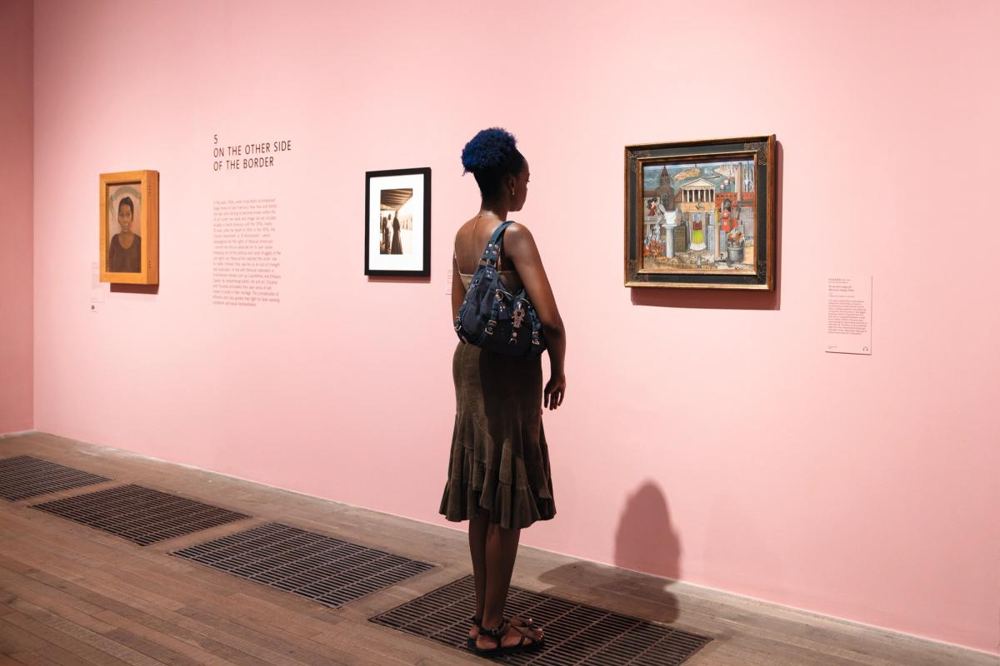
The On the Other Side of the Border section addresses Kahlo’s reception in the US in the decades after her death in 1954, specifically among Chicana/o artists in the 1970s. As the artist and critic Amalia Mesa-Bains recalls in an essay for the Tate catalogue, this was more than a matter of formal or cultural affinity. Mesa-Bains and her contemporaries interviewed older artists in the San Francisco area who had known Kahlo and even engaged in exquisite-corpse drawing sessions with her. The exhibition Homage to Frida Kahlo followed in 1978 at Galería de la Raza, and among its most enduring outcomes was Rupert Garcia’s portrait of the artist. This bold poster-style rendering adds Kahlo’s image to the roster of radical faces of the era: an “icon” to display alongside Che Guevara and Malcolm X.
In the show’s final room, some contradictions and limitations become obvious. We have been reminded more than once in the second half of the exhibition that Kahlo was a politically engaged, indeed “activist”, artist. No matter how plausible the insistence on her radicalism in gender and sexuality, or her importance for later racial and cultural struggles, there is a strange and glaring absence throughout. Kahlo’s politics were explicitly Marxist, she was a longtime member of the Communist party, and among her final actions was to demonstrate against the US-backed coup in Guatemala.
No doubt it will seem crude to a curatorial or institutional milieu that is intent on painting artists of the 20th century as more or less amenable to present cultural politics. But what exactly is gained and lost when we pretend that an artist as celebrated as Kahlo did not have a very specific radical politics that was local and global and widely shared as well as reviled in her lifetime and beyond? You can walk through Frida: The Making of an Icon and encounter little or nothing of this history apart from the hammer and sickle she painted on a plaster breastplate in 1950.
You might, on the other hand, be put in mind of Marx and commodity fetishism when you reach that last room, devoted to the theme of Fridamania. Here is the Frida Kahlo coffee cup, styled after the Starbucks logo; a pair of Kahlo floral Converse sneakers; her face on bottles of shampoo and conditioner; Kahlo’s head on the body of Patti Smith; and of course countless dolls. Is this a cabinet of Kahlo kitsch or evidence of pop-cultural relevance and real meaning? The viewer must decide, because at this point in the exhibition it is very unclear what artistic, critical or contextual point is being made.
At worst, this final room reflects poorly on the rest of the show. There is a claim made earlier, among the wall texts, that until Andy Warhol, Kahlo was the most obvious 20th-century artist who became, or turned herself into, an image. It is only true, of course, if one ignores Pablo Picasso and Salvador Dalí. But the more pressing issue is surely the slackness of “icon” and “iconisation” as catchalls for self-invention, appropriation and outright banalisation. A few steps away in the gift shop, you can buy a T-shirt that conflates the season’s hit shows at Tate into one all-diminishing slogan: “Tracey/Ana/Frida”.
- Frida: the Making of an Icon , Tate Modern, London, Until 3 January 2027
In The Observer , Laura Cumming laments the focus on Kahlo’s image at the expense of her work: “Frida is back, commodified into oblivion at Tate Modern. For the sake of simplicity, or sales, she no longer has the cumbersome dignity of a surname.” Alastair Sooke writing in The Telegraph concludes that “everything about this show dilutes the art of Kahlo”. Meanwhile, in The New York Times , Emily LaBarge notes that “the museum, sometimes seems stuck between the rock of art history and the hard place of social relevance when it comes to Kahlo”.