Leipzig airport attack fallout lays bare Germany’s polarisation on Russia
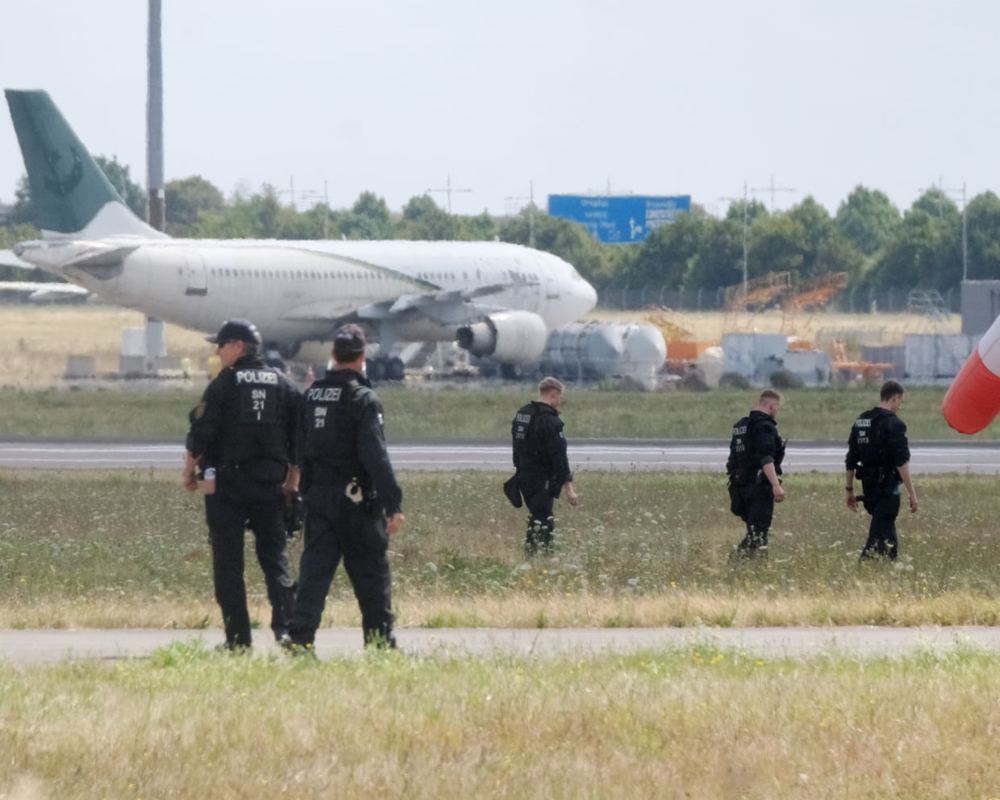
The government’s increasingly hostile stance towards the Kremlin has drawn criticism from the far right – and the far left Even before the German government laid the blame this week on Russia for an attempted drone attack at Leipzig airport , the topic of German ties to Moscow was high on the political agenda. But the timing of the unsurprising yet explosive Leipzig announcement – days before a key regional vote – has exposed the extent to which German politics is polarised on the issue. Continue reading...
The government’s increasingly hostile stance towards the Kremlin has drawn criticism from the far right, and the far left
Even before the German government laid the blame this week on Russia for an attempted drone attack at Leipzig airport , the topic of German ties to Moscow was high on the political agenda.
But the timing of the unsurprising yet explosive Leipzig announcement, days before a key regional vote, has exposed the extent to which German politics is polarised on the issue.
Leading the polls nationally and in the state of Saxony-Anhalt, which votes this weekend, is the far-right Alternative für Deutschland (AfD). The party has repeatedly called for a closer bond with the Kremlin, and crucially, for its cheap oil and gas to flow to Germany once again, despite Moscow’s unrelenting onslaught on Ukraine.
Germany is already on tenterhooks. The interior minister, Alexander Dobrindt, had warned that Berlin faced a growing threat of hybrid warfare, and on Wednesday morning, the day after the Leipzig announcement, police were investigating a second sabotage assault on the electricity grid within just 24 hours.
An explosion at Augsburg railway station in the early hours of Wednesday morning also initially looked like it might fall into the same category, illustrating the extent to which the country remains nervous and on high alert for attacks on its vital infrastructure.
Investigations into all these incidents and others from the near past, many of which are said to be linked, are ongoing, even as authorities warned against drawing premature conclusions.
Moscow has denied involvement, and accused Berlin of trying to divert attention from its own domestic problems, including the rise of the far right, and the state’s failure to protect its own infrastructure.
The resulting uncertainty, chaos and angst appear to be nothing less than grist to the mill of the AfD. Its foreign policy spokesperson, Markus Frohnmaier, accused the government of sorting acts of sabotage “according to political expediency”.
While it had “escalated the situation against Russia within days”, he said, the 2022 attack on the Nord Stream pipeline, where Ukrainian operators are suspected of being responsible for sabotaging a key route for Russian gas to Germany, had so far remained without consequence. ( Two Ukrainian nations named by Germany as suspects have been arrested over the attack , with one last year extradited from Italy and the other currently in Croatia.)
“This is not a consistent security policy, but rather a double standard in foreign policy,” Frohnmaier claimed, adding he was convinced the government would use the Leipzig incident “as justification for even more support for Ukraine and an even deeper involvement of Germany in this war”.
The AfD, which has called for talks with Moscow, ending sanctions against Russia , and slashing support for Ukraine, has urged the government to lay bare its proof of Russia’s involvement, saying so far the evidence is lacking.
Wary of escalating a conflict with Moscow, the government of Friedrich Merz waited days before making its painstakingly-worded declaration. In a more frank admission than the German government has ever made, foreign minister Johann Wadephul stated: “We are not at war, but we are a daily target of hybrid warfare.”
The details released on Wednesday of two Russian suspects identified as having been involved in the Leipzig incident is unlikely to assuage the AfD’s complaints or, it would seem, the far-left Die Linke.
Its leading MP, Dietmar Bartsch, said on Wednesday that the suspicions of Russian involvement did not justify the government’s decision to shut down the Russian consulate in Bonn as well as a sprawling Russian cultural centre in Berlin and would not make Germany safer. On the contrary, they increased the risk of a “major war” drawing closer, he said.
With the AfD on around 42% in the eastern state of Saxony Anhalt and possibly poised to form the first far-right-led administration since the second world war, Merz’s Christlich Demokratische Union (CDU), on around 22%, is under intense pressure.
Within Merz’s own party, there have been growing calls for him to toughen his stance against Moscow and pure frustration that it has taken so long. For years, members of his Christian Democrats and his current coalition partner, the Social Democrats, along with generations of diplomats, have remained caught up and seduced by the long-standing romantic notion that Russia could be tamed by trade and energy pipelines, according to the CDU’s Roderich Kiesewetter.
The former soldier and the party’s respected foreign policy expert said Germany “must give up its caution with regard to Russian state terrorism on German soil, as well as this romantic notion of Russia as a great cultural nation. Russia cares not a damn about this caution, but rather sees it as an invitation to keep escalating,” he told broadcaster InfoRadio.
He criticised Merz’s recent public reference to Russia as a great cultural nation, “because great cultural nations do not subject their neighbouring states to war, violence, and child abductions”. He said it was time for Merz to name the current Russian regime for what it was.
Konstantin von Notz, foreign policy expert for the Greens, praised the government’s “significantly clear language” over Moscow’s behaviour, even as he described it as “long overdue”.
The extent to which voters in Saxony-Anhalt fear how a further deterioration of relations with Moscow could affect them may yet be felt at the ballot box.