French back-to-school vocabulary guide
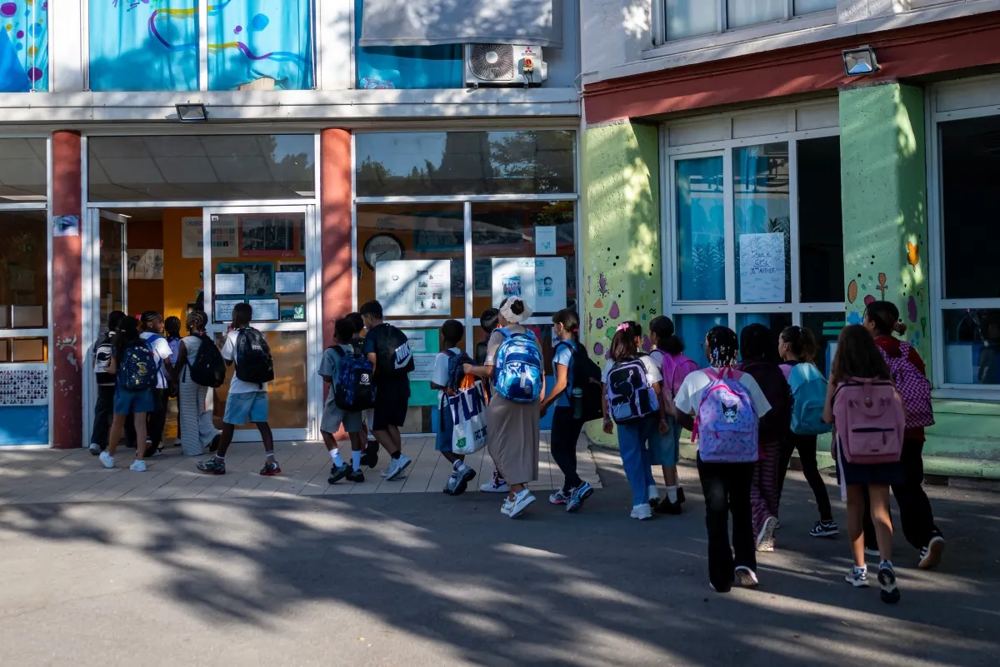
If you're new to the French education system, September can feel like a crash course in vocabulary as well as a new school year - from the school year system to class trips and homework books, here's our vocab guide.
If you're new to the French education system, September can feel like a crash course in vocabulary as well as a new school year - from the school year system to class trips and homework books, here's our vocab guide.
Starting at a French school has all sorts of challenges for both children and their parents - but foreigners have the additional problem of understanding the specialist vocabulary that forms part of the school day.
From ' le cahier de correspondance ' and ' le cartable ' to class-level abbreviations like CP, CE1 and CM2, here are some common French school words and phrases you might come across.
La rentrée ( la rahn-tray ) - The return to school after the summer holidays. More broadly, la rentrée can refer to the whole period when people return to work and normal life resumes after the summer.
Les fournitures scolaires ( lay foor-nee-toor skoh-lair ) - School supplies, such as pens, pencils, notebooks, folders and rulers.
La liste de fournitures (la leest duh foor-nee-toor) -The school supplies list. Parents are often given a detailed list of everything their child will need for the new school year.
READ ALSO: Fournitures scolaires: The dreaded French school stationery lists
Le cahier de correspondance ( luh ka-yay duh kor-res-pon-dahns ) - This is a notebook used to communicate between parents and the school. Teachers and school staff can use it to send messages, announcements, permission slips or other information home, while parents can use it to write notes to teachers. Parents may be asked to check it regularly and sometimes sign messages to show they have been seen.
At some schools this is now being replaced by an app or an online system that shows marks and messages.
Le cartable - school bag, usually huge to hold all the things on that list of required stationery. Younger children have a large backpack or sometimes a bag on wheels. By the time they get to collège or lycée they usually prefer a slightly cooler backpack ( sac à dos ) to keep their stuff in.
Téléphone - from September 2026, pupils must hand in their phone at the start of the school day. This rule includes both smartphones and 'dumbphones' (those without internet connection), plus any other connected devices such as smartwatches - it's up to each school exactly how they enact this policy, and parents should be informed of the procedure.
La cantine ( la kahn-teen) - The school canteen or cafeteria.
La cour de récréation ( la koor duh ray-kray-ah-see-ohn ) - The school playground, where children go for la récré.
La récré / la récréation ( la ray-kray ) - Break time or recess.
Le professeur / la professeure (luh pro-fess-ur / la pro-fess-ur) - This refers to the teacher, but in everyday speech, the abbreviation le prof or la prof is very common.
Le maître / la maîtresse ( luh met-r / la met-ress ) - Traditional terms for a primary-school teacher, particularly one teaching younger children.
Le directeur / la directrice ( luh dee-rek-tur / la dee-rek-trees ) - The headteacher or school principal.
L'emploi du temps ( lahm-plwah dew tahn ) - Timetable or school schedule.
Une classe ( ewn klass ) - A class, both in the sense of a group of pupils as well as a classroom
L'EPS (éducation physique et sportive) ( euh-pay-ess ) - Physical education, or PE. This is the official school subject covering sport and physical activity.
Une sortie scolaire ( ewn sor-tee skoh-lair ) - A school trip or educational outing. It usually refers to a day trip or shorter outing organised by the school, such as visiting a museum, theatre, historical site or going on a nature walk. Parents will often be asked to sign a permission slip before their child can take part, and may be asked to volunteer to help out with the trip.
Une classe verte ( ewn klass vair-tuh ) - Literally translates as a "green class", but it refers to a school trip where pupils spend several days away from home, usually somewhere in the countryside or another natural setting. The idea is to combine schoolwork with outdoor activities.
Une classe de découverte ( ewn klass duh day-koo-vair-tuh ) - A broader term for a school trip lasting several days, during which pupils leave their usual school environment to learn through activities and experiences elsewhere. A classe verte is one type of classe de découverte .
A classe de découverte can also be a classe de neige , which refers to a school trip to the mountains involving skiing or winter sports. You can also have a classe de mer , which is a trip centred around the sea with activities such as sailing or discovering marine life.
Les accompagnateurs ( lay ah-kom-pah-nyah-tur ) - The adults who accompany pupils on a school trip or outing, such as teachers, school staff or parent volunteers.
The French school system uses a series of abbreviations for different year groups, which can be confusing. Here's what they mean, and roughly how old children are in each class.
La maternelle - Preschool or nursery school. Children generally attend from the age of three, although some start at two, until six.
La petite section (PS) - The first year of maternelle , generally for children aged three.
La moyenne section (MS) - The second year of maternelle , generally for children aged four.
La grande section (GS) - The final year of maternelle , generally for children aged five.
Le CP ( cours préparatoire ) - The first year of primary school, generally for children aged six. This is when children formally begin learning to read and write.
Le CE1 ( cours élémentaire première année ) - The second year of primary school, generally for seven-year-olds.
Le CE2 ( cours élémentaire deuxième année ) - The third year of primary school, generally for eight-year-olds.
Le CM1 ( cours moyen première année ) - The fourth year of primary school, generally for nine-year-olds.
Le CM2 ( cours moyen deuxième année ) - The final year of primary school, generally for 10-year-olds.
After primary school comes le collège , followed by le lycée .
La 6e ( sixième ) - The first year of collège , generally for children aged 11 to 12.
La 3e ( troisième ) - Generally 14 to 15 years old and the final year of collège .
La seconde - The first year of lycée , generally for 15 to 16-year-olds.
La première - The second year of lycée , generally for 16 to 17-year-olds.