Putin spent over €110bn on Ukraine war so far in 2026, up one-third on last year (Ukraine Battlefield update, Day 1,659)
New budget data and battlefield videos reveal a Russia quietly scrambling to finance soaring war costs, hide territorial setbacks and defend supposedly “safe” assets thousands of kilometres from the front.
The Russian state has so far spent 30 percent more money on the military this year than it did last year.
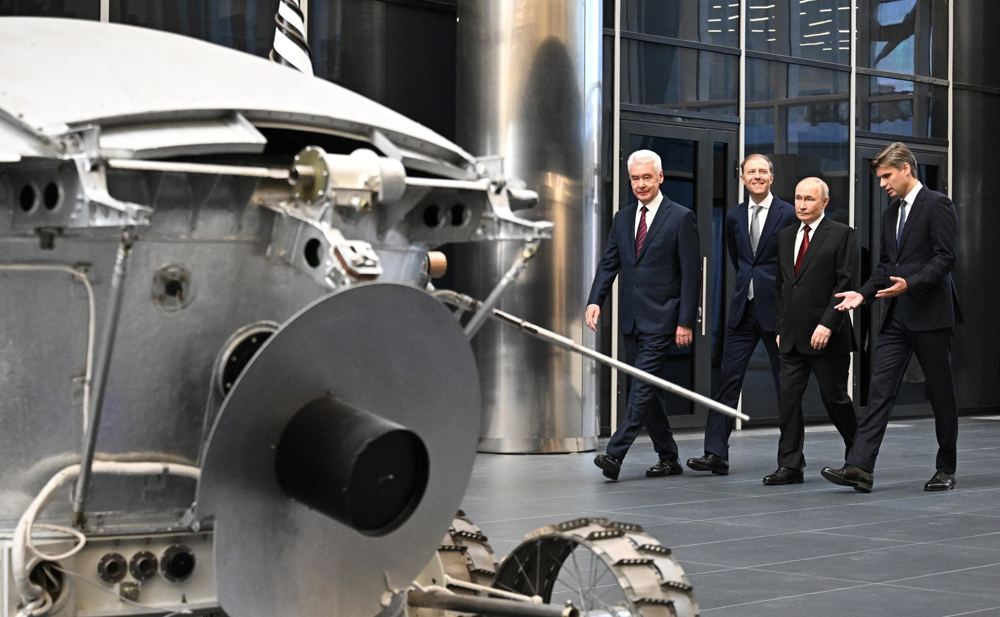
When Russian president Vladimir Putin recently spoke at an economic conference in Vladivostok , he sought to create the impression that the Russian economy was doing well. “Nothing critical is happening,” the Russian president said.
This was despite Ukrainian attacks on refineries limiting fuel availability at Russian petrol stations, and attacks on warehouses belonging to companies such as Wildberries complicating online shopping in the country.
Russia’s public-finance budget is also in trouble. “The fiscal situation is deteriorating rapidly as war costs continue to rise sharply,” wrote German economist Janis Kluge, who specialises in Russia’s wartime economy.
Kluge analysed new data from the Russian finance ministry. According to the data, Russian spending on the war has risen significantly this year.
In the first half of 2026, Russia spent a total of 10.7 trillion roubles on the military, and thus on the war in Ukraine, equivalent to around €110bn. This represents a 30-percent increase in military spending compared with 2025.
In billion rubles: https://t.co/ZdhRrRliPE pic.twitter.com/CsYUo1y7LN
Kluge included both declared and classified defence expenditure in this total. As he wrote, 85 percent of the state’s classified spending goes to the military.
The table above shows how Russian military spending in the first half of the year has risen since 2018. In the first year of the war, in 2022, Russia spent just under three trillion roubles in the first six months. And although inflation has eroded the value of money since then, defence spending has risen almost fourfold.
Kluge’s second table shows first-half military spending as a percentage of the country’s annual GDP.
Data is from the SWP Russian Budget Monitor. Military spending / full-year GDP: https://t.co/277wLG74QN pic.twitter.com/Lv9ENpOx9r
In the first half of 2026, Russia therefore spent 10.5 percent of GDP generated during that period on the military. Overall, 57 percent of state-budget revenue went to the military.
“More than half of every rouble the government collected in taxes and other revenues went to the war,” Kluge wrote .
Overall, Russia’s plans had envisaged military spending being lower this year than in 2025.
Another chart shows Russian budget plans approved in the autumn for various years. These are plans, for example, the actual military budget last year amounted to around eight percent of GDP.
“If military expenditure continues to grow at this pace, it will exceed nine percent of GDP by December, setting a new record in Russia’s post-Soviet history,” Kluge added .
Here is the planned military budget for each of the last years (relative to GDP) - this is not actual data, but original budget laws. Actual military spending in 2025 was close to 8% of GDP. There was a big reduction planned in 2026: https://t.co/YGJKIuTmhH pic.twitter.com/JXAW62UHR9
Russian budget revenues, meanwhile, are not reaching the levels planned in the autumn of last year. This is due to lower revenues from oil and natural-gas sales, although high prices following the US-Israeli attack on Iran have helped.
“As revenues are lower, higher military spending will lead to an increase in the budget deficit. According to budget data, the deficit had reached 2.8 percent of GDP by the end of July, almost twice the original annual target,” Kluge added.
Russia initially financed the war mainly from its National Wealth Fund. However, it has already spent a large part of these reserves and must therefore borrow. In Russia’s case, this is more complicated than for an ordinary European country.
“This means that the Russian finance ministry must rely on new debt as its main source of financing. Domestic borrowing has, however, become exceptionally costly for Moscow,” the German economist added.
Nevertheless, this does not mean that Russia has reached its limit and has no more money to draw on for the war. But the strained budget is another of the problems facing the Russian economy.
“The main problems confronting the Russian economy are labour shortages, the growing federal-budget deficit and the deteriorating situation in the banking system,” HUR chief Oleh Ivashchenko told Ukrinform.
Nevertheless, Ukrainians do not expect the Russian economy to collapse soon either. They believe that Russia will probably have the resources to finance the war for the next two years as well. “We do not rule out that these resources will last until 2027 and 2028,” Ivashchenko said .
If the phrase that Russia has resources for the next two years sounds familiar, there is a reason for that, similar predictions have been made in the past . Russia has so far managed to find ways to defy foreign expectations, although this is unlikely to be possible indefinitely.
Russia said that its Geran-4 jet-powered drone had struck a Ukrainian MiG-29 fighter jet at Vasylkiv air base in Kyiv region. It also released a video purporting to prove this.
The Russians claim to have destroyed a MiG-29 fighter jet at the Vasylkiv airfield near Kyiv today. Russian channels posted video footage, but Ukraine has not confirmed it. pic.twitter.com/k5BXcjV8J7
The footage shows a Ukrainian MiG-29 fighter jet flying past the drone. It was apparently filmed by another, probably reconnaissance, drone. It then showed the fighter jet at the airfield and the Geran-4 drone striking it. It has not been conclusively established that this was the same fighter jet as the one seen in the air. In any case, the fighter jet at the airfield was destroyed.
The Russian side releases footage from the strike with a Geran-4 jet-powered long-range OWA-UAV on a Ukrainian MiG-29 fighter jet stationed on the territory of Vasylkiv Air Base in Ukraine's Kyiv Oblast. The targeted plane was destroyed on the ground as a result of the attack.… pic.twitter.com/fHYnETwOSK
A former Ukrainian drone operator, now a drone expert using the pseudonym Kriegsforscher, described it as “very worrying”.
This was not the first such documented case. As analyst John Hardie wrote , it first happened in late June, when a Geran-4 struck a MiG-29 at Voznesensk airfield in Mykolaiv region.
According to Oryx, Ukraine has lost 38 MiG-29 fighter jets in total, the latest one has not yet been included.
Although the Geran-4 is described as a jet-powered drone, experts such as Fabian Hoffmann consider it more akin to a cheap, lighter cruise missile, given its similar characteristics. It is already faster than conventional drones, although unlike conventional cruise missiles it carries a smaller warhead. This is nevertheless sufficient to destroy a parked Ukrainian fighter jet.
Russian propagandists are gradually beginning to acknowledge the Ukrainian offensive north of Lyman. As pro-Ukrainian sources reported this week, Ukrainian forces have managed to liberate 200 square kilometres of territory there over the past four months. They eliminated a Russian salient which Russia had used to threaten to encircle Sloviansk from the north. Until now, Ukrainian sources had said almost nothing about the operation.
Russians are now gradually beginning to acknowledge it as well. “We do not deny that the enemy is exerting considerable pressure in this area and that our units have withdrawn from some forward positions. This is a tactical success for the Ukrainian side,” the Paratrooper’s Diary channel acknowledged .
It stressed that Russian forces had managed to withdraw in time, which pro-Ukrainian sources also confirmed. The Paratrooper’s Diary wrote of 300 Russian soldiers.
The channel added that the territory re-entered by Ukrainian forces was not under firm Ukrainian control, with a significant part of it remaining in the grey zone.
Overall, it can be said that this source acknowledged Ukrainian successes but downplayed their significance.
“The correct wording is simpler: we suffered an unpleasant tactical defeat in the Lyman sector. However, there was no encirclement; most of our soldiers were withdrawn, and everything now depends on whether the Ukrainian armed forces can exploit this success east of the Zherebets river,” it wrote .
Russia had been misleading people about this territory, as other Russian channels also acknowledged. For example, the Two Majors channel wrote that the enemy had been mounting counterattacks for months and that the situation had long required the attention of commanders. The channel added that the dissemination of “good news”, about false advances, should be banned.