Germany news: Merz, Weidel face off after AfD state win
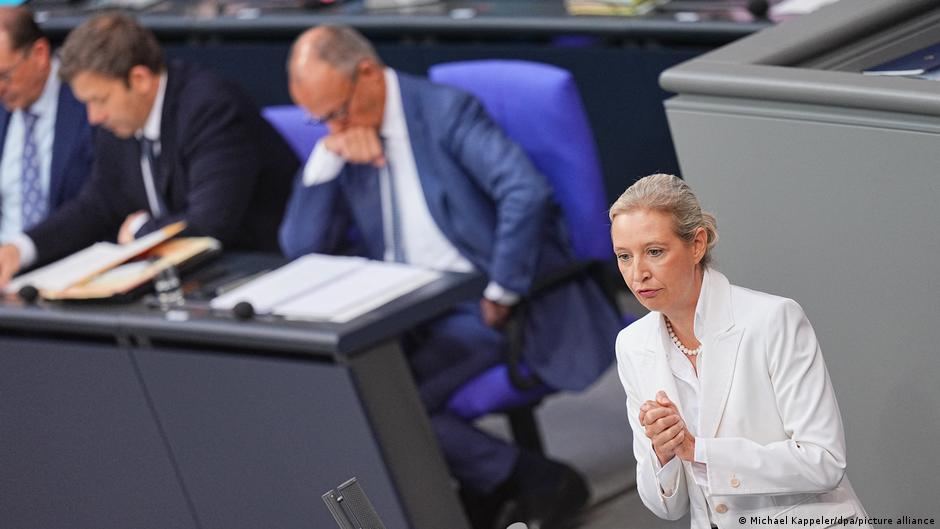
Alice Weidel and Friedrich Merz traded barbs in the Bundestag days after the AfD's victory in Saxony-Anhalt put new pressure on the German chancellor.
These live updates have been closed. Thank you for joining us.
Here is a roundup of top stories from and about Germany from Wednesday, September 9, 2026.
US defense company Covenant said Wednesday it aims to produce cruise missiles at a new factory in Germany beginning next year. The move comes as investment in Germany defense industry increases.
The plant, in the eastern German city of Leipzig , would manufacture long-range Anthem missiles, with a payload of 200 kilograms (441 pounds).
The 10,000-square-meter (108,000-square-foot) site will be the group's largest missile production facility, Covenant said in a press release, without mentioning the value of the investment.
The Anthem ground-launched cruise missiles will also be manufactured at sites in the United States and Israel.
Production in Leipzig will begin with around 1,000 units per year, before increasing to 5,000 units, and create many jobs, the firm said, without giving further details.
To view this video please enable JavaScript, and consider upgrading to a web browser that supports HTML5 video
Anthem is aimed at helping to plug a "capability gap within European armed forces in the field of long-range precision weapons," Covenant said.
"When you look at our adversaries, you see thousands of hardened targets, beyond the range of current capabilities," said Michael Kaufman, Covenant's co-founder and chief executive said in a press release.
"Anthem was built to credibly hold those targets at risk in a prolonged conflict. If our stockpiles run thin, so does our deterrence."
Germany and other European NATO members are looking for long-range weapons as a response to the Russian threat . At the NATO summit in Ankara, the German government agreed with the United States to buy US Tomahawk cruise missiles .
Founded in 2024, Covenant said it has raised more than $250 million from investors in three funding rounds, including investment from a venture capital firm belonging to Peter Thiel, a billionaire and ally of US President Donald Trump.
Last week several hundred people demonstrated in Leipzig against Covenant's plans to open a factory there.
German Chancellor Friedrich Merz has again called for cuts to the next EU long-term budget amid a visit to Berlin by European Council President Antonio Costa.
He argued that the plan was unaffordable at a time when domestic spending restraint was increasingly necessary.
The proposed budget put forward by the European Commission is for the 2028-34 period. In total, it envisages spending of almost €2 trillion ($2.33 trillion) across the seven years.
This is a fraction of what individual EU member states combined spend at the national level but then it only covers a small fraction of public sector responsibilities, the largest of which are agricultural spending and so-called "cohesion policy," or regional development and attempts to uplift less prosperous parts of the union.
"Europe needs both realism and reform," Merz said at a press conference with Costa, noting that the current budget it almost 60% larger than its predecessor. "At a time of budget cuts in all member states, this is simply unaffordable."
Merz also called for the next budget to reprioritize issues like competitiveness and defense, saying it would not be possible "to solve 21st century problems with a 20th century budget."
The budget, formally known as the Multiannual Financial Framework (MFF), is always difficult to negotiate for two main reasons. It tends to naturally pit net contributors, who often want to keep spending low, against net recipients, who tend to argue the reverse. It also requires unanimous approval from all 27 member states, so a true compromise acceptable to all must be found.
Costa and Merz said they hoped an agreement could be reached by the end of 2026, which would allow for a planning period of one year after the budget is agreed.
Costa is currently touring European capitals seeking common ground on the issue among heads of state and government.
"We cannot ask [for] more from member states," he said. "We need to create new own resources in order to protect the national budgets. All national budgets must be respected."
Police in Freiburg near the Swiss border say that their search of a car at the Rheinfelden border crossing is complete.
They confirmed prior reports that suspicion of a potentially dangerous situation arose, initially at around 1 p.m., "as a result of the actions of explosives-detection dogs."
Two German citizens were provisionally detained, a standard safety exclusion zone was set up and federal police specialists responded at the scene, police said.
The incident had led to long queues at the busy boder crossing between Germany and Switzerland across the Rhine River east of Basel.
"At around 8 p.m. the all-clear could be issued. No dangerous materials were found. The autobahn could be reopened once again," police said.
Porsche has completed its sale of its remaining stakes in luxury supercar marque Bugatti and Croatian electric supercar maker Rimac.
It had first announced plans to sell its remaining stake in the company to HOF Capital in April of this year, saying it wanted to prioritize its core businesses.
On Wednesday, Porsche said that the sale had been approved by regulators and been completed.
The struggling Stuttgart-based company said it had raised roughly €1 billion ($1.16 billion), €250 million of which would go towards debt repayments and pension funds.
Rimac and Porsche had previously shared ownership of Bugatti, once purely a part of the VW Group, which includes Porsche, in a 55:45 split, while Porsche held a minority 20.6% stake in Rimac.
The VW Group had resurrected the Bugatti brand, already twice deceased, in 1998 and used it for a series of prestige projects making the fastest road-legal cars in a straight line available anywehere in the world, typically selling only a handful of models to the super-rich in a loss-making but headline-grabbing venture.
As it faces up to swingeing cuts and a drastic restructuring scheme, such luxury projects and anything falling beyond the remit of its core business are coming under considerable pressure.
German confectionary giant Haribo has called off a long-running annual autumn promotional event for a second year running.
For decades, the company had run a scheme in which members of the public were invited to bring in chestnuts and acorns that they had gathered, and exchange them for Haribo sweets.
The company said on Wednesday that the prevalence of African swine fever, sometimes called warthog fever, in western Germany made the event too dangerous. Typically Haribo would donate the nuts to animal parks and game reserves. But because of the risk of transmission, via saliva remnants potentially on the nuts, this would pose too great a risk.
It took the same step last year but said on Wednesday that the tradition would have to be shelved "for the foreseeable future."