‘I was hit by an emotional hurricane’: Esther Freud, Deborah Levy and other novelists revisit their childhood homes
Even in adulthood, the place where you grew up never really leaves you. Could paying a return visit help six writers understand its power? Continue reading...
Even in adulthood, the place where you grew up never really leaves you. Could paying a return visit help six writers understand its power?
I recently took my best friend to see my childhood home in Kensington, west London. I lived there with my parents and four siblings from the age of one until I was 20; I have not been inside since I was 23, hen it was sold, 43 years ago. Yet it still appears in my dreams. It occupies a place inside me. I wanted to return to help me understand why it still held such power.
As we walked through nearby Holland Park, my body remembered before my mind did. A warmth spread through me. I thought of family picnics on the grass, ice-creams on hot afternoons, school sports days and sneaky cigarettes behind bushes as a teenager.
The closer we came to my street, the more I noticed what had survived. The backs of the Victorian houses facing the park looked almost unchanged. The trees were taller but familiar. As I turned the corner, my heartbeat quickened. Then I saw it.
A large white stucco Victorian house, even bigger than I remembered, as later owners have extended it. The two stone eagles that stood guard at the entrance, which I used to tap every time I ran up the steps, had disappeared. The little coal hole in the front wall was still there. My twin brother and I invented endless games through that opening. I could see us both there, age six, completely absorbed in a world of our own.
My friend and I stood on the opposite pavement, looking up at the house, when the family who live there now unlocked the front door and went inside. I felt an unexpected punch in my stomach. For a split second, I wanted to call after them, “I used to live here. Would you mind if I came in?”
I immediately changed my mind. I realised I did not want to go inside at all. I wanted to preserve the architecture of my memory. Every room held another version of me.
I looked up at the top-floor window on the left. That had been my bedroom. I could picture the desk I persuaded my mother to buy me, where I spent hours writing stories simply for the pleasure of disappearing into another world. I remembered the hall with its black and white tiled floor, the sweeping staircase covered in orange carpet. I recalled lying on the landing with my brother, on guard to see who entered and left. I could see my little legs trying to follow my sisters up the stairs, two steps at a time. My last significant memory is stepping down those stairs in my wedding dress, then standing in the hall beside my husband to welcome our guests.
If I walked through those rooms today, they would hold another family’s furniture, another family’s smells, another family’s life. Those memories would become mixed with someone else’s reality.
As I stood there, I felt two versions of myself share the same pavement. The woman I am today and the child who knew every creaking stair and every colour in every room of that house. As a psychotherapist, I’ve learned that people rarely return to their childhood homes because they miss the building. They return because they are revisiting earlier versions of themselves.
Children remember the emotional atmosphere of home as much as its architecture. Long before we have language, we absorb the rhythms of family life. We learn whether someone comes when we cry, whether conflict feels frightening or survivable, whether we belong and whether we matter. A stable home creates an inner sense of safety. An unpredictable one leaves us scanning for danger. Those early experiences become the template we carry into future relationships.
When parents die and families clear a childhood home, they do far more than sort possessions. Every object carries memory. Every room holds echoes of family life.
Another family belongs in my childhood home now, and I hope they fill it with a rich life of their own. I didn’t need to step inside because what mattered had never been contained by bricks and mortar. That house gave me my first experience of rootedness and belonging. Those foundations have steadied me through loss, change and uncertainty.
Our childhood homes shape our first understanding of safety, belonging, love and family. We leave them physically, but their emotional architecture stays with us for the rest of our lives.
This is not the first time I have returned to my old house on Valley Road in Anfield, Liverpool. I moved out in 1971, aged 19, when I gained a place at Chelsea School of Art. When my mother was still alive, I would visit Liverpool once a month or so, and, although I had bought her a nice semi in the verdant south Liverpool suburb of Aigburth, I would regularly take friends who had come to visit to see our old house. I don’t know why I thought they’d be interested, but they didn’t get a choice.
It lies near the top of a street of modest terrace housing, built of yellow brick and distinguished from the most basic of working-class houses by its bay window. The last time I had visited was about a decade ago. At that time, every house in the street had been tastefully done up. Only my former house remained unimproved. Perhaps this was some commentary on how Liverpool viewed my legacy.
On this latest visit I assumed I would feel the warm nostalgia I usually experienced. I had no anticipation of the emotional hurricane that assaulted me when I stepped out of the taxi from Lime Street station and stood on the corner of Valley Road and Oakfield Road. I felt like someone who had been kidnapped, had a bag jammed over their head and dumped on some unfamiliar street corner in a rough part of town.
My gaze followed the curve of Oakfield Road to a building a few hundred metres away, an edifice of such vastness that it resembled a colossal warship anchored in the harbour of some small town. This is Anfield Stadium, the home of Liverpool FC. It had always been there but seemed to have increased in size exponentially since my last visit, grown fat on TV rights and shirt sales.
My old neighbourhood is unusual in that there are times when these streets are crammed with tens of thousands of people, but when the people have gone it feels as if this intermittent frenzy has caused it to lapse into exhaustion.
As I walked down Valley Road, I was hit by a range of unexpected emotions, the foremost of which was sadness. I felt a sense of familiarity but also of dislocation. Seeing my old house on an airless summer afternoon aged 74 brought back all sorts of memories of childhood: playing in the street, walking to school and visiting the shops. It all seemed such an impossibly vast time ago that it was hard to believe that I had been alive for so long.
When I was little, there was a dairy at the end of Valley Road that actually had cows in it. The building was still there, but it was housing now. When I returned from staring at it, there was a man sitting in a chair outside my old house drinking a can of beer. He said the house belonged to his sister and that she wouldn’t mind me looking around, but it didn’t look like it had changed much from my last visit, so I declined.
In my youth there were so many nearby shops, chandlers, greengrocers, delicatessens, and each was busy, but now 95% of shopfronts are shuttered. Strangely, the only place open was a smart-looking takeaway selling tacos and churros. The twin spectres of economic collapse and incompetent and corrupt redevelopment did for Anfield.
On the drive over, I’d asked my cabby how he thought the city had changed in the last few years. He told me that, for a long time, following Thatcher’s economic assault on the city, people were filled with despair, but they were starting, in a modest way, to regain hope.
To my mind, the grounds for this hope lie in initiatives such as the Homebaked Cooperative Bakery, which occupies a corner site a little farther along Oakfield Road from my former home. The building had been a bakery for more than 100 years, one that I remember visiting many times as a child, but it closed in 2010. After the Liverpool Biennial art festival used the site as a base, locals worked with the organisation to reopen the bakery in 2013. Now, it is thriving.
Perhaps this is where hope lies, not in grand schemes but in a little shop selling pies. Hopefully, other grassroots enterprises will follow and the streets of Anfield will again be teeming with people. I’m not sure if I will visit again. Seeing my childhood home after a decade was a surprisingly gruelling emotional experience. If I make it to 84, it’s hard to imagine what unsettling effect that will have.
How I’ve Tried to Change the World by Alexei Sayle (W&N, £16.99) is out now.
There were a lot of childhood homes. My sister and I counted them once: 16 in two years, but the longest and most defining was a converted laundry in East Sussex where I lived between the ages of eight and 14. The house was owned by an American, the father of three girls. The initial understanding was that my mother, my sister, Bella, and I were renting rooms from him, but it wasn’t long before I discovered my mother’s bed empty when I crept through to her in the middle of the night.
My stepfather, as I came to refer to him later, after we’d moved out, had recently divorced, and gained custody of his three young daughters, most unusual in those days. He had bought a derelict laundry on an old estate, which overlooked Ashdown Forest, in a village so small it was termed a hamlet, although there was a pub, a shop and a telephone box, from which we occasionally received calls from our father, pre-arranged by post.
The Old Laundry was the last building on the estate to be restored. There was also a coach house and several stable blocks, and the mansion with its Jacobean facade had been turned into flats. Our stepfather had renovated the house himself, adding an extension to the original square brick building. Inside, there was a chimney stack vast enough to heat the water that once washed the estate linen, and this was transformed into a fireplace big enough for us to sit inside on cushions.
It seemed at first that our ramshackle family would not be welcome on the Holly Hill estate: our van broke down on the cattle grid; our dog regularly escaped; and a feud developed with the man next door, a retired colonel, who had illegally, according to our stepfather, cut down an ancient tree that blocked his light. The rest of us ignored this quarrel, unwilling to risk our friendship with Margaret, the colonel’s wife, a big‑hearted woman who employed all five of us girls, rewarding us disproportionately for dusting and polishing, or ironing a shirt. Margaret became our ally and would drop round to sample our baking, watch our plays and listen to our recitals.
I was happy in that house. There were meals around a big old kitchen table, feasts that issued from an Aga, and occasionally my stepfather would make lasagne, commandeering every surface of the kitchen and allocating jobs. On Sundays he would make pancakes, and on winter evenings we would sit inside the fireplace while he played guitar and sang folk songs. I loved the rituals. I even loved the chores, I was in charge of feeding the chickens and collecting their eggs. And I loved the new baby, a boy, born when I was 10.
But there were dark days, too, when one or other of us, most often my stepfather, would lock themselves in the bathroom. When frustrations and jealousies would blacken the mood. Days when my sister would pull me aside and insist the whole setup was a charade: the singing and the pancakes. He didn’t love us or our mum. Charade or not, this house was where much of my character was formed, for better or for worse. The bookshelves, the conversation, the rituals and routines, the idea of family and what, at its best, it could be.
I didn’t expect the suddenness with which the household broke apart. I arrived home one day to find a note: my mother had gone. My sister and I were to follow her to Cambridge, she explained, and we would not be going back.
My mother, I’m fairly certain, never returned to the house. My sister, absolutely not. But I did, decades later. Finding myself in Sussex, I drove over the cattle grid and into the estate. There were the familiar shrubs and lawns, the Gate House, the Coach House, the steep path that led up to the Old Laundry. I knocked on the door, full of dread, what if there wasn’t any answer? What if there was?
The new owners were happy to show me around. The house was smaller, tidier. How had this been the scene of so much joy and anguish? The Aga was still there and the fireplace, but my old downstairs bedroom had been turned into a dining room, and the trees that shaded it had fallen in the storm of 1987, allowing light to flood in. The colonel would be pleased, I thought. As I looked across the fence, I had a yearning to see Margaret, to tell her I still used the button box she had given me, to say how important she was.
I was quiet as I drove away. The Old Laundry, mythical receptacle of stories, was nothing but a shell. The real house, the one in which I had learned to read, fallen in love, experienced both triumph and despair, only existed now inside my head.
Esther Freud’s most recent novel is My Sister and Other Lovers (Bloomsbury).
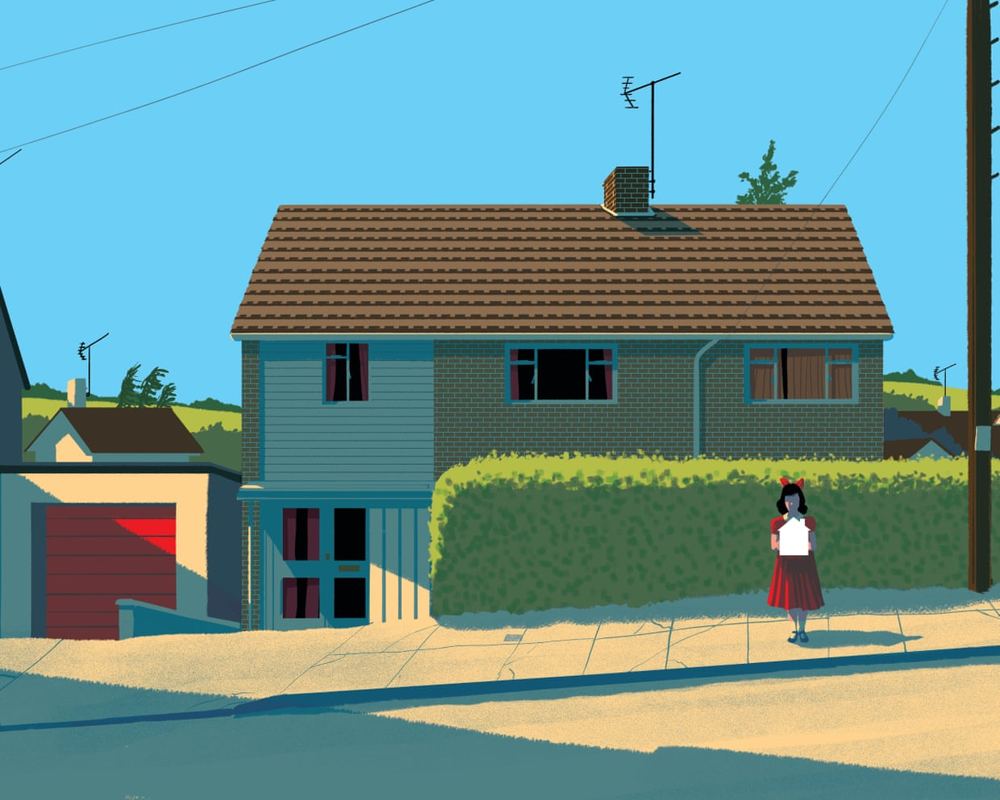
I do not have to literally knock on the door of my childhood house to enter its domain. It is always inside me, “my first universe”, as the philosopher Gaston Bachelard put it . Yes, in my mind’s eye, the door is ajar at this modest bungalow in Johannesburg, South Africa, 1966. It presents itself to me like a museum. Everything is in place. Nothing has changed since my last visit.
Of course, should I visit 11 Iris Road in the suburb of Norwood in real life, everything will have changed, but let’s press a foot into the dust of the past and see what it reveals.
Despite the force of the African sun and piercing stretch of blue sky above the tiles of its roof, the interior of the bungalow is dark and cool. Maybe the curtains are drawn in some of the rooms to keep it that way. I can smell floor polish as I glimpse myself, aged seven, with a crooked fringe trimmed by my mother and wearing a sleeveless summer dress, making my way towards the giant sack of oranges propped against the wall in the pantry.