The EU’s Arctic problem won’t go away without Norway, Iceland and UK’s help
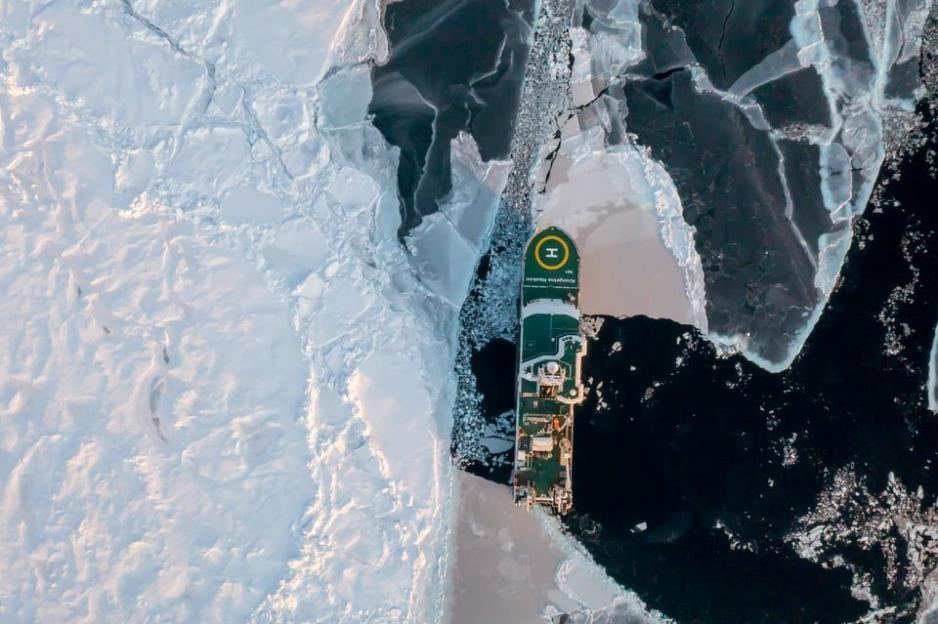
With Monday and Tuesday's Arctic summit, the EU’s real Arctic weakness is not a lack of ambition, but a lack of a proper category for its closest non-member neighbours – Norway, Iceland, and increasingly the UK.
When a power cable was sabotaged under the Baltic Sea last year, nobody in Brussels had to hold an emergency summit. Within days, a group of 10 countries, including Britain, Norway and several EU states, but not the EU itself, had a system running that tracked the ships responsible .
The European Union was not involved. It could not be. It is not a member of the group that did it.
That gap says more about the EU’s real problem in the Arctic than last month’s Iceland referendum result does.
Icelanders voted narrowly against reopening talks to join the EU , on 29 August.
Some of the coverage since has treated this as a setback for Brussels’ Arctic ambitions. It is not, and understanding why says something important about what the EU can and cannot do in the region, whatever Icelanders had decided.
Iceland is not, and was never going to become, an EU member any time soon. Even a ‘Yes’ vote would only have reopened talks, with a second referendum still needed before Iceland actually joined.
That process would have taken years. So the real question was never ‘in or out’? It was: does the EU have any way to work closely with a country like Iceland that sits permanently in between?
And the clearest proof isn't Iceland at all, it is Norway, a country that has rejected EU membership twice and isn't voting on anything.
Norway has a spaceport, Andøya, that experts say is one of the best-placed launch sites in Europe for the kind of satellites the EU wants to put into orbit.
The EU has its own major satellite programme, called IRIS, to provide secure communications for Europe. Andøya cannot be used for it .
Not because Norway said no, and not because of any political dispute, simply because the EU wrote the rules for that programme assuming every launch site would be inside an EU member state.
Norway is not one, even though it's about as close a partner as the EU has.
Nobody planned this outcome. It's just what happens when your rulebook only has two categories, “member” and “everyone else”, for a continent that doesn't actually work that way.
This is the EU’s real Arctic weakness: not a lack of ambition, but a lack of a proper category for its closest non-member neighbours, Norway, Iceland, and increasingly the UK, all of which sit somewhere between “in” and “out” that Brussels has never formally defined.
Iceland's referendum didn't create that gap and it didn't close it either, because full membership was never the fix.
Meanwhile, actual security cooperation in Europe’s north keeps happening without the EU. That cable-tracking system above is run by the Joint Expeditionary Force, a UK-led military group. Nato runs its own separate patrol mission in the same waters. Both work. Neither needs Brussels.
What the EU could actually offer, money for undersea cable protection, financing for critical mineral mines , a fixed regulation so Andøya can launch EU satellites, does not need unanimous agreement from all 27 member states, contrary to what EU officials often imply.
These are technical, fixable problems. What is missing is not political will inside the EU. It is a formal way to include partners who will never become member states but who Europe's security increasingly depends on.
One early sign came on 7 September, when Ursula von der Leyen flew to Nuuk and signed a new €200m partnership deal with Greenland .
Crucially, she did not sign it with Greenland alone, Denmark’s prime minister signed too, as an equal party.
That matters more than it sounds: Greenland’s foreign and security policy is legally Denmark’s responsibility, not Greenland’s own, so a real EU commitment has to include Copenhagen. This time, it did.
A new EU security strategy is expected in early October , with an updated Arctic policy due to follow later that month.
Both will be judged against a bar already set. On Monday and Tuesday (13-14 September), before either document was published, European leaders met in Finland for a summit devoted entirely to the Arctic. Whatever they say there now has to survive translation into an actual strategy text, not the other way around.
If either produces just another document that name-checks Norway, Iceland and the UK as “important partners” without creating any actual mechanism they can use, nothing will have changed.
If instead the EU finally builds a real category for these countries, a dedicated northern cooperation budget line , joint decision-making structures instead of rules written in Brussels alone, and genuine co-ownership from the start, that would matter far more than any referendum result.
Telling sign: even von der Leyen’s own team branded her Nuuk trip on social media as a visit to “Europe's Northern Neighbourhood”, a good name for something that still does not formally exist.
None of that depends on what Iceland decided in its referendum. Icelanders voted on fish and mortgage rates, not geopolitics.
The EU’s Arctic problem was never really about Iceland. It is about admitting there is a whole tier of important European partners the EU still has not figured out how to work with, in and about the Arctic.
Andreas Raspotnik is director of the High North Center for Business and Governance at the Nord University Business School in Bodø, northern Norway.
Andreas Østhagen is research director Arctic and ocean politics at the Fridtjof Nansen Institute in Oslo and a senior advisor at the High North Center for Business and Governance at Nord University in Bodø.