The Crusades: How a medieval Holy War still shapes politics
In 1095, the Catholic Church launched the Crusades, wars that left millions dead and whose legacy still shapes political and ideological conflicts.
"The present moment is much like the 11th century ... We don't want to fight, but, like our fellow Christians a thousand years ago, we must." Those are the words of United States Secretary of War Pete Hegseth in his 2020 book "American Crusade: Our Fight to Stay Free."
Hegseth has repeatedly used the biblical language and symbolism of the Crusades to frame both domestic and foreign policy, from the current war in Iran to the "fight" against the "scourge of leftism."
Nearly 1,000 years have passed since the cold November day in 1095 when Pope Urban II delivered the fiery speech that would ignite centuries of warfare and change the course of history.
But Hegseth is only the latest in a long line of politicians and extremists to reference to the Crusades, from the Ku Klux Klan to US President George W. Bush and Osama bin Laden.
Why do the Crusades remain such a powerful source of inspiration for contemporary leaders?
The history of the Crusades is long and complex. But it can be summarized as an extraordinary example of how religion can become a powerful tool for political goals, helping leaders to unite people, justify wars and mobilize support on a massive scale.
In the mid-11th century, Muslim Seljuk Turks conquered vast swathes of territory in the Middle East. In the early 1070s, they took control of Jerusalem, the most important holy site in Christendom. Rumors spread that pilgrims and Christians living in the region were being persecuted, and holy sites desecrated.
The papacy in Rome at the time was locked in a bitter power struggle with Holy Roman Emperor Henry IV over who really held the reins of power in Western Christendom. When Byzantine Emperor Alexios I Komnenos appealed to Pope Urban II for help to defend against the Seljuks in 1095, it presented the papacy with an opportunity to demonstrate its power by bypassing Henry to rally Europe's nobility for nothing less than Holy War.
Urban believed that a major Christian cause would strengthen his authority by uniting Western Europe towards a common external enemy.
War was the status quo in medieval Europe, which had been hit by a series of droughts, famines and plagues. Belief in the "end times" was widespread.
In this context, Urban's call for a Holy War to "liberate the Church of God" was persuasive: He demonized Muslims and promised Crusaders complete forgiveness for all past sins, as well as eternal salvation.
"If you think about what a Crusade is, it's asking people to go into the unknown, thousands of miles into an unknown land," explains Jonathan Phillips, an expert on crusading history at Royal Holloway University in London. Their chances of dying were about 35 to 40%, notes the expert. So they had "to be driven by something. Religion has to come at the top," he adds.
Urban's call to Holy War was taken up by men and women from every level of society, from "princes to peasants," explains Phillips. A "tabby cat army," as he describes it, composed of peasants, low-ranking knights and nobles, and led by preachers, set out for the Holy Land in 1096.
This would later become known as the People's Crusade, which claimed its first victims in the Rhineland, where they massacred Jewish communities in one of medieval Europe's earliest outbreaks of antisemitism .
A better organized army of European upper nobility was eventually assembled in Constantinople between November 1096 and April 1097.
The Holy Land, located between what is today Turkey , Syria and Egypt , was a polyglot society divided among Sunni Seljuk Turkish warlords and the Shi'a Fatimid Caliphate.
It took some time for locals to understand that this wasn't just another raid, explains Mohamad El-Merheb, an expert on the premodern Islamic Eastern Mediterranean at SOAS University of London: "It takes maybe at least a decade for some people to see it as an ideological project to convert and take the Holy Land."
"Some of the cities are well defended, some are not. But it is all in the context of very fragmented political power," says El-Merheb.
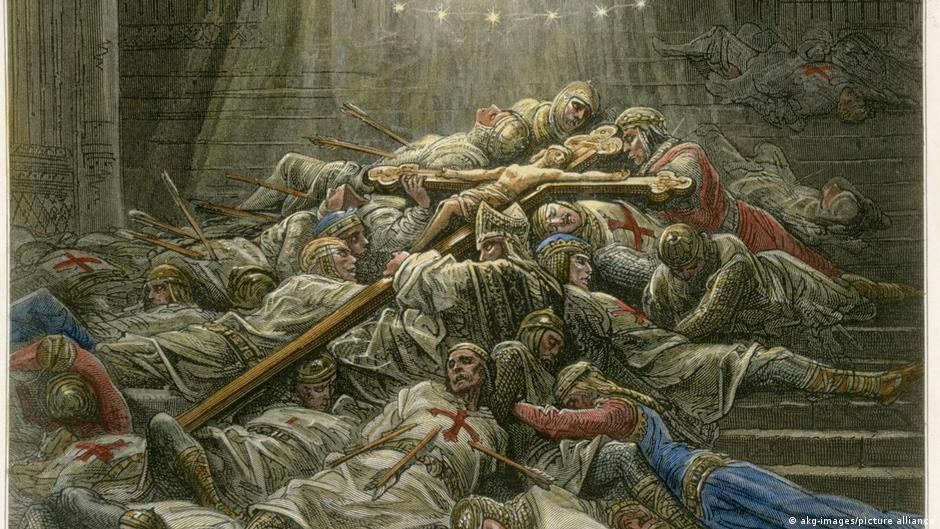
The Crusaders had what El-Merheb describes as a series of swift conquests in important cities like Edessa and Antioch. Despite these early victories, life fighting a Holy War was grueling. The majority returned home, or died of disease, hunger or sheer exhaustion.
When they captured Jerusalem in 1099, Crusaders massacred thousands of Muslims and Jews because they couldn't tell them apart.
Many historians consider the fall of the city of Acre to Mamluk warriors in 1291 to be the end of the Crusades in the Holy Land.
However, later crusades were also called, for example to block the advance of Ottoman Turks in Eastern Europe in 14th century, while "Reconquista" Christian military campaigns aimed to retake the Iberian Peninsula from Muslim rule into the late 15th century.
The legacy of the Crusades remains a powerful and polarizing cultural touchstone. In both the East and the West, the historical memory of these medieval holy wars is frequently repurposed to frame modern identities, politics and conflicts.
In 2001, US President George W. Bush caused uproar when he described the so-called "War on Terror" as a "crusade," a term already used by Osama bin Laden to frame US-led wars as religious wars intended to destroy Islam .
In his propaganda to legitimize his global jihad, bin Laden also invoked the legacy of Saladin, a legendary Kurdish commander revered to this day as the hero who recaptured Jerusalem from the Crusaders in 1187.
"As of the 19th century, Saladin specifically becomes a symbol of fighting Western colonialism and imperialism," says El-Merheb. "Throughout the 20th century, a lot of Islamist groups also start referring to the Western powers as Crusaders, so this becomes part of political nationalism on the state level and also on a more popular level in films, for example. This is happening in the West now in the opposite way."
Crusader symbolism has long been used by far-right movements in the US and Europe to promote narratives of civilizational conflict. The Latin phrase "deus vult," or "God wills it," has been used by figures including far-right mass murderer Anders Breivik and Germany's far-right Alternative for Germany (AfD) party, while France's far-right party Reconquête draws its name from the Reconquista campaigns. US Secretary of War Pete Hegseth famously has "deus vult" tattooed on his arm and a Crusader cross on his chest.
But El-Merheb believes that such references often reduce the Crusades to a simple clash between Christianity and Islam, "which really was never simply the case."
This framing, he explains, ignores "how the Crusades were from the start very antisemitic projects, or violent projects against other Christian communities in Europe such as the Cathars in France, against Byzantium and the Islamic world and ignores the many cross-religious alliances between Muslims and Crusaders."
Along the way, he adds, these politicians are also forgetting how violent and destructive these historical campaigns were.