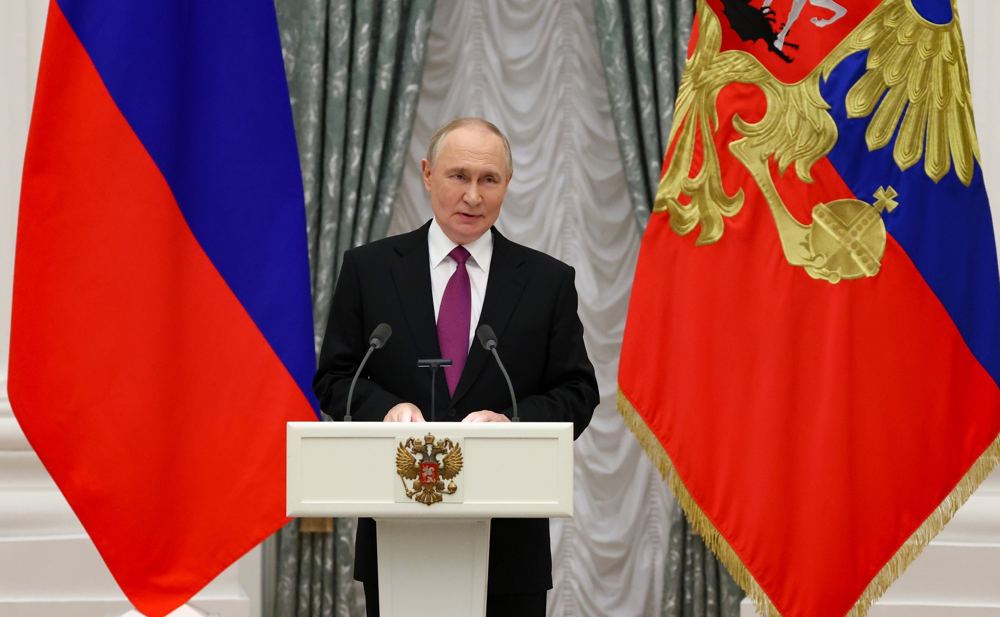
Putin sends a 14th century saint’s hand to Ukraine front to boost morale (Ukraine Battlefield update, Day 1,663)
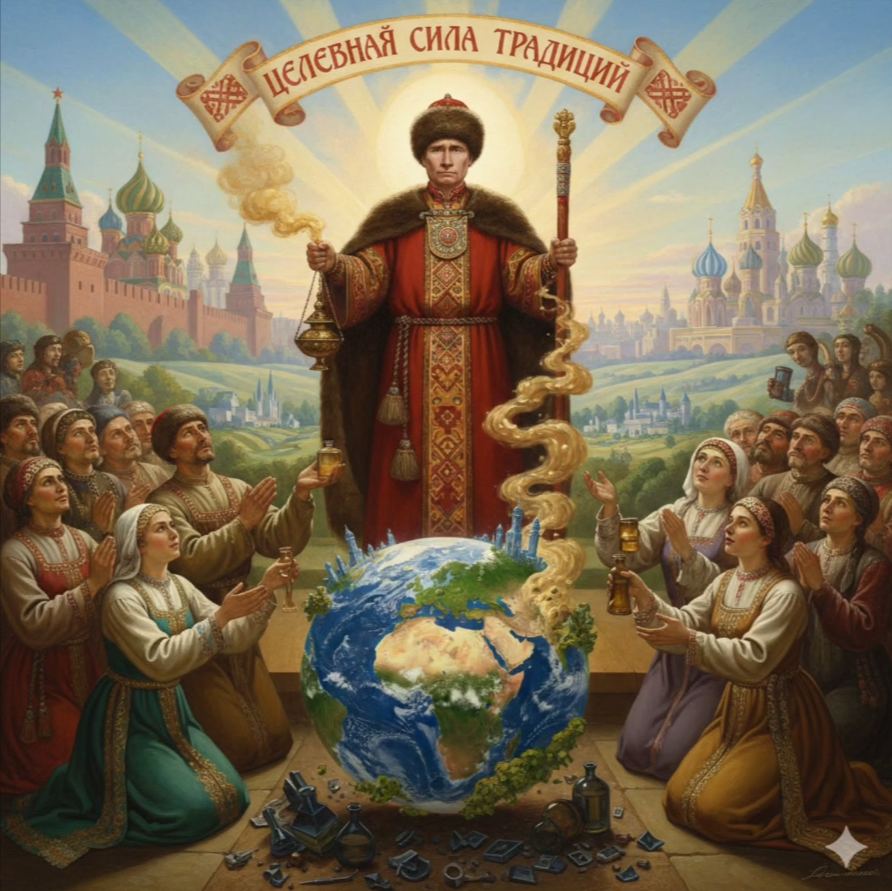
Putin has paraded a medieval saint’s severed hand before frontline troops, as Russian forces grind forward around Orikhiv and drones openly hunt Kherson civilians.
He defied the Golden Horde; now the magical power of his 637-year-old limb is meant to help defeat Ukraine.
Russians are trying to fight their way towards Orikhiv; fighting is under way in central Mala Tokmachka, and they have also penetrated other nearby villages.
Ukraine faces a harsh winter, not only because of military operations, but because its economy is also suffering.
How August strikes on refineries affected the length of queues at petrol stations in St Petersburg and Nizhny Novgorod.
Russians are deliberately attacking civilians in Kherson and make no secret of it.
Videos of the day, Russians deliberately attack civilian targets; a Ukrainian infantryman, aided by a drone and displaying great bravery, rescued an injured comrade; the first “naval” drone battle; a Russian Gerbera bounced off the ground.
He defied the Golden Horde; now the magical power of his 637-year-old limb is meant to help defeat Ukraine. However bizarre the following report may sound, it describes a real event in which the regime is trying to raise the morale of the army and society as a whole in a manner reminiscent of the Middle Ages.
It is one example of how, after four and a half years of unsuccessfully trying to defeat Ukraine, the Russian regime has descended into a combination of paranoia and mysticism.
Before looking at which hand is setting off on a tour of the front, it is worth mentioning a few examples of paranoia, as the exile newspaper Meduza described them . It collected several justifications for excluding politicians from the September elections. Of course, they will be rigged and their outcome is already known, but the Kremlin leaves nothing to chance.
For example, Yabloko party candidate Dmitry Smirnov was excluded in the summer of 2026 over a 2015 post in which, after the death of Motörhead singer Lemmy Kilmister, he published a photograph of him wearing a cross. A Russian court deemed it a potentially extremist symbol.
A court in Chelyabinsk, meanwhile, cancelled the registration of another candidate from the same party, Yevgeny Shcherbakov, because a video featured an image of Banksy’s Girl with Balloon and a quote by former Soviet foreign minister Andrei Gromyko: “Better 10 years of negotiations than one day of war.”
Other grounds for preventing candidacies included a photograph of late dissident Alexei Navalny, as well as the logos of Facebook and Instagram, which have likewise been deemed extremist symbols.
In this context, the decision to boost soldiers’ morale with a relic comes as no surprise. Radio Liberty reported on the regime’s seemingly desperate effort.
The story began in July this year, when the remains of a famous military commander were removed from a Kremlin cathedral in Russia. It was such a major occasion that Russian president Vadimir Putin himself came to see them in August.
There is a strong alliance between the former KGB intelligence agent and the Orthodox Church. Russian priests routinely bless tanks, engineering works and similar objects, but a rare relic directly on the front line is a novelty. It belongs to Dmitry Donskoy.
Many people remember this Moscow prince from history lessons in connection with the Battle of Kulikovo Field, which took place in 1380, 200 km away. The forces of Russian princes united by Dmitry defeated the army of the Golden Horde at the time. Although it restored its influence just two years later and the Russians resumed paying it tribute, Prince Dmitry became a saint to Russians as a result.
His bones are now being sent around Russia. His right hand will be brought to soldiers at the front. According to Radio Liberty, they are expected to venerate it as divine protection on the battlefield.
Putin’s regime is also waging the war in Ukraine as a religious conflict. It considers the restoration of the Moscow patriarch’s authority over the Ukrainian church, which became independent of Moscow, to be one of the key issues.
The religious dimension is emphasised by billionaire, ultranationalist and Orthodox believer Konstantin Malofeyev. He has called the war against Ukraine holy and described the exhumation of the relics as a “miracle”. Two days before Putin went to see them, he wrote about them on 18 August:
“This event is undoubtedly a direct blessing from God for Russia and the Russian army... The Horde was an instrument in the hands of the West. It was financed by Genoese merchants and usurers. At Kulikovo Field, not only the Horde but also Latin mercenaries fought against our ancestors. The Battle of Kulikovo thus became the first historic Russian victory over globalist aggression. And today, amid our fateful confrontation with the collective West, by God’s providence, Saint Dmitry Donskoy himself once again stands at the head of the Russian army. Holy and faithful Prince Dmitry, pray to God for the victory of the Russian army!”
Russians are trying to fight their way towards Orikhiv; fighting is under way in central Mala Tokmachka, and they have also penetrated other nearby villages. “In the Orikhiv area, Russian forces are continuing attacks in the central part of Mala Tokmachka and are attempting to advance towards the eastern outskirts of Preobrazhenka. Attacks on enemy positions in the built-up area have already been recorded there. Attempts to infiltrate deeper into Ukrainian positions are also continuing. During one attack, a Russian group managed to enter Chervona Krynytsia and hide in a basement. After being detected by Ukrainian drone operators, the group was neutralised,” the Ukrainian Telegram channel Petrenko wrote .
All the aforementioned settlements are marked on his map, and it is immediately clear that Orikhiv is beginning to face a direct threat. In previous weeks, Russians had been infiltrating the area from the south, west of Mala Tokmachka, but they are now approaching directly from the east.
The Polish OSINT account Thorkill, which is sometimes criticised for exaggerating Russian gains but is often among the first to report them accurately, sees the situation as more dramatic than Petrenko does.
His map offers a clearer outline of the Russian plan, which is highly likely to involve breaking up Ukraine’s defence into smaller sections while also outflanking Orikhiv from the north.
The most comprehensive analysis of the situation on the Zaporizhzhia axis was published by Ukrainian analyst Kostiantyn Mashovets in three separate posts. In the first , he describes the situation east of Orikhiv; in the second , west of the town; and in the third , he summarised his conclusions.
Put simply, Mashovets argues that Russia’s 58th Army, which is fighting on this sector, is pursuing the same scenario that Russian forces used in Pokrovsk and Kostiantynivka. Here, too, coordinated attacks on two flanks are intended to outflank the defensive stronghold and place it in an untenable position.
In Orikhiv itself, Mashovets’s description suggests that the situation is not as dramatic as on the previous map. According to him, Russian forces managed to get a very small group of soldiers into the town and another into a wooded area between the town and Mala Tokmachka, but they have not been able to build on this success over the past two weeks.
Mashovets also warned, however, that Russian forces are intensifying attacks west of Orikhiv and are again trying to break through near Stepnohirsk and Prymorske, from where they were driven out in the spring and summer.
Ukraine faces a harsh winter, not only because of military operations, but because its economy is increasingly suffering as well. Economy minister Oleksandr Kravchenko estimated on Saturday that direct damage from Russian attacks on infrastructure is approaching $10bn (€8.7bn) this year. The total damage, together with the blockade of ports, has reduced Ukraine’s GDP this year by 1.5 percentage points.
According to Reuters, Kravchenko estimated that as much as $40bn is at risk as a result of the blockade. That would be the total loss of exports if Black Sea ports do not resume operations.
The European Union finances a large part of Ukraine’s war costs. But Kyiv can no longer pay even its share, because budget revenues have fallen $1.35bn short of the plan. The shortfall is accelerating: as much as one-quarter of the total amount did not reach the budget in August.
At the same time, the cost of the war has risen significantly. While one day cost an average of $140m last year, it is already $190m this year.
How August strikes on refineries affected the length of queues at petrol stations in St Petersburg and Nizhny Novgorod. This is according to Janis Kluge, a German economist and expert on the Russian economy. Last week, he focused specifically on Russia’s second-largest city. Late on Sunday, he published a chart dividing queue lengths into five categories, with the shortest being up to five cars and the longest 100 or more.
While during the first wave of the crisis in mid-July queues of 50 to 100 cars appeared only exceptionally, and no longer queues were recorded at all, the two worst categories on the chart now account for more than one-third of all cases.
Another chart from St. Petersburg, comparing the previous gasoline shortage in July with the situation in September. Queues are longer this time, according to Gdebenz. pic.twitter.com/VACEZpB7rx
The main problem is not diesel, which is plentiful, but petrol. As two months ago, there is an almost complete shortage of the highest-grade petrol with octane ratings of 98 and 100, which is available at only around five percent of petrol stations. Diesel availability, shown by the green line, fluctuates around 60 percent. The lower-grade 92 and 95 petrol is available at only one-fifth of stations.
There is enough diesel, but not enough gasoline. pic.twitter.com/6JNzMmCYRx
The situation in Nizhny Novgorod is not quite as bad as in the first fuel crisis in July, but there is still a shortage. And again - diesel is apparently not the main issue anymore. pic.twitter.com/amJX6Q1yVJ
The next chart shows how the strike on the Kstovo refinery, which supplies Nizhny Novgorod, affected the city. The number of petrol stations with queues increased, but it would be wrong to speak of a supply collapse.
This is the situation at gas stations in Nizhny Novgorod, which is supplied by the Kstovo refinery. Kstovo was attacked on August 26. Since then, the gasoline crisis has returned to the city. pic.twitter.com/Tvmx5jh4Nx