Geissele Automatics reveals ‘production-ready’ assault rifle for SOCOM
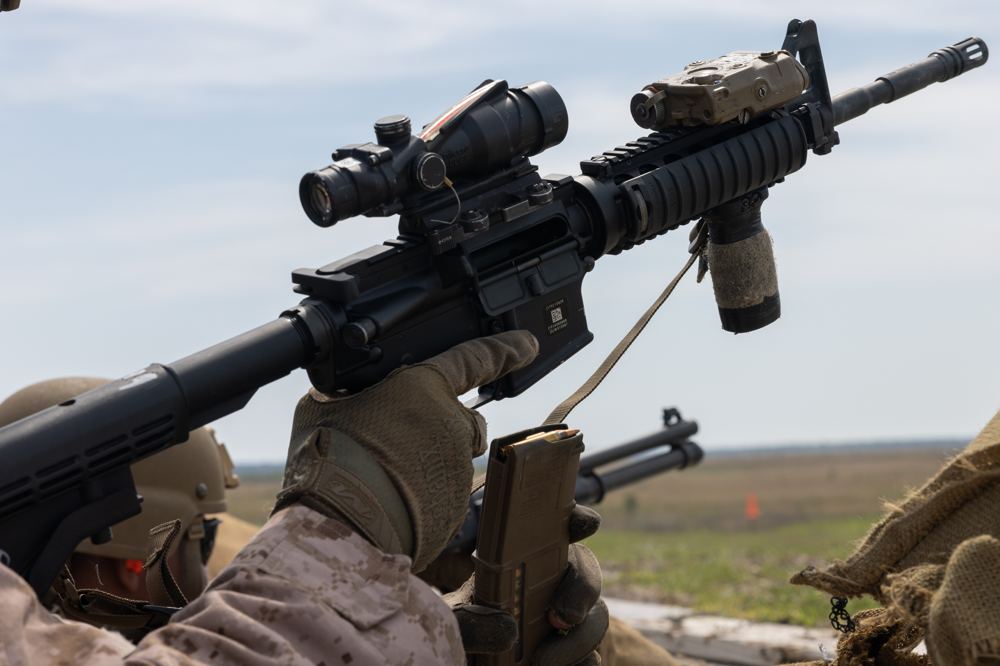
The Pennsylvania gun company introduced a model of its Hypervelocity Improved Capability Assault Rifle.
The Pennsylvania gun company Geissele Automatics introduced a production-ready model of its Hypervelocity Improved Capability Assault Rifle , or HICAR, as part of a Special Operations Command (SOCOM) program to extend the service life of the legacy M4 carbine with new capabilities.
The company started a series of promotional videos about building the HICAR since announcing the weapon early last month, saying it wants to highlight the design’s performance and show what “high-speed product development” looks like.
The Naval Surface Warfare Center, which issued the solicitation in May, had a 21-day response period that has ended. The solicitation asked for an M4-style platform capable of firing “future hypervelocity” 5.56mm ammo, which would increase the weapon’s effective range from 300 to 600 meters.
Bill Geissele, the founder and president of Geissele Automatics, explained in an interview with Military Times that they were able to respond to the solicitation so quickly because they were “already well familiar” with the technology.
He said they had been working on other government and commercial projects involving high-pressure ammunition for about three years before the solicitation. The company is currently contracted to make sniper rifles for SOCOM.
Details about the U.S. military’s hypervelocity 5.56mm, designated M855A1+, are non-existent. SOCOM referred Military Times to the U.S. Army Combat Capabilities Development Command, which described the cartridge in an email as a “conceptual approach for achieving increased range and performance within existing calibers.”
For internal testing and demonstrations, Geissele said they created their own hypervelocity cartridge using commercial products that replicates the military ammunition.
He explained that the major difference between legacy 5.56mm ammo and the hypervelocity round is that the hypervelocity case is loaded to 82,000 PSI, or about 20,000 PSI higher.
However, because of the project’s sensitive nature, Geissele said they won’t sell the civilian variant of the HICAR until the ammo becomes commercially available.
In the promotional videos , Geissele engineers equip the HICAR with a long-range scope to demonstrate the weapon’s range while also measuring the velocity with a chronograph. The company said the HICAR, equipped with an 11.5-inch barrel and shooting pressurized ammo with a 77-grain bullet, will consistently deliver a muzzle velocity of 2,700 feet per second and is accurate out ot 800 meters.
“When you put a high-performance engine into a vehicle that’s not designed for it, other things in the vehicle have to be beefed up in order to handle the horsepower,” he said. “And it’s the same thing with high-pressure ammunition.”
Geissele explained that one challenge with high-pressure ammunition is the stress it puts on the barrel. To address this concern, they used a higher-quality steel, the kind typically reserved for artillery barrels, for the HICAR.
Yet, some unknowns remain about the longevity of a firearm running high-pressure ammunition. “That’s why we’re making the ammunition and testing it,” he said. “We haven’t shot as many rounds through to find a limit of it. We are shooting our first iteration of the barrel now.”
He called the testing process “actually extremely difficult” because they have to fire thousands of rounds and closely monitor not just the performance, but the wear on the materials as well.
Because they haven’t completed testing, the Geissele HICAR has not yet reached its final iteration. Geissele explained that the company is close, but it just has not had an extremely high round count yet.
But that’s also why the company started releasing the videos. “I think it’s interesting to see it. I think it’s very interesting for people to see product development and how Geissele does it. You know, people want to understand what exactly is going on so it’s not a mystery.”
He called their HICAR design a “production-ready weapon” and beyond the prototype phase. “We could, you know, if we got an order for 5,000 guns tomorrow, we could turn the machines on and start making them,” he added.
Daniel Terrill is a contributor to Military Times. He’s been reporting on military issues, the gun industry, and the outdoors for nearly two decades. Although writing is his passion, he’s been a Marine, police officer, and, perhaps the most dangerous job of his career, a substitute teacher.