Fall in small boats down to law enforcement, agency says
But other factors, including developments in the Middle East, may also be playing a role.
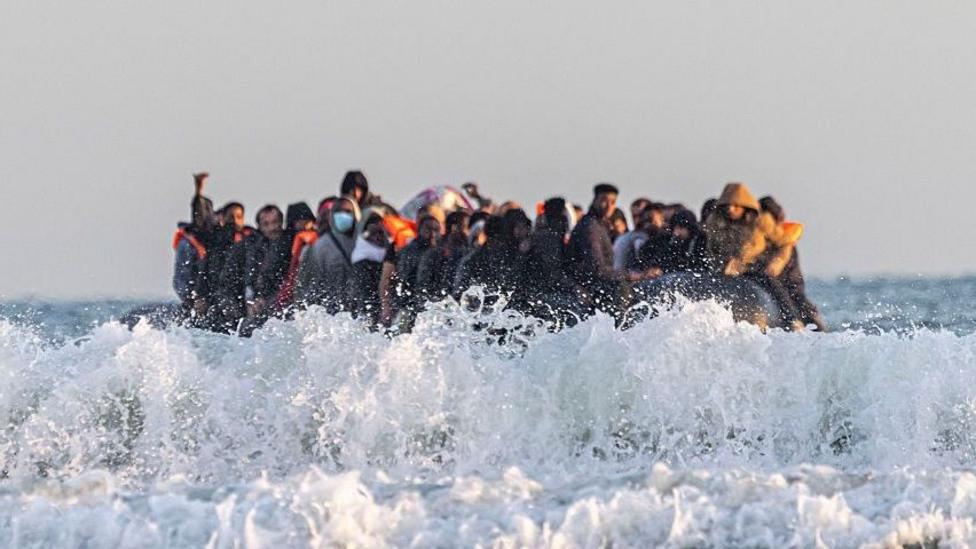
Law enforcement activity has been a "key factor" in reducing the number of small boat Channel crossings, the National Crime Agency (NCA) says.
The number of people arriving in the UK in the first half of 2026 was down 41% on the year before, government figures show.
The NCA said the drop followed a "significant increase in arrests and seizures", although added "fluctuating demand" for crossings, and the French authorities preventing boat launches had also played a role.
However, Mihnea Cuibus, a senior researcher at the University of Oxford University's Migration Observatory, says it is "impossible" to disentangle the effects of government policy and other factors on small boat arrivals.
While recent policy changes appear to have led smugglers and migrants to alter their behaviour, Cuibus says fewer unauthorised arrivals into the EU and developments in key origin countries - such as improved security in Syria - may be partially behind the decline.
"It is hard to know how much restrictive measures contributed to reducing [arrivals] in 2026," he continues.
He said limitations on refugee family reunion and a reduction in the asylum grant rate could also have had an impact.
The Conservatives have previously said the weather played a huge role in the fluctuating numbers of crossings from France and Belgium.
NCA director general of operations Rob Jones said the agency was "devoting more resources to tackling organised immigration crime than ever before".
"However, we are not complacent, and the job is by no means done," he continued.
"We must continue to keep up the pressure on these criminal gangs, as they continue to put lives at risk in the Channel."
The NCA said organised crime groups had been affected by "supply constraints" on vital equipment used in crossings.
More than 1,600 boats or engines have been seized by the authorities since late 2023, it said.
The wholesale cost of these items has gone up as a result, according to an NCA spokesperson.
The NCA said a "number of key suppliers" had also been targeted, including the jailing of Adem Savas who reportedly supplied equipment used in about half of all crossings in 2023.
However, the NCA also admitted the war in the Middle East had also made it harder for criminals to source dinghies.
It added it could not publish its report on small boats in full because it contained sensitive intelligence.
Between 1 January and 7 September 2026, a total of 17,281 people crossed the English Channel by small boat from France. This was down by 43% on the same period the previous year.
These crossings have become the most common way for people to be detected entering the UK illegally since 2020.
Nearly all those who arrive by small boat claim asylum. Under international law, this means they are allowed to stay in the country while their asylum application is considered.
Small boat arrivals made up 40% of asylum applications between July 2025 to June 2026.
Boats that arrived in the UK from 8 September 2025 to 7 September 2026 carried an average of 68 people. This has more than doubled since 2021.
Experts say overcrowding in boats makes crossings riskier . At least 84 people died while attempting to cross the Channel in 2024, according to the United Nations (UN).
When looking at the scale of small boats crossings, the number of these arrivals is about 5% of the size of total immigration into the UK from January 2025 to December 2025.
The government has pledged to âsmash the gangsâ behind these crossings in order to reduce the numbers.
People from Eritrea accounted for 18% of all arrivals from July 2025 to June 2026.
In the latest figures covering January 2025 to December 2025, at least 2,335 people who arrived by small boat were found to be potential victims of human trafficking or other forms of modern slavery, according to the Home Office.
Another 4,712 people were detected entering the UK without permission via other methods including hiding in vehicles, travelling on ferries or through airports from July 2025 to June 2026. This was down by 17% on the same period the previous year.
There are also individuals who arrive legally, for example via a work or study visa, and then overstay their limit.
The total number of people who live in the UK illegally after arriving legally is not known.
The NCA also pointed to activity targeting people smugglers as having reduced small boat crossings.
In the year to April 2026, arrests linked to organised immigration crime involving the NCA increased by more than 55%, it said.
An NCA spokesperson said international partnerships with French, Dutch, German and Bulgarian authorities had made "real impacts" on the number of arrivals.
The agency added it had worked with social media networks to have more than 40,000 posts pages or accounts linked to immigration crime removed.
"We are making it more difficult and costlier for people smuggling networks to source equipment, more difficult to get it to the beaches and in the water, more difficult to communicate with potential customers, and more likely smugglers will be confronted by law enforcement," said Jones.
"Our message to the gangs is clear â moving people in small boats and supplying equipment gets riskier for you by the day," he continued.
However, the Migration Observatory said "most notably" there had been a sharp decline in detected unauthorised border crossings into the EU.
It said arrivals fell 26% in 2025, before declining another 37% in the first half of 2026.
"This is likely to lead, with a lag, to fewer unauthorised crossings to the UK, since most small boat migrants travel through the EU before reaching beaches in northern France," it added.
In August, the Home Office credited police in France with intercepting 185 potential crossings involving 4,300 migrants this summer over four separate weeks, as well as stopping 12 boats at sea using new techniques.