In Pictures: highlights from Art Basel’s Unlimited section, focused on monumental projects
Curated this year by MoMA PS1's Ruba Katrib, Art Basel's large-scale sector has a monumental air
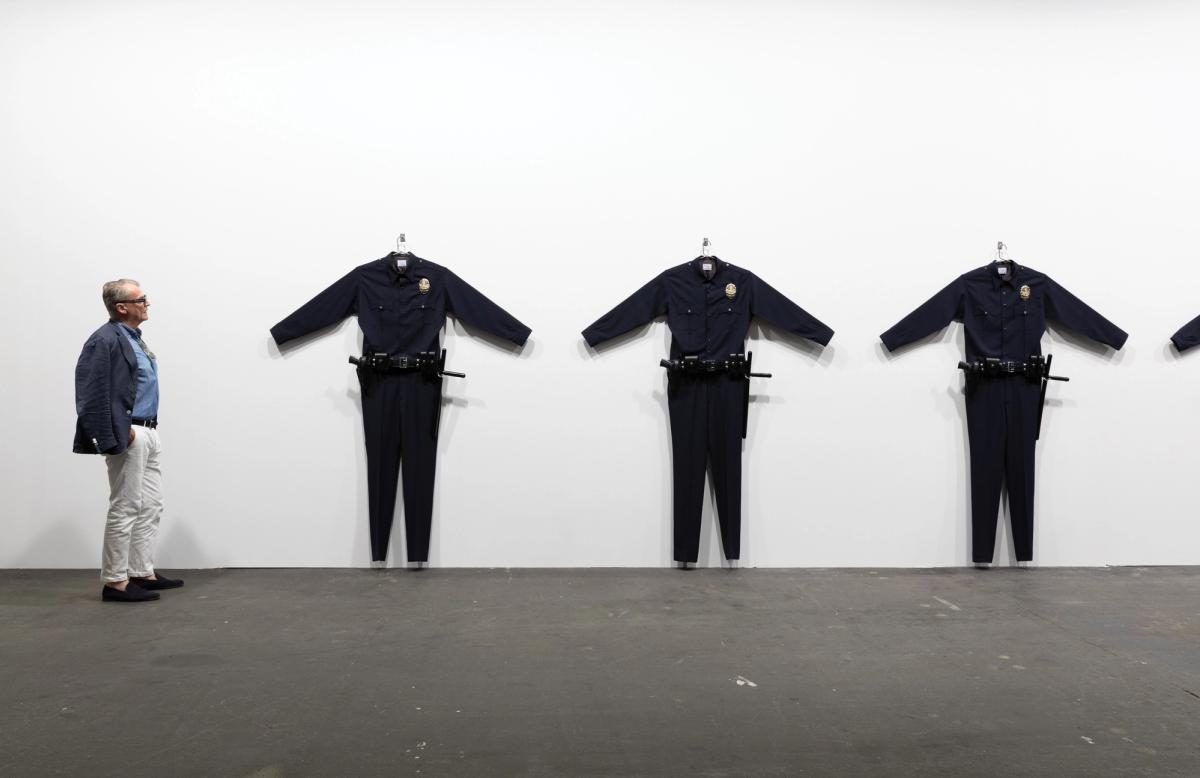
The oversized Los Angeles Police Department (LAPD) uniforms serve as the opening statement for this year’s section. The piece was created as a response to the acquittal of the four LAPD officers behind the horrific beating in 1991 of Rodney King, a Black man. “This is a work that unfortunately continues to be relevant today,” Katrib says.
This is a set of 12 internet images of the World Trade Center attacks, which the German artist has manipulated by, for example, enlarging the pixels and enhancing the colours. The series suggests themes such as how images “circulate in the world, and how they are mediated”, Katrib says.
Niki de Saint Phalle’s obelisk-like sculptures were made in response to the HIV/Aids crisis. “She was thinking of these works as playful, perhaps tongue-in-cheek, models for condoms,” Katrib says. The works made up part of Saint Phalle’s broader attempts to raise awareness about HIV/Aids.
Jean-Kenta Gauthier, Goodman Gallery, Galerie Lelong, Lia Rumma and Galerie Thomas Schulte
Steeped in red light, the installation comprises a photograph of a typewriter, with the area where paper should be filled instead with projected images of figures in crisis. “It explores the limits of language and how images shape our understanding,” Katrib says of the work created not long after Jaar arrived in New York, having fled Augusto Pinochet’s dictatorship in Chile.
Peter Hujar’s final major series, of 70 photographs, is presented here as it was for a show in New York’s East Village, is a rare opportunity to get into the American photographer’s mindset. “The exact relationship between the images is really set by him, and that’s what we see here,” Katrib says.
Galerie Kaléidoscope and Galerie Le Minotaure in collaboration with Galerie Louis Carré
Eduardo Arroyo created this monumental painting upon hearing that the Spanish dictator Francisco Franco was close to dying. It is a reimagination of Rembrandt’s La Ronde de Nuit (1642), in which contemporary weapons are placed in the hands of the figures, while side panels nod to the fact the Rembrandt work was cut so it could fit into a city hall. It is a tribute to a leading Old Master that also creates a link between “mundane, bureaucratic” state violence and the “vivid violence of weapons”, Katrib says.
The Bauhaus artist’s wall-mounted wire sculpture comprises three human body-like forms in different proportions. Light and shadow are critical to the experience of the work, Katrib explains, together, they contribute to an exploration of the relationship between the body and space.