Berlin election shows how the EU turns its most mobile citizens into second‑class voters
European law gives EU citizens the right to vote in municipal elections, but this does not extend to state or national elections, for which Germany reserves voting rights to German citizens. This results in an odd discrepancy even within a single member state.
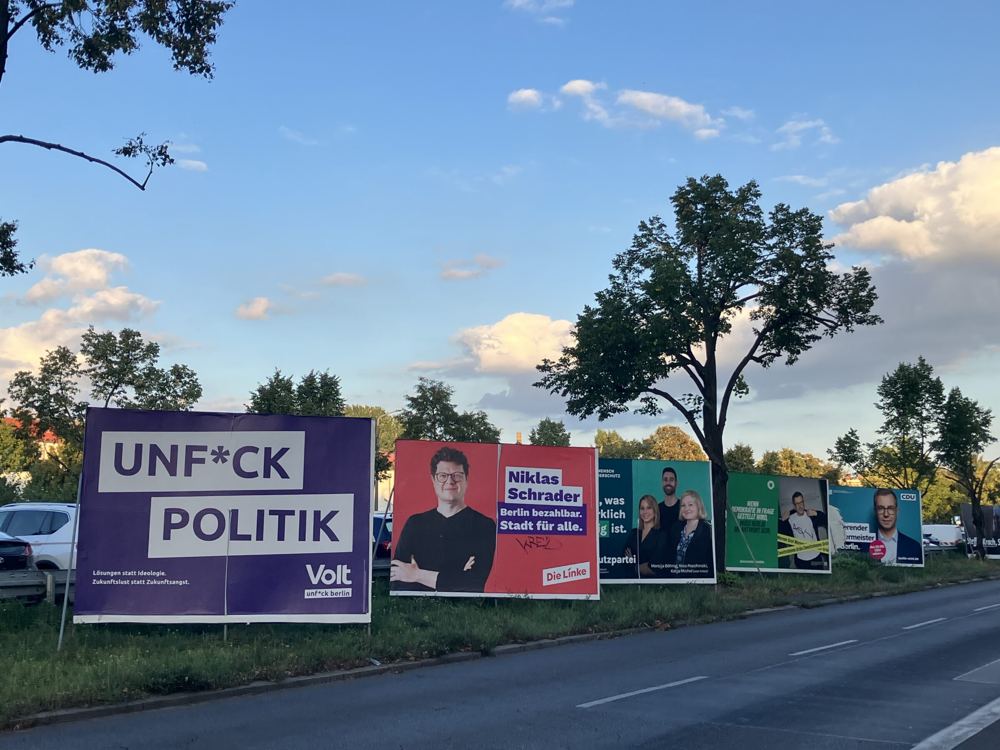
If you are in Berlin this week, you won’t be able to miss that an election is taking place. Since the start of August, almost every lamppost in the city has been taken over by election posters, with housing, transport and Berlin’s rubbish problem dominating the campaign.
But Berlin is not holding just one election but two, with two different electorates.
The larger electorate includes around a quarter of a million EU citizens who can vote for one of Berlin’s 12 borough assemblies, but not for the parliament that governs the city as a whole.
The boroughs have an important role in managing school buildings and green spaces, making local planning decisions, and determining which services for young people receive funding.
But many of the decisions that shape Berlin as a whole, including issues such as the school curriculum or whether parts of Tempelhofer Feld, the huge inner-city open space on the site of a former airport, should be developed for housing, are made at city-wide level.
It’s a quirk of German constitutional history that Berlin is both a city and a federal state.
European law gives EU citizens the right to vote in municipal elections, but this does not extend to state or national elections, for which Germany reserves voting rights to German citizens. This results in an odd discrepancy even within a single member state.
While EU citizens living in Munich were able to cast a vote for their new mayor earlier this year, those living in Berlin will have no such say over who becomes the next occupant of the Rotes Rathaus [Berlin’s city hall, named after the colour of its brickwork, not its political complexion.]
The EU leaves it up to national governments to decide whether to extend voting rights to regional elections, and few member states have chosen to do so.
Notably, the United Kingdom did so before its decision to leave the European Union. Today, EU citizens can still vote for the London Assembly, Scottish Parliament and Welsh Senedd.
There is a certain irony in the fact that an EU citizen living in post-Brexit Britain might enjoy greater voting rights than an EU citizen living in another EU member state.
Earlier this year, announcing measures to strengthen EU citizens’ ability to exercise their local voting rights, Marilena Raouna, then Cyprus’s deputy minister for European Affairs and minister responsible for the country’s EU Council presidency, put the principle succinctly: “Freedom of movement must go hand in hand with the full and equal ability to participate in democratic life.”
And while the council’s measures are to be welcomed, they amount to little more than tinkering around the edges of a much larger question: what should political citizenship mean in an EU where millions of citizens live permanently in a member state other than the one whose passport they hold?
EU citizens have had the right to vote in municipal elections in their country of residence for more than three decades, and in European Parliament elections for even longer.
But what seemed radical when the Maastricht Treaty was signed in 1992 increasingly feels parochial and unjust to an EU of citizens living, working and raising families across borders.
Yet few legislators seem willing to openly challenge the underlying illogicality: EU citizens can vote for the representatives who decide on everything from parking wardens to libraries, as well as those who regulate tech firms and vote on international trade agreements, but are given no say over anything in between.
As a candidate for the pan-European party Volt in Berlin’s elections, in recent days I have been putting up posters emblazoned with an eye-catching expletive, addressing this democratic deficit head on and calling for full voting rights for EU citizens. This prompted an Austrian couple who have lived in the city for many years to stop and talk to me. While it was nice to be able to vote for the Austrian president, they said, they would much prefer to have a say in the elections that actually determine what happens where they live.
This gets to the heart of the problem: in encouraging EU citizens to move across borders but failing to keep pace with the lived reality of what this means in practice, the EU has created a democratic gap of its own making.
Those with the least political power are often those who have embraced European integration most fully by making another member state their home.
If the EU is really serious about freedom of movement as more than an economic freedom, political participation must evolve with it. EU citizens who build their lives in another member state can and must be trusted with voting in regional and national elections.
That is why, this weekend, you will find me taking this argument onto the streets of Berlin. One poster at a time.
Matt Bristow a London-born British-German dual national standing for Volt in Neukölln in Berlin’s state and local elections on 20 September.