What if companies could finally use their most valuable data?
Every company has data it guards more closely than the rest. For a bank, it might be millions of customer transactions. For a pharmaceutical company, it could be years of proprietary research. For a cybersecurity business, detailed information about threats and vulnerabilities across its networks.
This is often the data that makes a company different from its competitors. It’s also exactly the kind of information businesses are wary of putting anywhere near an external AI model, and for good reason.
Inputting sensitive customer information, intellectual property or regulated data into an AI service can create questions about who can access it, where it's processed and what happens to it afterwards. For companies dealing with GDPR, AI and industry regulation or national security requirements, getting those questions wrong can carry serious consequences.
The result is something of a contradiction. Businesses are spending heavily on AI while some of the data most likely to generate real commercial value from it remains locked away.
For much of the past few years, discussion around enterprise AI has focused on the models: which ones are the smartest, fastest or cheapest. But the model is only part of the equation.
Take a bank trying to spot sophisticated fraud. The more context an AI system has across transaction histories, customer behaviour and previous incidents, the more useful its analysis could become.
Or a pharmaceutical company sitting on years of experimental data. Combining that information with powerful AI models could help researchers uncover solutions that would otherwise take months to find.
The opportunity isn’t to make the AI itself better. It’s to put information that a business already owns to work in ways that could improve products, reduce risk, speed up research or create entirely new services.
Yet the more commercially valuable the data becomes, the less straightforward that is.
Businesses already have ways of protecting data when it's sitting in storage or moving between systems. The difficult moment comes when that data actually needs to be used.
An AI model has to process information to analyse it. Traditionally, that creates a point at which sensitive information may become visible within the infrastructure running the workload. This is the problem confidential computing is designed to address.
Rather than relying only on rules determining who should be able to access information, confidential computing uses hardware-backed protections to isolate data while it's being processed.
This creates a locked room for computation. The data and AI model can enter. But the infrastructure operator, and sometimes even the model provider, doesn’t get access.
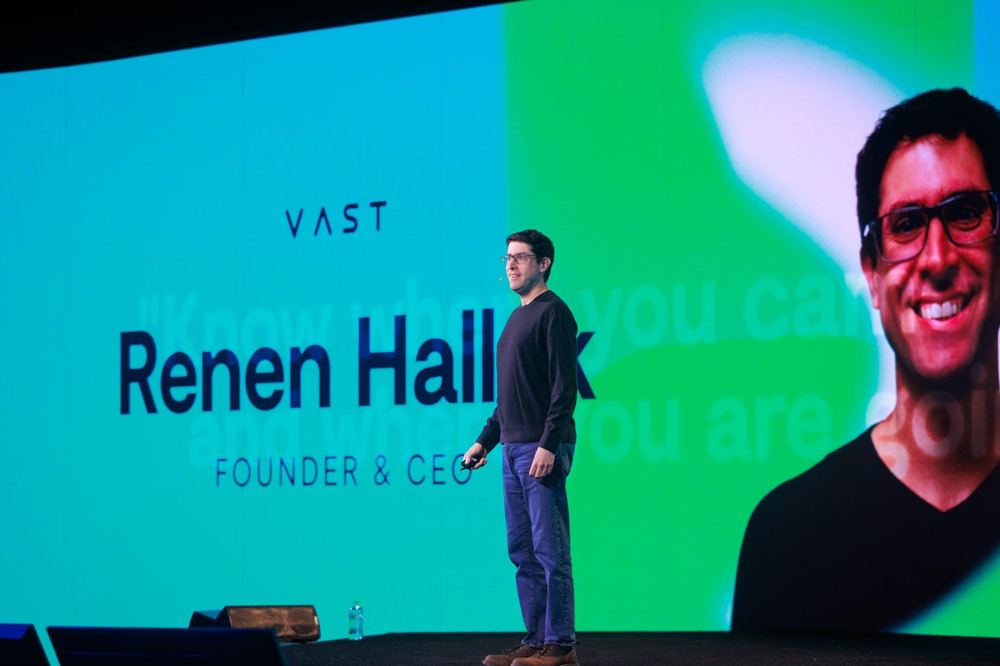
VAST Data is one company betting that this will change how businesses deploy AI.
Its new DataEnclave technology is designed to allow companies to bring AI models into confidential environments containing sensitive data, while keeping the model, data and underlying infrastructure isolated from one another.
The company builds a unified AI operating system that combines data storage, databases and compute infrastructure on a single platform.
This reverses one of the assumptions behind many AI deployments. Instead of asking a business to move sensitive information somewhere an AI provider can access it, the model can effectively be brought to the information.
A financial services company could analyse sensitive customer information without handing the underlying records to its AI model. A cybersecurity business could run AI against highly confidential threat data. A government could use AI capabilities on information it would never consider placing into a public AI service.
Europe has built businesses with highly specialised datasets in sectors such as finance, healthcare, defence and industrial technology. Much of their competitive advantage lies in information accumulated over years, information they understandably don’t want leaking into somebody else’s systems.
If that data can safely be combined with a wider choice of AI models, businesses no longer have to make the same trade-off between accessing the latest AI capabilities and protecting their own intellectual property.
None of this removes the need for good governance. Companies still need to decide which data should be used, which models they trust and what employees or AI agents should be allowed to do with the results. Confidential computing doesn’t make those decisions disappear, but it could remove one important barrier.
The AI industry has spent the past few years racing to build increasingly capable models. For many businesses, however, the next big opportunity may not come from another jump in model performance.
It could come from finally being able to use the information they’ve been protecting all along.