Russians dream of encircling Dobropillia, as Ukraine’s Azov force pushes back (Ukraine Battlefield update, Day 1,673)
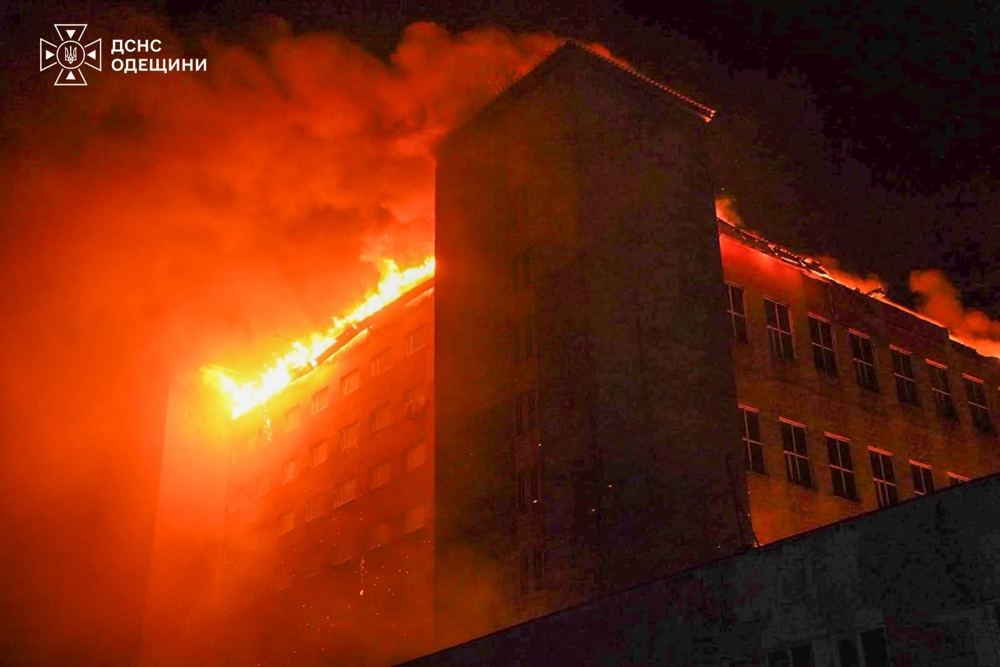
While Kyiv suffers the highest number of Russian attacks since March 2022, Russian Z bloggers have exaggerated claims of trapping Ukrainian soldiers in "cauldrons” in Dobropillia.
“Cauldrons” in which Ukrainian soldiers are allegedly trapped have become prominent in Russia’s online sphere.
On Tuesday, Russia’s defence ministry made a surprising claim. It announced that Russian forces had encircled the town of Dobropillia. It is located in the Donetsk region and is currently a key section of the front. Russian forces are attempting to advance further, which could allow them to threaten the cities of Sloviansk and Kramatorsk from the south.
Russia claims to have completed the encirclement of the town, which had a population of 28,000 before the war. According to Tass , soldiers from the 4th and 15th brigades of Ukraine’s National Guard, as well as the 425th Skala Assault Regiment, remain trapped there. “The elimination of enemy units remaining in the trap is currently under way,” the Russian defence ministry said .
Anyone who regularly follows developments on the battlefield, relying on various independent accounts that often draw on geolocated videos from both sides, must know that the claim that Dobropillia has been encircled is completely detached from reality.
For example, according to Finnish analysts from the Black Bird Group, Russian forces are indeed approaching the town from the east and south, but they are certainly not present in the north and west in sufficient numbers for this to be described as an encirclement. At most, small numbers of soldiers have infiltrated these areas.
Here is a map by the Black Bird Group , which may reflect the actual situation on the battlefield.
Russia, however, sees the situation entirely differently. We looked at a map published by the Russian state news agency RIA Novosti. It is probably the closest to the maps used by Russia’s defence ministry.
Even the propaganda channel Rybar and other Russian Telegram accounts appear highly conservative and “pro-Ukrainian” by comparison.
Its overall map of the Donetsk region, meanwhile, ignores the fact that Ukrainians liberated part of the territory north of Lyman. Instead, it still shows Russian forces controlling Sviatohirsk, as Russian president Vladimir Putin claimed a few weeks ago. In reality, the front is 25 km east of the town.
This is a map of the Donetsk region, alongside a map from the Black Bird Group account for comparison. Pokrovsk is known in Russian as Krasnoarmeisk.
Misleading claims and lies on the Russian side are nothing new, although the discrepancies between Russian maps and maps based on open sources and geolocation are growing. What is new, however, is the widespread fantasy in the Russian media space about encircling Ukrainian soldiers. Dobropillia is merely the latest case.
Russian sources also write of Ukrainian soldiers being encircled in the north of the Kharkiv region near Vovchansk. They likewise say they are attempting to encircle Orikhiv in the Zaporizhzhia region. While the situation there has deteriorated, Russian forces remain far from a physical encirclement.
As the Ukrainian account Petrenko wrote , Russian sources often use videos altered by artificial intelligence for this purpose. For example, they added Russian flags to the village of Polna in the Vovchansk direction.
This is what the “encirclement” in the north of the Kharkiv region looks like according to Russian sources, based on RIA Novosti’s map .
The obsession with encirclements is already beginning to irritate some Russian war bloggers. Yuri Kotenok wrote that “everyone in the Russian media space, ‘respected’ bloggers, ordinary bloggers, television commentators and media outlets, has become a ‘cook’ and is showing a ‘cauldron’ everywhere”.
He, too, acknowledged that these were not real encirclements.
“We are dealing with ‘operational cauldrons’, in which we are gaining complete or partial fire control over the enemy’s supply routes and logistics, cutting them off from their rear areas. Nevertheless, there is no genuine encirclement involving the physical closure of the ring, for several reasons, the enemy still has forces and is capable of counterattacks. Its actions near Lyman confirm this. And at present, neither side simply has sufficient forces for classic encirclement manoeuvres,” Kotenok wrote .
Azov attacks near Dobropillia. While Russia’s ministry and media fantasise about the encirclement of Dobropillia, a successful operation by Ukraine’s 1st Azov Corps of the National Guard took place not far away. The unit is led by Denys Prokopenko, whom we have mentioned several times in recent days.
On Wednesday, Azov announced that it had cleared Russian positions from one of the areas between Druzhkivka and Dobropillia. This area is important. Defences in the form of fortifications and barriers are not as strong here, and a breakthrough would allow Russian forces to bypass Sloviansk and Kramatorsk from the south, or possibly the south-west.
This is approximately the area where Russian attacks were pushed back.
Dobropillia-Druzhkivka directions. According to the official announcement from the 1st Corps "Azov" ( https://t.co/X2gTUtAFuO , https://t.co/uINGE2wmB0 ), since August 7th the Ukrainians conducted a clearing of the yellow area. Since late August I've been following the situation… https://t.co/gmEghk43Qd pic.twitter.com/NWHDhM0Wkw
Ukrainians had evidently recognised this and sent reinforcements there. It paid off, and they pushed Russian forces back. However, they did not disclose by how many kms. The Playfra account had previously written about the counterattacks .
“The first task was to isolate the area in which Russian forces had concentrated and to contain the enemy. Ukrainian forces were then to create conditions for their own offensive operations,” the website Militarnyi wrote .
The first assault groups began advancing on Friday (7 August). They included the Skala Regiment, which had previously been criticised for excessively risky operations that resulted in heavy troop losses.
According to one commander, they killed 237 Russian soldiers, wounded 44, and three surrendered. Dense vegetation, unusual tactical movements and extensive drone activity aided Russian forces, making it difficult for Ukrainians to evacuate their wounded soldiers.
“According to participants in the operation, the loss of this area is forcing the Russian command to seek alternative routes of advance, which will require additional time and resources,” the website Militarnyi wrote .
Russia is conducting its largest campaign against Ukraine’s capital Kyiv and the surrounding area since the first months of the war. This follows from an AFP analysis, and is also suggested by data published by French OSINT analyst Clément Molin.
According to AFP , which drew on the ACLED think-tank’s database, there were 118 “incidents” in the Kyiv region during the first 18 days of September. This is the highest figure since March 2022, when 174 attacks were recorded there, but over the entire month. The daily number of incidents is now even higher than it was then.
Molin published a map showing all attacks on Kyiv over the past three months.
In the last 3 months, at least 350 Russian strikes 🇷🇺 have been recorded in Kyiv 🇺🇦 and around ▫️July 2026 : 112 strikes including 70 missiles ▫️August 2026 : 124 strikes including >21 missiles ▫️September 2026 : 117 strikes including >25 missiles It's worth noting that a big… pic.twitter.com/zFH7ocmJ9K
As he wrote, there were 112 attacks on the Ukrainian capital in July, 124 in August and 117 so far in September. This suggests that September will probably be the worst month of the period under review.
Seventy missiles struck the capital in July, more than 21 in August and more than 25 in September. As Molin noted , the figures for the past two months may be higher, since industrial facilities and critical infrastructure were hit in many cases, with information to emerge later.
And what exactly are Russian forces hitting in Kyiv? According to Molin, primarily warehouses, as many as 62 in September, but also industrial facilities, military bases, petrol stations and, very often, civilian targets. This photograph, for example, shows an Iskander ballistic missile that burrowed into the ground between cars and apartment blocks. Fortunately, it did not explode.
‼️ Iskander did not detonate in one of the courtyards of Kyiv. The warhead lies between the houses. pic.twitter.com/8v5S6Jk7lC
Deaths in Kyiv are reported every day. For example, on Thursday (24 September), at least two people were killed there in Russian attacks, while further casualties were reported in previous days.
Russian forces are aided in their attacks by the fact that Ukraine does not have enough missiles for Patriot systems or other means to neutralise ballistic missiles, and also by the fact that Russia has switched to jet-powered Geran drones, which are more difficult to shoot down.
“The next few months will be very difficult for Ukrainians in Kyiv. Mass migration can be expected, as well as attacks on power plants, electricity substations and further drone and missile strikes,” Molin wrote.
Russian foreign minister Sergei Lavrov said at the UN that Russia did not intend to stop attacking infrastructure, as Zelensky had called for, because this would give Europeans the opportunity to “pump the Kyiv regime full of weapons”.
The figures and analysts’ reports can obscure what a city under almost unprecedented fire actually looks like. Ukrainian journalist Illia Ponomarenko described his observations. On Wednesday (23 September), he drove through the city, which he knows well.
“It is a strange feeling. At first glance, you see the same perfectly ordinary life that has been going on here for almost the entire 10 years that I have wandered these streets,” he wrote . He mentioned packed supermarkets, cafés and McDonald’s, with cars honking in traffic jams.