My hometown shows that high streets have to change or die
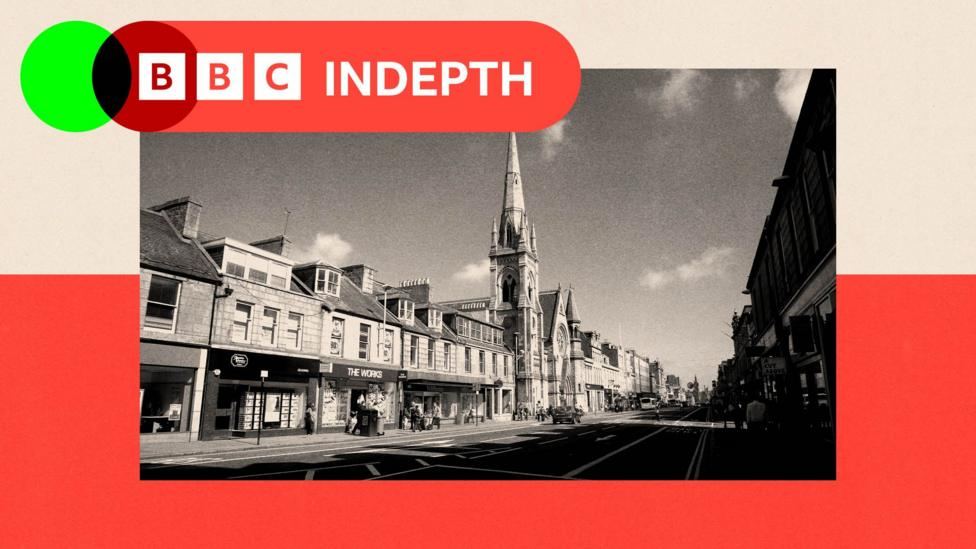
Aberdeen is launching an ambitious bid to revive its struggling centre. Could it offer lessons for other high streets?
The empty building that used to be the home of Marks & Spencer in Aberdeen is one of the first things you see when you arrive off the train and come into the city centre. The sign has gone, though the shape of the lettering can still be made out; the windows are blacked out and the doors boarded up.
This is my hometown. As a teenager, I spent hours on Union Street, its main thoroughfare, nicknamed the Granite Mile after the local silver-grey stone. It was the place to try on all the latest fashions from the likes of Clockhouse and Chelsea Girl.
The street used to be packed with shoppers from across the north-east of Scotland.
"I come to Union Street to take a bus somewhere else... there's nothing to shop for now⦠it's horrendous," complains Marie Sim, a lifelong Aberdeen resident.
It's a similar story across the country: High Streets, once bursting with shops, hit first by the rise of out-of-town retail centres and then by online commerce.
But Aberdeen is in the thick of an ambitious turnaround plan. The port city has essentially declared war on its empty shop problem, taking an unusually hands-on approach to filling vacant units and bringing long-neglected upper floors of buildings into use.
On top of that, the council is pouring tens of millions into trying to make the city centre a destination again. Like many other places, it's leaning into the "experience economy", with a new indoor food and drink market and a major redevelopment of the seafront.
High Streets are integral to how we feel about where we live. The sight of vacant shops and graffiti can quickly become a vicious circle, deterring shoppers, discouraging investment and leading to anti-social behaviour.
Politicians of all stripes have been trying for years to breathe new life into town centres - and Andy Burnham, who has made a focus on "place" part of his political identity, is the latest. He argues they should become "symbols of Britain's renaissance".
But can it be achieved? And if they're to survive, do town centres need a fundamental rethink?
One in eight properties on British High Streets are currently vacant, according to Green Street, the property and retail analytics company, a number that's stayed stubbornly high for years.
"If there was a silver bullet, it would have been fired years ago," says Jackie Sadek, a former government adviser on urban regeneration, who has spent nearly four decades working in town centre renewal.
One of the biggest obstacles is fractured ownership. Shops and buildings are often owned by dozens of different landlords, sometimes through offshore companies or complex structures, each with their own interests and priorities. That can slow decision-making and make large-scale regeneration difficult.
But even with empty units that are available, you need to find someone willing to take them on.
The cost of running a High Street business has also risen; employment costs are higher, and there's the burden of business rates.
Firms need customers. Footfall on many High Streets has been in long-term decline as shopping and services move online, and this enormous structural shift has yet to play out fully.
Two-thirds of town centre experts think there is still 20% to 40% too much retail space, according to a survey by retail body Revo and real estate consultancy Lambert Smith Hampton.
In Aberdeen's boom years of North Sea oil, from the late 1970s through to the early 2010s, it didn't have to work hard to fill its hotels and restaurants and get the cash tills ringing because of the wealth the energy industry brought to the city.
I remember weekends with friends as a teenager, spending whatever cash we had in the fashion chains and shoe shops. Later came the pubs and bar-hopping, and trips to the art deco Capitol Theatre (now office space), where I saw Duran Duran.
But by the end of 2022, Union Street had hit rock bottom. Aberdonians had long deserted the High Street for a shopping centre, which opened in 2009 next to the railway station.
"They'd fallen out of love with their city," says Bob Keiller, head of Our Union Street coalition, a community-led group formed after an emergency summit to reverse the decline.
The first thing it did was listen to what residents wanted, receiving thousands of submissions. Restoring a bit of civic pride and filling empty units became the focus.
It's been a co-ordinated effort, involving letting agents, the council, landlords, businesses and a big team of volunteers, led by Keiller, a former FTSE 100 CEO, who isn't getting paid. He has a map on his office wall, detailing the status of every property, unit by unit, with colour-coded Post-it notes.
They audited the street, tracking down absent landlords, and logging what was empty and why. Volunteers offered to give the empty properties a clean and a lick of paint, to make them more attractive to let. They also spruced up the streets, picking litter, weeding, and painting bins. A small team still goes out once a fortnight.
There's a website where all the available properties are collated; crucially, all of the financial incentives are also listed. These can include council fit-out grants (where a new business gets money to decorate premises), and a two-year discount from business rates.
In 2023, 57 of the 198 units on Union Street were empty. As of today, 33 have been filled, with a further 14 in the process of being let.
But it can feel like a game of whack-a-mole because since the initiative started, another 20 units have become vacant. "The key thing is, we're filling quicker than emptying," Keiller insists.
Keiller's operations director, David McKeith, describes it as putting an arm round the shoulder of those they can help and being a "wasp in the ear" of people who just say no.
At one end of the office, a small, young team produces social media content, linking visitors and residents to a new Our Aberdeen app, showing what the city can offer.
For Keiller, the "small wins" - like tackling graffiti - are needed to help change public perception.
"We've realised the psychology is not to do it once but be prepared to do it two or three times before people that do these things eventually say, 'there's no point in putting it there because somebody's going to paint over it.'"
Attention is also turning to the often-forgotten upper floors of buildings along the once-iconic Union Street. In a separate initiative, experts are getting inside those vacant high-up spaces to identify the barriers to bringing them back into use.
Aberdeen sought the help of a High Street troubleshooter, Iain Nicholson, who's worked with dozens of towns and cities through his Vacant Shops Academy.
Out of more than 1,000 empty units he helped audit nationally, on average more than half didn't have a letting agent actively marketing the property. He says some councils don't even know who the landlords are.
Empty shops, he says, won't all be filled by the market alone. Towns and cities need to encourage a broader range of occupiers, from arts and culture to leisure, health and well-being.
He says what's striking about Aberdeen is its joined-up approach, and the fact people "rolled up their sleeves" and overcame differences. "That's not something you can yet say about everywhere."
Nicholson also helped Crewe in Cheshire. As a smaller place than Aberdeen, it is focusing on arts, culture, and community, with a new women's centre opened this month.
And English councils are being encouraged to take a more interventionist role.
They can now force an empty commercial unit that's been vacant for at least a year to be offered to tenants through a High Street Rental Auction, even if the landlord doesn't want to let it.
It's early days but the mere prospect of losing control of a property is delivering some results. Bassetlaw Council in Nottinghamshire, an early adopter of the scheme, says more than 30 shops across the district have been let or are currently under offer as a result of the policy.