A leftwing victory in Berlin shows people want freedom, and liberals cannot deliver it | Eva von Redecker
Die Linke’s surge was propelled by a compelling promise: for voters to have the freedom to stay in their city. This is how to fight back against the far right The German leftwing party Die Linke won the state elections in Berlin on 20 September. It’s unclear whether the party will be able to form a coalition, appoint its lead candidate Elif Eralp as mayor , and follow through on her core campaign promise: to socialise the housing stock of the city’s biggest real-estate companies. A barrage of accusations started to circulate immediately after the results came in. Even by the standards of prese
Die Linke’s surge was propelled by a compelling promise: for voters to have the freedom to stay in their city. This is how to fight back against the far right
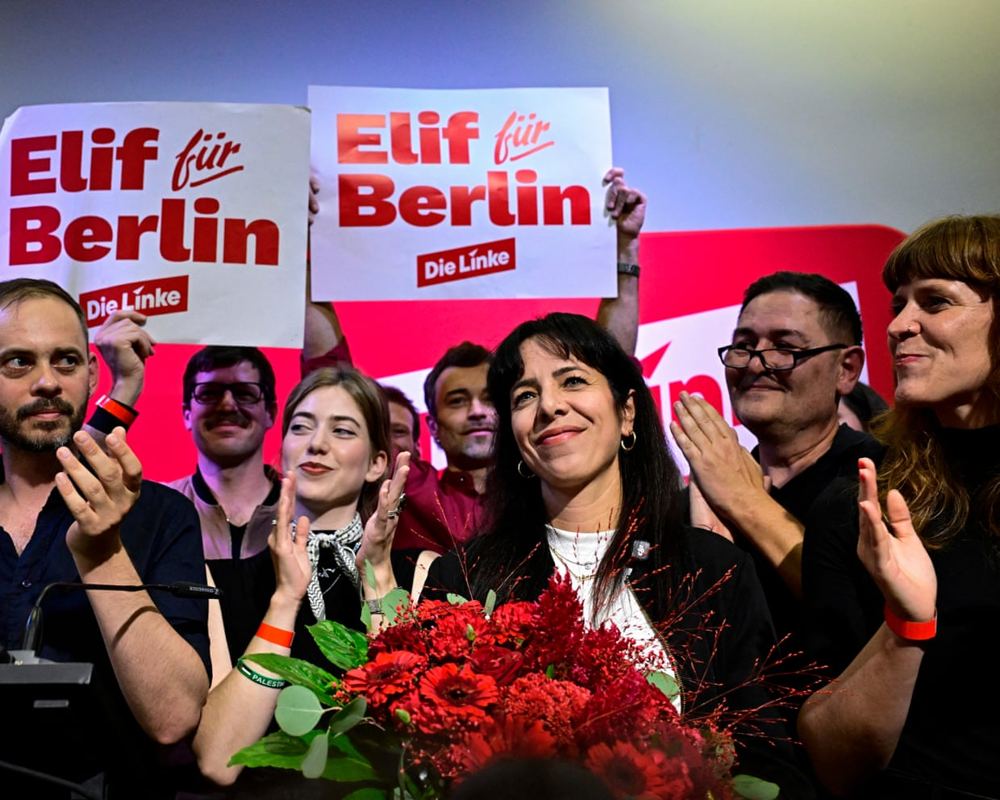
T he German leftwing party Die Linke won the state elections in Berlin on 20 September. It’s unclear whether the party will be able to form a coalition, appoint its lead candidate Elif Eralp as mayor , and follow through on her core campaign promise: to socialise the housing stock of the city’s biggest real-estate companies. A barrage of accusations started to circulate immediately after the results came in. Even by the standards of present-day polarisation, the pitch was extreme.
On the basis of one leaked chat and one rapper’s performance , the party was described as schmoozing with criminal clans and endangering the lives of Berlin Jews . Accusations of antisemitism prompted the Greens and the SPD, potential coalition partners, to question any potential cooperation, while “alt-right” opinion-makers suggested that “Hamas and Hezbollah” had won the elections , or that the German Democratic Republic (the old East Germany) was about to come back. Alice Weidel of the rightwing AfD alleged that Die Linke intended to “shoot the rich”.
Our liberal capitalist orders are designed to protect property. Touch one bit of it, and the whole thing is apparently on fire. And yet, nerves aren’t always this raw. The current flare-ups reveal a deep crisis. Sober-sounding commentators have pointed out that the accusations against Die Linke are simply a strategy to stop the socialisation agenda. But that account of moral panic as deliberate strategy can hardly explain everything. Why do so many people want to believe the smear campaigns, especially while the simultaneous wins for the AfD are swiftly normalised?
The frenzy becomes less surprising once we understand the way in which liberalism is under pressure, and how that pressure predisposes the saner political forces to look like freedom’s foes. Freedom is the core of liberalism. It is freedom of a particular kind: individual freedom. It lets you do whatever you want as long as you don’t violate the freedom of others or, crucially, their property. The analogy between freedom and property runs deep: my entitlement to do whatever I want is derived from ownership of the self. I am my own quasi-property, and in that capacity I face other self-owners and rely on the state to adjudicate between us.
This balance, between personal freedom and the freedom of all others, is already precarious , but in the face of the global crises we face now, it is especially under strain. Liberalism cannot govern economic inequality or ecological disaster, except by pitting the individual freedom of future or far-away others against the freedom of the currently privileged. Without democratic pride in our collective ability to rule our shared fate, the resulting policies look like sacrifice with no upside, I lose the (however hypothetical) freedom to own a row of houses, or I lose the freedom to drive a car, but even if I got public housing or public transport in turn, that wouldn’t register as compensation. After all, I cannot do whatever I want with those.
Reason might be on the side of anti-discrimination, social distancing or electric vehicles, but freedom kicks on the other side. It isn’t full liberal freedom any more, which would have to regard other people as a limit, but its unhinged, ultra-possessive part.
The right offers quasi-property (or “phantom possession”, as I like to call it) to satisfy its voters: it defends traditional gender roles, the family, freedom of speech and the nation as though they were things to own. “Take back your country” was a core campaign slogan of the AfD. It alludes to the “great replacement” myth, according to which white populations are in the process of being replaced by people who are not. This plot weaves together several possessive entitlements: white citizens should “own” their country; the country and its men should “own” female reproductive powers to increase the domestic birthrate. And migrants aren’t even seen as capable of moving by their own will, but are imported by a woke or Jewish cabal, and now need to be removed by “remigration”.
While such racist discourse is more associated with rural areas, “phantom possession” can suddenly override concern for fellow migrant citizens in Berlin, too. Any wrong step by the Left will suffice for the political middle to succumb to its own generalised property panic. Shaken by the success of the AfD, disoriented by a future that liberalism effectively cannot rule, challenged by emancipatory claims of various groups, and struggling to defend Israel’s crimes, much of the so-called centre also breaks the liberal pact that is founded on equality.
In what some German Jews describe as “ paternalistic philosemitism ”, centrist pundits exceed the concern to fight antisemitism where it happens. Instead, they prop up an idea of absolute victimisation and defend it at all costs. They defend German “memory culture” as if it were their private asset. Consequently, Die Linke, just as human rights organisations, anti-zionist Jews, pro-Palestinian demonstrators and anyone perceived as vaguely “Arab”, is cast in the role of ruthless plunderer.
How Die Linke, and its promise to socialise some private housing, will weather this particular campaign is still unknown. But whatever happens, it has to continue to navigate a fractured political map. Like all emancipatory efforts at present, its potential Berlin mayoralty is up against unhinged claims, and faces objective problems that require real change.
Which is why the left cannot win within the liberal script. It can only win with a compelling formulation of freedom that points beyond the current impasse. Like Zohran Mamdani in New York, Die Linke has understood this. It has not only promised an abstract right, but literally the freedom to stay in one’s city, one’s neighbourhood, one’s flat. And this freedom can scale up: against the displacement of people affected by genocide, against the ecological doom that threatens our ability to remain on planet Earth.
The German left urgently needs to find a way to translate such an agenda to the countryside, where parts of the white population have fallen for fascist myths. Which non-toxic freedom could repair their lost sense of place? And above all, how can we guarantee the freedom to stay for the migrant communities who are threatened with deportation by the AfD? Where this fails, even the most basic liberal achievement of human rights is lost. And definitely not because of socialised housing.
Eva von Redecker is a philosopher and nonfiction writer. She is the author of The Freedom to Stay