On the rocks? Scotch distilleries pause production as unsold ‘whisky loch’ grows
Demand for Scotland’s most famous export has slumped, with industry facing job cuts and closures Obscured by the Scottish countryside on the outskirts of Kirkcaldy, Cluny bond is, in effect, a small town built to store whisky. By the time the latest set of warehouses are finished on the former opencast coal mine, Diageo’s 220-hectare (544-acre) maturation campus will be able to store almost 3m casks of Scotch. The drinks multinational needs the space. After a 15-year boom turbocharged by the Covid-19 pandemic, demand for Scotch whisky has slumped around the world. Distilleries have paused prod
Demand for Scotland’s most famous export has slumped, with industry facing job cuts and closures
O bscured by the Scottish countryside on the outskirts of Kirkcaldy, Cluny bond is, in effect, a small town built to store whisky. By the time the latest set of warehouses are finished on the former opencast coal mine, Diageo’s 220-hectare (544-acre) maturation campus will be able to store almost 3m casks of Scotch. The drinks multinational needs the space.
After a 15-year boom turbocharged by the Covid-19 pandemic, demand for Scotch whisky has slumped around the world. Distilleries have paused production across Scotland to avoid adding to the glut of supply, known as a “whisky loch”, the equivalent of a “wine lake”.
Last week, the community-owned GlenWyvis Distillery in the Highlands announced it would appoint administrators following sustained financial pressure in the whisky market. On Monday, workers at Cameronbridge, Diageo’s largest distillery, a short drive from Cluny bond, began strike action in opposition to the company’s plans to cut hundreds of jobs across its Scottish operation.
Diageo produces about one in three bottles of Scotch globally, including popular brands such as Johnnie Walker. Dozens of Scotland’s 156 active distilleries are rumoured to be up for sale.
“Strangely, Scotch has had a really good time since the 2008 financial crisis,” said industry veteran Nick Morgan. “But people have stopped buying at the crazy rates they had been.
“People who bought whisky in the pandemic because they had nothing else to do realised they probably had enough at home for two or three years. There’s increased awareness of health issues, many are choosing to drink less, and booze got very expensive during the good years for the business.”
Fluctuations in Scotch whisky’s £5.36bn export market have proven particularly hard to navigate. By law, the drink must be matured for a minimum of three years in an oak cask in Scotland, with high-end speciality Scotch being aged in barrels for up to 40 years. Such lengthy maturation periods, used to create a wide range of flavour profiles from sweet to sulphurous, can make it hard to plan production.
Despite Donald Trump’s decision to remove duties on Scotch exports to the US after the King and Queen’s state visit to the White House earlier this year, the industry had already suffered a significant hit. The US president’s “liberation day” tariffs in April 2025 resulted in a 15% fall in Scotch exports to the US , according to the Scotch Whisky Association.
Demand in France, until recently the largest market by volume, has fallen, while the market in China has never really taken off as hoped. Optimists point to early signs of a tentative recovery, however, with the industry returning to growth in the first half of this year. Exports to India in particular have surged, but have not yet offset declines elsewhere.
The downturn is by no means limited to Scotch, either. Many drinks manufacturers are experiencing a post-pandemic slump, with five of the biggest publicly listed alcohol producers sitting on a record $22bn of aging spirits, according to the Financial Times .
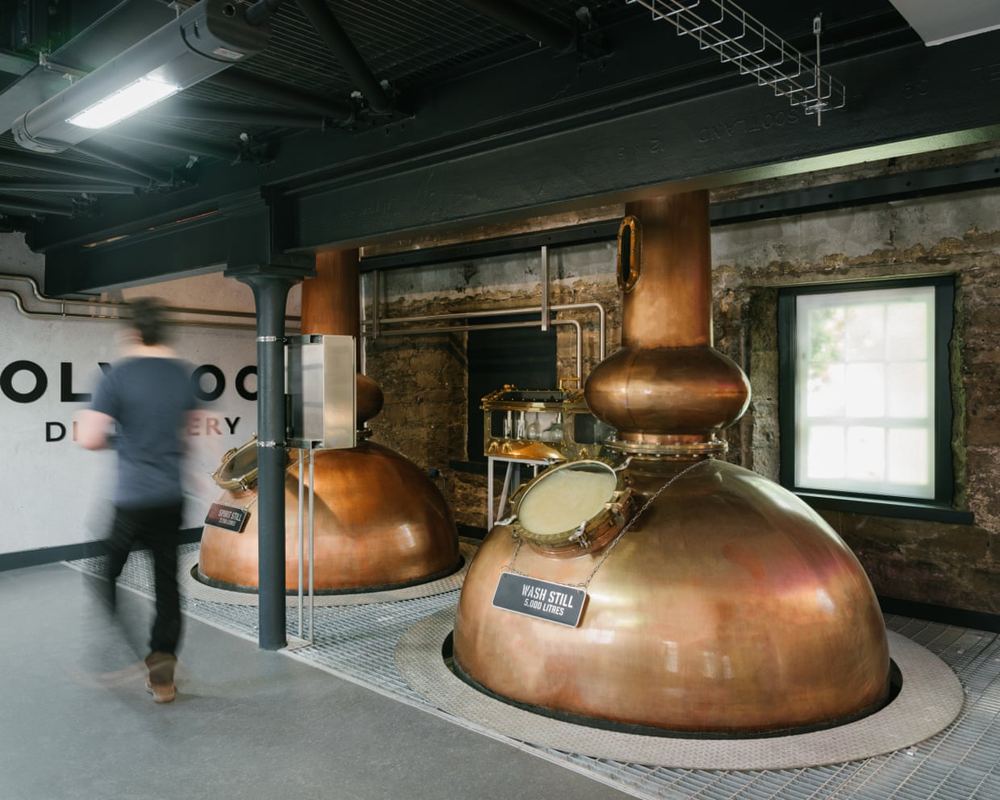
Holyrood Distillery, in the shadow of Arthur’s Seat in Edinburgh , is among those to have paused production while its owners wait out the difficult period. Its bulbous copper stills, which would usually be hard at work producing single-malt Scotch, sit idle. Co-founder Rob Carpenter says he does not know when that will change.
“Anecdotally, my understanding is that the industry might be producing around a third of its normal level right now,” he said. “No one has a crystal ball, so nobody knows what is going to happen 10 years from now. You try to anticipate where things are going to be. It is a curse of the industry in a sense.”
Unlike many of its rivals, Holyrood Distillery benefits from tourists visiting the Scottish capital. About 40,000 people each year tour the stone building, which is almost 200 years old and used to support the Innocent railway . The tours account for around half of the company’s current revenue.
“It is not really that people have stopped drinking spirits,” Carpenter added. “[But] consumers are nervous. We all see what’s happening in the world. There is not a lot of predictability in things right now, and people are just being careful with what they spend their money on. This is a luxury spirit.”
The current industry downturn is not new. In the 1980s, the Scotch whisky industry faced a similar mixture of weak demand and chronic oversupply, causing a flurry of distillery closures across Scotland. The rise of Japanese whisky producers, a global economic downturn, and overconfidence from a 1970s boom drove a prolonged bust.
Today, few think the latest slump is the beginning of a permanent change in the industry’s fortunes. When Holyrood Distillery opens for tours, visitors file in, scanning through the single malts on the shelves.
“Whisky is a waiting game,” said Morgan, who charted Johnnie Walker’s 200-year history in a 2020 book. “If you look at the data on sales, every time you have one of these downturns, it comes back higher. At the moment, the business is in the trough. I can pretty much assure you in five years time, when demand really cranks up again, they’ll find they haven’t got enough whisky, and they’ll have to switch everything on.”