Renoir and Love review, ‘The happiest exhibition of the year! Et pourqoui pas?’
National Gallery, London Grab your straw boater – and revel in these light-as-souffle masterpieces that celebrate life’s pleasures, from picnics to dances to frolics in the bushes ‘They knew how to enjoy themselves,” David Hockney once told me, gleefully pointing out the cigarette and cigar butts littering the ground under Renoir’s dancers. There are broken clay-pipes too beneath the swirling pink skirts and blue trousers of the couple in his tall, narrow 1883 canvas Dance at Bougival as they bring their faces close, placing their arms around each other and pirouetting in the soft, airy space
National Gallery, London Grab your straw boater, and revel in these light-as-souffle masterpieces that celebrate life’s pleasures, from picnics to dances to frolics in the bushes
‘T hey knew how to enjoy themselves,” David Hockney once told me, gleefully pointing out the cigarette and cigar butts littering the ground under Renoir’s dancers. There are broken clay-pipes too beneath the swirling pink skirts and blue trousers of the couple in his tall, narrow 1883 canvas Dance at Bougival as they bring their faces close, placing their arms around each other and pirouetting in the soft, airy space Renoir makes you feel as well as see. It’s an outdoor afternoon dance enclosed by fluffy, lime-coloured trees. A couple sitting at a table get friendlier with each swig of beer.
And oh, the lunches! Renoir seems to have invented the slow French lunch, relaxed and liquid, that launched a thousand bistro daydreams. In After the Luncheon, another one to delight Hockney, we see a white-clothed, open air table neatly arranged with porcelain coffee cups, carafes and glasses, and a woman sipping a liqueur while the bearded man she’s lunching with lights up, savouring the moment as his cigarette end glows fire-red against the pale blues, whites and silvers. The Lunch at the Restaurant Fournaise (The Rowers’ Lunch) lingers on the same climactic moment, one man lounging back in tobacco reverie while the lovers or about-to-be-lovers on the other side of the table chat soulfully.
Pierre-Auguste Renoir, who was born in 1841 and lived until 1919, saw the height and fall of the French bourgeois civilisation whose pleasures he so infectiously celebrates. His son, the film director Jean Renoir, revisits his father’s world with the sadness of hindsight in his screen recreation of an impressionist picnic, Partie de Campagne : there you know the happiness is fragile. But in Pierre-Auguste’s paintings, there’s no punishment. Nobody gets syphilis or drinks themselves to death, or drowns in the Seine. This is the happiest art exhibition of the year.
Et pourquoi pas ? Renoir, this perfect exhibition lays bare, is the most radical of the impressionists, which will come as a shock to anyone who sees him as the soppiest and most kitsch. Impressionism started as a pejorative label chucked at a loose group of artists in 1870s France who tried to capture modern life in motion. It is Renoir who most enthusiastically embraces this as a philosophy of life itself. He doesn’t just paint the changing light of the passing moment. He urges us to live in it.
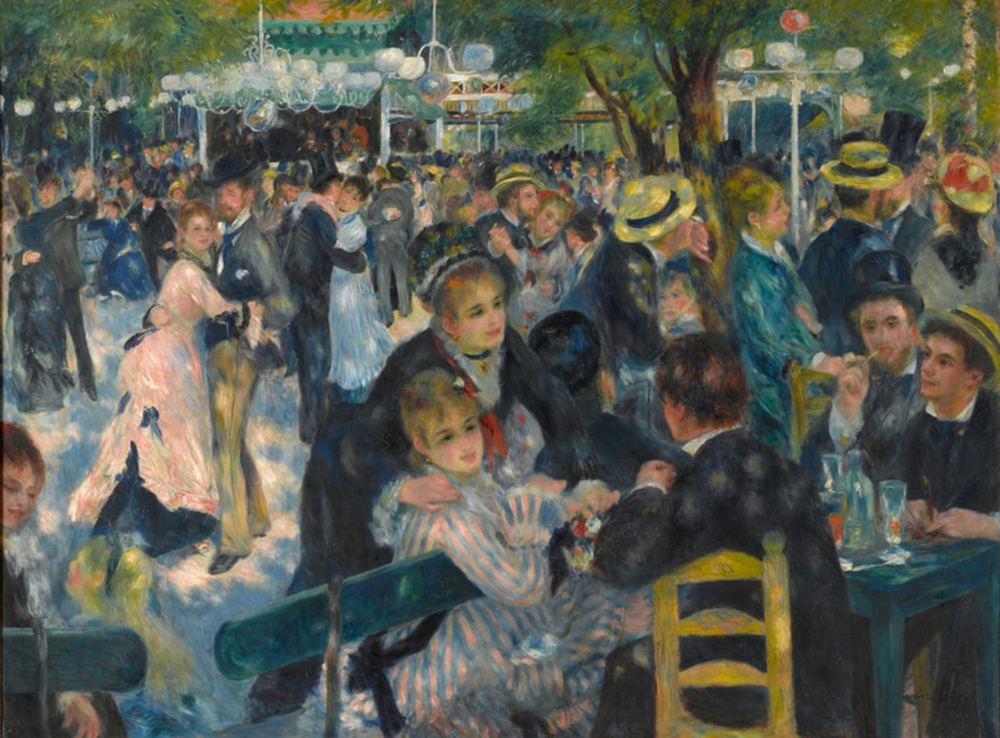
This ideal of enjoying life as it comes makes his masterpiece Dance at the Moulin de la Galette, lent by the Musée d’Orsay, as grand as a history painting and as light as a souffle. As hosts of people take pleasure in each other’s company in this open air hangout in Montmartre, their flirtations, longings and consolations are caught in a dappled, mobile dance of golden light and cool shadow. The light is so ethereally pervasive it turns the crowded canvas into a flickering fragile wonder, a brief moment of revelation that you might have, sitting in this crowd silently for a second and seeing a blue-and-white dress, a straw boater, a woman’s sensitive face as she puts an arm around her friend, a young man’s open admiration as he looks at her.
The exhibition is called Renoir and Love, and love is everywhere you look. On a rainy street under the canopy of umbrellas, a man looks dotingly on a woman who appears lost in her own daydream. In what seems at first a simple painting of a boatyard by the Seine, View of Bougival, we actually get to spy on a lovers’ tryst: the woman lowers her parasol, letting her dog play in the sun, as she converses deeply with her beloved.
It’s not all heterosexuality either. The curators cite a story by Maupassant to suggest that The Skiff, in which one woman rows another on the glittering, hallucinogenic, light-kissed water, may be a lesbian scene. Who knows? But there is no question that Renoir, like Maupassant and Zola, sees women as autonomous characters. In Place Clichy he focuses so exclusively on the flushed face of a woman in a furry coat and hat about to cross the road that the crowd behind her become blurred. It’s a cinematic close up from before the age of film, no wonder his son went into the movies.
Renoir paints the moment but he is also a storyteller. Almost every lunch, rowing party and stroll in the park feels like a languid set-up for what will follow. Couples, or solitary women, in theatre boxes as the show is about to start fascinate him. Parks too are stages. The Promenade was painted in 1876 but recreates the 18th-century love scenes of Watteau as a man leads a well-dressed woman by the hand into the bushes. She looks uncertain. Perhaps she’s married. Or perhaps here is the menace Renoir usually doesn’t see.
Renoir can strike some as a soft touch, especially when you compare him with the tough, ironic realism of Manet. He also went off later in his career. The National Gallery acknowledges this by including his anti-impressionist, nude indulgence The Great Bathers . The work’s fun in its way, but it’s the early Renoir who shines here as a truly great modern artist. Let’s remember the good times. Be happy, be in love, mes amis .