Who’s Afraid of Virginia Woolf? review, Gillian Anderson fights tooth and nail in marital meltdown
@sohoplace, London There is no shortage of sparring between Anderson and Billy Crudup in Edward Albee’s classic, though its comedy has an air of George and Mildred Those who want to moan about the toxic reliance on celebrity casting and screen stars in the West End can stop right there: Billy Crudup and Gillian Anderson both began their careers on stage. Here they are now, glittering up Edward Albee’s conflagration of a play about unhappy marriage and its necessary illusions, immortalised on screen by Richard Burton and Elizabeth Taylor. Anderson and Crudup can hold their own against that land
@sohoplace, London There is no shortage of sparring between Anderson and Billy Crudup in Edward Albee’s classic, though its comedy has an air of George and Mildred
T hose who want to moan about the toxic reliance on celebrity casting and screen stars in the West End can stop right there: Billy Crudup and Gillian Anderson both began their careers on stage. Here they are now, glittering up Edward Albee’s conflagration of a play about unhappy marriage and its necessary illusions, immortalised on screen by Richard Burton and Elizabeth Taylor.
Anderson and Crudup can hold their own against that landmark adaptation of the play about George, a middle-aged history professor with a sagging academic libido, and Martha, his frustrated, ceaselessly needling wife. They are confident performers and it makes sense that this 1962 American classic about conjugal warfare is taken on by two Americans, albeit under the aegis of British directorial powerhouse Marianne Elliott. If Elliott’s previous production, Les Liasons Dangereuses at the National Theatre, had what some considered an anaemic connection between its leading lovers, there is no shortage of sparks and sparring for the central couple here. They are shouty and jousting, although it does not feel dangerous or emotionally eviscerating enough between them for rather too long.
Their night-long fight at home begins after a faculty party thrown by Martha’s university president father. The pair’s guests are a younger couple, biology academic Nick (Josh Dylan) and his wife, Honey (Phoebe Horn), who first watch Martha and George play their emotional games, then get sucked in.
Elliott preserves the play’s original setting, with Miriam Buether’s set an elegant 1960s-era living room complete with the all-important drinks trolley. The couples are drunk but intent on getting drunker, each refill raising the stakes.
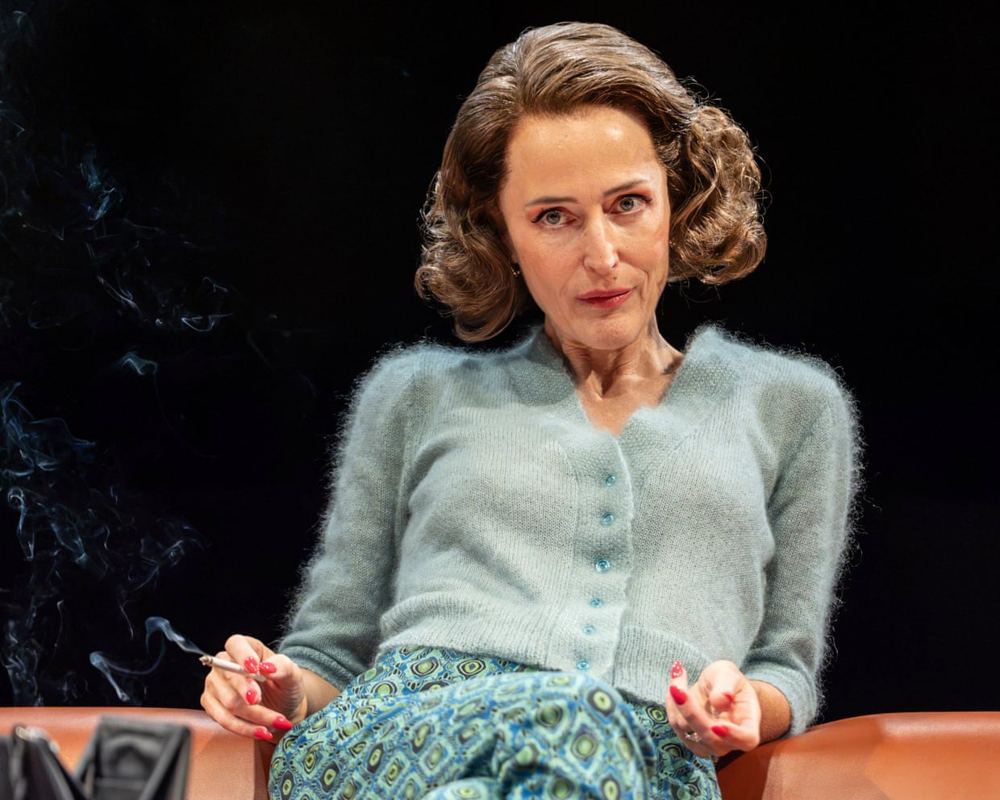
Anderson makes a formidably angry Martha as she needles away, poking George in every place it hurts. She is all hard edges and armour, agitating for a fight from the off, with a big, dirty laugh and a bawdy flirtation with Nick. Crudup is put-upon, dusty, literally all (in) grey. He initially leads with passive aggression, mansplaining Martha’s behaviour to the room and batting off her barbs with intellectual superiority or sarcasm, before entering into more confrontational territory.
It ends in hand-to-hand combat but before that, laughter is eked out of the first act, which emanates a deliberately upbeat lightening of tone. George and Martha have more than a touch of George and Mildred, their game-playing a little cartoonish at times.
The chemistry of rivalry and one-upmanship between the men is at first stronger. In between Nick and George’s Darwinian fight to be the bigger chest-beater, there is banter and a sharing of confidences, which in one of this production’s most brutal moments is used agonisingly against Nick and Honey.
Horn and Dylan play their relationship with less comedy and are always compelling, Nick seeming like an overgrown frat-boy, Honey quietly tragic. They make a subtle mirror reflection of George and Martha, both with their own versions of phantom children.
The most savage moments between Martha and George keep their queasily comic edges: her groin-thrusting dance with Nick which graduates to boastful “necking” in the hope to get a rise from George and her digs at his academic underachievement, delivered with bent-kneed, pointy-fingered, almost panto-like drunken accusation.
The play, while exquisitely written and structured, feels tortuously long at over three hours, and though this is the point, to watch how two people destroy each other yet love each other, it still feels like a punishment. Staged in the round, it leaves little room for hiding. There is a revolve, slow for the most part, which shows their marriage up close, from every angle.
For all the comedy and nervous laughs, this couple does combust and the end is devastating. Martha stops her high-pitched attack and becomes vulnerable. George lets go of his emotional cruelty. They have finally stopped the power games and play-acting of their marriage. Or have they?