Germany news: Many believe Merkel more capable than Merz
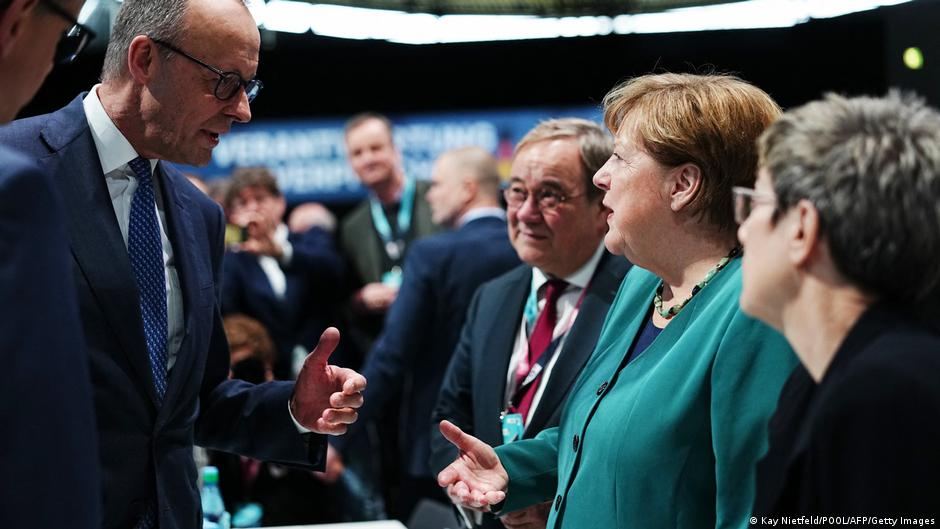
Nearly half of Germans view former Chancellor Angela Merkel as better suited to handle Germany's challenges than current Chancellor Friedrich Merz. Also, today is the last day of Oktoberfest in Munich. DW has the latest.
48% of Germans say former Chancellor Angela Merkel is more suited to deal with Germany's challenges than current Chancellor Friedrich Merz
Meanwhile, Merz is visiting Kyiv as Ukraine faces a fifth winter of Russia's invasion
Today marks the last Germany's famous Oktoberfest event in Munich
On Saturday, Germany's leaders gathered in the northern city of Bremen for official festivities marking Unity Day
German President Frank-Walter Steinmeier warned that Germany's democracy is being challenged again, pointing to the threat from right-wing extremism
Here is a roundup of top stories from and about Germany on Saturday, October 3, and Sunday, October 4, 2026:
German Chancellor Merz is in Kyiv on an unannounced visit, along with Economy Minister Katherina Reiche and other leading German economic figures.
Merz is expected to announce new military aid for Ukraine along with other initatives as Ukraine faces its fifth winter amid Russia's ongoing invasion.
A new survey from YouGov which was commissioned by German news agency DPA found that 48% of Germans believe former Chancellor Angela Merkel is better suited to tackle Germany's challenges than current Chancellor Friedrich Merz.
The poll also found that 29% of Germans believe the two leaders would be equally capable of confronting Germany's problems.
Only 8% viewed Merkel less favorably than Merz; 15% didn't answer the survey or said they didn't know how to respond.
Both Merkel and Merz are members of the center-right Christian Democratic Union , but have long been political rivals.
Merkel served as chancellor for a period of 16 years from 2005 to 2021.
Merz, meanwhile, faces record low approval ratings since becoming chancellor in May last year.
Germany's problems include a stagnant economy, rising energy prices, an aging population with fewer working to support social programs, illegal immigration and foreign policy challenges such as the Russian invasion of Ukraine, among other issues.
Welcome back to our coverage this Sunday on what's happening in Germany.
Nearly half of Germans feel that former German Chancellor Angela Merkel , who governed for 16 years, is better suited than incumbent Chancellor Friedrich Merz to tackle the country's current problems, according to a new survey.
Both Merz and Merkel belong to the conservative Christian Democratic Union party.
The poll results come as Merz faces record low approval ratings as chancellor since he took the reigns in May last year.
To view this video please enable JavaScript, and consider upgrading to a web browser that supports HTML5 video
Also on Sunday, the chancellor paid an unannounced visit to Kyiv to show solidarity with Ukraine amid Russia's ongoing invasion.
And it's closing time! One last call for alcohol ― today's the last day of Oktoberfest in Munich.
All this and more from the heart of Europe. Stay tuned throughout the day.
German Unity Day's official celebrations have ended, and we're pausing our coverage.
We'll be back Sunday morning with more of what's making news in Germany.
Thousands of people protested against war, military buildup and possible conscription in Berlin and Stuttgart on Saturday.
Among other things, the protesters called for a end to all economic sanctions and arms shipments, calling instead for increased social spending.
Protesters in Berlin marched from the Brandenburg Gate through the city center. Police estimated there were 5,800 attendees while organizers put the turnout at 20,000 people.
The organizers in Stuttgart estimated a turnout of around 15,000 people. However, dpa journalists who were present at the demonstration estimated the turnout to be in the low to mid thousands.
Düsseldorf has been announced as the host city for next year's official commemoration of German Unity Day.
The annual event is hosted by whichever state holds the rotating presidency of the upper house of Germany's parliament, known as the Bundesrat. In 2027, it will be held by Germany's most populous state, North Rhine-Westphalia .
Düsseldorf is the second-largest city in North-Rhine Westphalia, after Cologne. The state is also home to the industrial cities of the Ruhr Valley including Dortmund, Essen, Duisburg and Bochum.
The mayor of Bremen , Andreas Bovenschulte, symbolically handed the baton to North Rhine-Westphalia's premier Hendrik Wüst, who will take up his post as president of the Bundesrat on January 1.
"Togetherness, connection, and unity are never a finished task," said Wüst.
"Continuing to work on this, maintaining one's interest, and keeping the conversation going, even with people whose outlook might be completely different from one's own," he added.
More than three decades after German reunification, the economy in the eastern states still lags beind the western states.
The five eastern German states reached just under 79% of western Germany's economic level in 2025, according to an analysis by the German Economic Institute (IW) released on German Unity Day.
The figure is based on an index designed to track eastern Germany's economic convergence with the west. It incorporates economic output per capita, productivity, investment, research and development, employment, unemployment and self-employment.
Although the east has made substantial progress since 1991, when the index stood at 51% of the west's economic development, this convergence has stalled over the past five years, hovering between between 78% and 79%.
The researchers pointed to large shortcomings in research and development (R&D) in particular. They found that the number of research and development personnel in the east was equivalent to just over 46% of the same workforce in the west.