Russia is losing its grip on Kaliningrad, despite using the exclave for anti-Nato scare stories
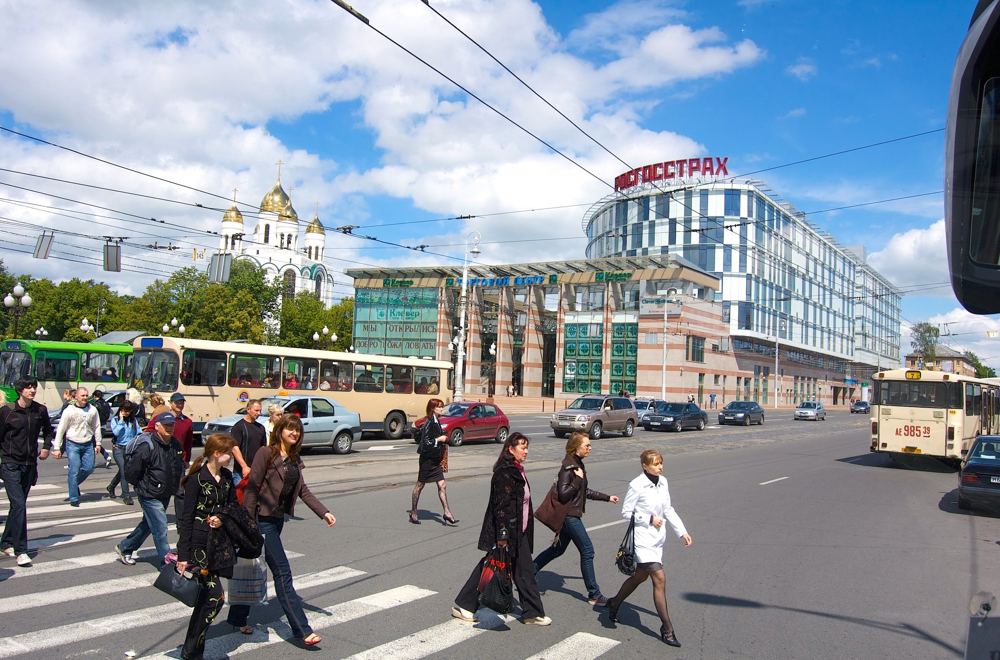
Nuclear sabre-rattling only underlines the fragility of Russia’s grip on its trophy territory.
Russia will use nuclear weapons if Nato tries to blockade Kaliningrad. That was the blunt warning from the Kremlin last week. In truth, this is an empty threat against an invented danger. Russia’s nuclear bluff is worn out from overuse, and Nato has no such intention.
But the outburst does signal something useful: Russia’s sensitivity about Kaliningrad.
The northern half of the former German territory of East Prussia is the Kremlin’s last great trophy from the Soviet victory over Hitler in 1945.
Like many trophies, it is less impressive on close inspection. Kaliningrad is an artificial creation, from its name (after the war criminal Mikhail Kalinin) to its population (imported after ethnic cleansing) and its southern border (a crude straight line, of the kind European colonists inflicted on African countries).
Now Moscow’s grip on this exclave, an island of Russian territory sandwiched between Poland and Lithuania, is increasingly fragile. Not because anyone will sever the precarious air, sea, and land routes that keep it supplied, but because of Russia’s all-too-real, corrupt, authoritarian, and incompetent system of government.
The weakness of the Russian system, aggravated by the cost of the disastrous war in Ukraine, makes holding on to Kaliningrad unsustainable: economically, socially, demographically, and politically.
Outside commentary mostly misses this, depicting Kaliningrad as a fortress from which Russia can menace its neighbours.
It is more realistic to see it the other way round, as Russia’s greatest strategic vulnerability: an Achilles’ heel.
The think-tank the Baltic International Security Centre (BISC) is conducting a big research project called Kaliningrad 2050.
The name poses an implicit question: do you really believe that Kaliningrad will still be under Moscow’s rule by the middle of the century? It looks increasingly unlikely.
BISC will this week convene 20 experts for crisis simulations examining how Kremlin rule might unravel, and how neighbouring countries could, would, and should react.
The causes are imaginary, for now. But an environmental disaster, a breakdown in fuel supplies, or a public-health emergency, such as the one now unfolding in Siberia , are all entirely possible in Russia’s current ramshackle state. Decision-makers will have to react to the resulting refugee flows, pollution, and humanitarian needs.
We do not yet know the BISC study's outcome: as with military 'war games', the aim of these exercises is to test how different scenarios play out. We hope the conclusions will be useful for those who deal with these dilemmas in real life.
Next up will be a book, Fragile Fortress , to be published later this year. Edited by the British Russia-watcher Christopher Peters, and written by local and foreign experts, it explores topics including memory politics, economic weaknesses, internal repression, and the state of public opinion. The main message: Kaliningrad survives only thanks to economic subsidy and political support from Moscow.
While the Kremlin blusters about a threat from Nato, social media scare stories depict supposed Russian invasion plans to be launched from Kaliningrad, with maps showing thick red arrows piercing the Suwałki Gap, a strategic stretch of land which links Poland and Lithuania.
But as the book’s military chapter shows, such an attack is impossible in current (or likely) conditions. Russia has almost no ground forces left in Kaliningrad: they have all gone to Ukraine. Nor does the Russian air force there have the kind of airfields and hangars needed for a real war.
Nato, especially since Sweden and Finland joined the alliance, is overwhelmingly dominant in land, sea, and air in the region: a point underlined by its recent surveillance exercises in the region.
In short, the nuclear bluster is irrelevant. Nobody is menacing Kaliningrad from the outside. And the real question is when and how, but not if, the Kremlin will lose it in the end.
Edward Lucas is a former senior editor at The Economist, founder and director of the Baltic International Security Centre think-tank, and a regular writer on defence, security and espionage for The Times and Foreign Policy. He is the author of The New Cold War (2008) and Deception (2011).