The butter boom, how the world fell back in love with the glorious golden spread
It’s being sculpted for fashion parties, collected by tourists and hoarded in freezers. There are even entire shops devoted to it. What’s behind the revival of the much-maligned foodstuff? Temperatures in Paris were nudging 41C when Erwan Leo opened Le Butter this summer. Wildfires had already been tearing through France and the city was quiet, particularly in the less touristy 8th arrondissement, a flex-your-wealth area near the Eiffel Tower known as the “golden triangle”. The last thing it needed, you would think, was a shop that sold loads of butter. “We were just so worried about the fridg
It’s being sculpted for fashion parties, collected by tourists and hoarded in freezers. There are even entire shops devoted to it. What’s behind the revival of the much-maligned foodstuff?
T emperatures in Paris were nudging 41C when Erwan Leo opened Le Butter this summer. Wildfires had already been tearing through France and the city was quiet, particularly in the less touristy 8th arrondissement, a flex-your-wealth area near the Eiffel Tower known as the “golden triangle”. The last thing it needed, you would think, was a shop that sold loads of butter. “We were just so worried about the fridges,” says Leo, the 34-year-old owner. “We didn’t think anyone would even turn up.”
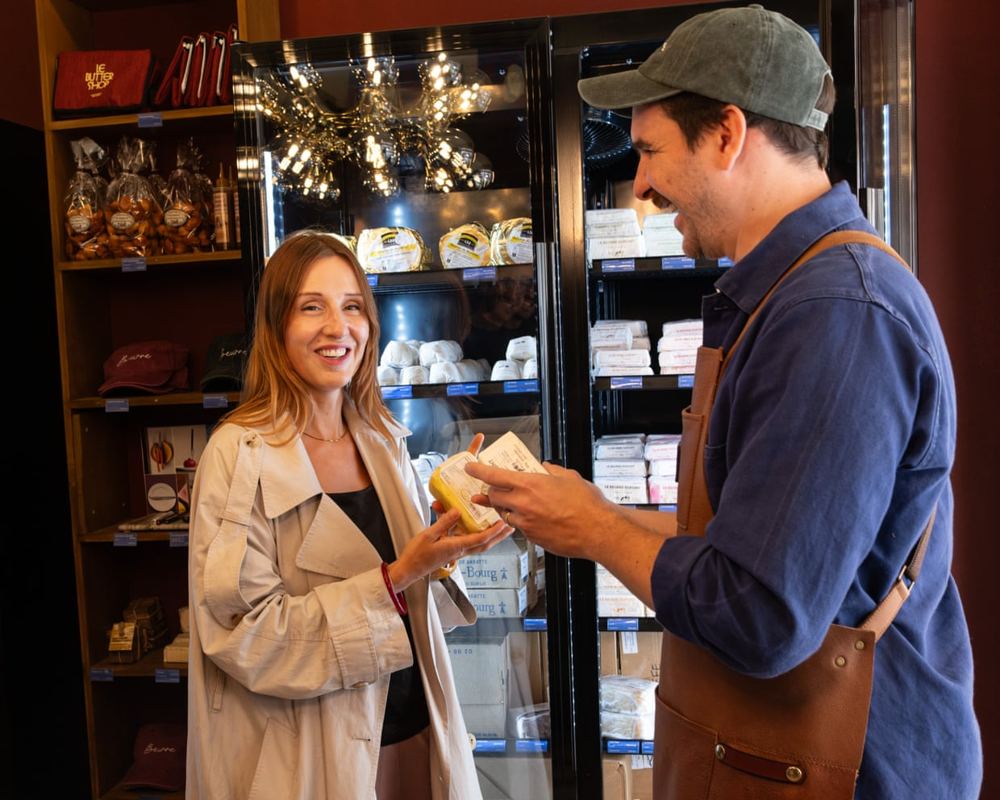
I visit Le Butter, the first shop in Paris dedicated to selling the stuff, two months later in September. It’s a quaint, photogenic spot between a wine shop that was opened by Leo eight years ago and a cafe famous for being blown up in Christopher Nolan’s Inception. Inside there are candy-striped walls, little shopping baskets, a shelf of Instagrammable buttery merch (knives, hats, totes) and two double fridges containing 50 different types of butter. It’s a lot cooler today; the fridges purr away at an exacting 3C. And the past few months have been busy, so much so that Leo has had to erect a bench for those waiting outside, and a retractable barrier to manage the queues.
Outside today, I find a gathering of butter fans comparing purchases. Among them is Clifford Yellen, a 66-year-old Italian-American chef and consultant who has bulk-bought “only pure stuff, salted”. He opens his paper bag to show me multiple packets, vacuum-packed for his flight home. “We chefs have a real thing about butter,” he says. He usually eats Italian, or the famously creamy Hokkaido from Japan.
Inside the shop, tourists from Brazil and Korea are gathered around a glass display cabinet on the counter where staff dispense quenelles of wild garlic butter on to wooden tasting spoons. The tasters follow it with raspberry flavour, and chocolate. “I call Le Butter an ice-cream shop for butter!” Leo says with a laugh.
And while British tourists have been banned from bringing French butter to the UK since 2025, to stop farm animal diseases spreading, as a nation we, too, revere butter. Earlier this year, the Pembroke Club in Belgravia, London, placed an advert for a butter sommelier in Country Life magazine, looking for someone able to confidently “curate our butter assortment and assist in training staff using our silver butter trolley”.
For those who can take butter home with them, there are entire threads on Reddit discussing the best way to transport it via plane (frozen, vacuum-packed, ziplocked) and where to buy it. Guided by one, I head to La Grande Épicerie de Paris to lay eyes on its famous “wall of butter” where 150 types are sold. The two most popular varieties, according to the staff, are Le Beurre Bordier and Beillevaire. Like most good French butters, they have a fresh, rich flavour with tangy depths, which you could probably put down to their high butterfat content and the grass-fed cows from which they come.
Even the high-end butter is relatively cheap, and right now, in this “little treat” economy , eking out €8 for a wheel of butter sprinkled with fleur de sel feels more manageable than buying a decent bottle of wine. The latest thing, Leo says, is people serving butter as they would cheese after dinner, on boards with crackers. “It’s also cheaper.”
While I’m reporting from Paris fashion week, my Instagram becomes a cavalcade of ambrosial butters laid out on event tables with great loaves of bread, or pummelled into submission and piled up into small hills as table centrepieces. I watch influencers biting into whole sticks of butter, or being served plates of medjool dates stuffed with slivers of the stuff. It’s at once beautiful and grotesque.
It has even become a material for food artists. Laila Gohar, the American-Egyptian artist, treats it like marble, and once carved it into a fragment of Michelangelo’s David. During a design festival, the food artist Imogen Kwok built a foot-high cone from whipped butter and foraged herbs.
It was the threat of shortage that turned South African journalist Safia Patel, 35, into a self-described “butter hoarder” who now collects and categorises it. At home in Istanbul she keeps cooking butter, eating butter and “ornamental” butter (too precious to eat), the last of which she stores in her freezer.
Her love of butter comes from her grandmother, who ate it in thick, cold slices on bread. But it was during the pandemic that she realised how much it really meant to her. She’d buy Lurpak locally in Istanbul, but as the pandemic wore on, it became harder to find. “Once things returned to normal, I began coercing people into bringing me butter from around the world in case I ran out.” Most days she carries two or three portion-sized packs in her handbag, “just in case. Yes, it can get messy.”
The prettiness of Le Butter’s packaging has naturally made it a social media hit, which Leo describes as a double-edged sword. “Obviously, I’m grateful,” he says. “But it can also be overwhelming. The aim of the shop is to educate people beyond supermarket butter, and to serve the locals as well as the tourists. We can only do our best.”
This fetishisation of butter is still quite divisive. “When it comes to food styling, some of what they do looks cool,” says Seb Myers of the restaurant Planque in east London. “But when you see a mound of butter, all that extravagance for the sake of a photo? I’m quite squirrelly with food. Waste is my big thing.”
In restaurants, I’ve lost count of the time I’ve been served butter shaped into little salted coins or whipped into something dippable. Bread and butter are still one of the most valued moments in a good meal. And as Anthony Bourdain wrote in Kitchen Confidential, “If you eat at any good restaurant, assume you’ve eaten a stick of butter.”
“That’s partly because it starts the meal,” says Myers, who takes his butter pretty seriously. “If someone serves you an ice-cold pat of butter, you know you’re not in for a good time”. His restaurant is a play on Parisian bistronomy, so “it’s in almost every dish”. They use Beillevaire butter demi-sel sprinkled with flakes, sliced and well tempered. He keeps it in “a cheese fridge for a week to slow-mature it”. For cooking, it’s Douceur de France (they get through 10kg a week in cooking alone).
Pravin Nayar runs Castle Farm restaurant in Somerset, and makes his own: “We like butter to be the hero product when we do supper clubs.” The key, he says, is how you serve it: room temperature, sprinkled with salt. “The way I see it, bread is just a spoon for butter.”
R emember when butter was considered bad? After all those anti-saturated fat health campaigns, consumption hit a historic low by the late 1990s, with the average Brit consuming just 2kg a year. The perception around it seems to have shifted, although with 50% saturated fat, and I say this with love, butter is not exactly a superfood.
“The heart-health advice hasn’t changed,” says Tracy Parker, a registered dietitian and an adviser for the British Heart Foundation. “If you’ve got high cholesterol, or your diet already leans heavily on saturated fat, think fatty meats, pastries, cakes, biscuits, then you should probably reconsider how much you’re eating and whether you could swap it for something like olive, avocado or nut oil.” Butter is fine in moderation, though. “A light scrape on your morning toast, and thinking about everything else you eat, you’re probably OK,” she says.
So why the cultural rehabilitation of butter in a health-fad-mad 2026? Parker thinks it has become tangled up with the anti-ultraprocessed-food movement. “UPFs have been linked to poor health including obesity, type 2 diabetes and heart disease,” she says. Whereas butter is seen as a preindustrial, farm-adjacent product. “People view butter as a natural food and therefore better than, say, margarine,” she says.
My family of four eats a pack a week. Is that a lot? Not really. In the UK, we eat just over 3kg of butter per capita per year , which amounts to a modestly covered slice of toast each day. And that is nothing compared to the Belgians, who put away 8kg. Or the French and Danes, who consume almost 9kg per person per year.
Many people I meet in Paris still believe in the French Paradox: the idea that they can eat butter and cheese without suffering the same rates of heart disease as other nations. One of the most popular flavours at Le Butter is chocolate, a nice riff on the traditional after-school snack (known as le goûter or le quatre-heures) of dark chocolate squares, salted butter and fresh bread. The fact that cardiovascular disease is the second leading cause of death in France probably won’t affect this too much. “It’s something we eat every day,” says Leo. “I don’t check my cholesterol, I don’t want to know.”
I, on the other hand, have familial hypercholesterolemia, a fairly common genetic disorder that causes very high levels of low-density lipoprotein (LDL) or “bad” cholesterol from birth. When I tell Parker, she responds with a polite “ah”. I am not overweight but at some point I will need to go on statins; I also come from a long line of heart attacks. After we talk, I comfort myself with a slice of buttered rye toast, knowing I should probably also reconsider my life choices. But I, like so many people, love butter.
For Patel, one pack of butter stands out from the rest of her collection: a half pack of Kerrygold from 2019, frozen ever since. “I have it partly as insurance, in case I run out. But also because it’s reassuring, it reminds me of a different time.” She loves her work but her dream job is to run a dairy farm. “Or at least go to Paris, to that shop, and eat all that butter.”