‘Curious and circumspect creatures’: the artist making sculptures for the rats of New York City
For his latest project, Asad Raza made ‘public art’ for rats with pieces designed to appeal to the city’s maligned rodents “We call this the Hell Door,” artist Asad Raza explained animatedly. It’s 10pm on a warm August evening, and we are standing outside a small enclosure at the back of a seafood restaurant under the Manhattan Bridge that to any other passersby would have been invisible. “Are you ready?” he asks and, with my OK, pulls the door open to reveal what looks like 100 rats cascading over the dumpsters stored in this small, dimly lit room and scampering away into their secret passage
For his latest project, Asad Raza made ‘public art’ for rats with pieces designed to appeal to the city’s maligned rodents
“W e call this the Hell Door,” artist Asad Raza explained animatedly. It’s 10pm on a warm August evening, and we are standing outside a small enclosure at the back of a seafood restaurant under the Manhattan Bridge that to any other passersby would have been invisible. “Are you ready?” he asks and, with my OK, pulls the door open to reveal what looks like 100 rats cascading over the dumpsters stored in this small, dimly lit room and scampering away into their secret passages in the walls and floor.
This foul-smelling, grime-encrusted site is just one of more than 20 that Raza, and his team of three installers, fellow artists Devyn Gallindo, Kunning Huang and Jared Packard, have identified across New York City as prime locations for, as he calls it, “public art for rats”.
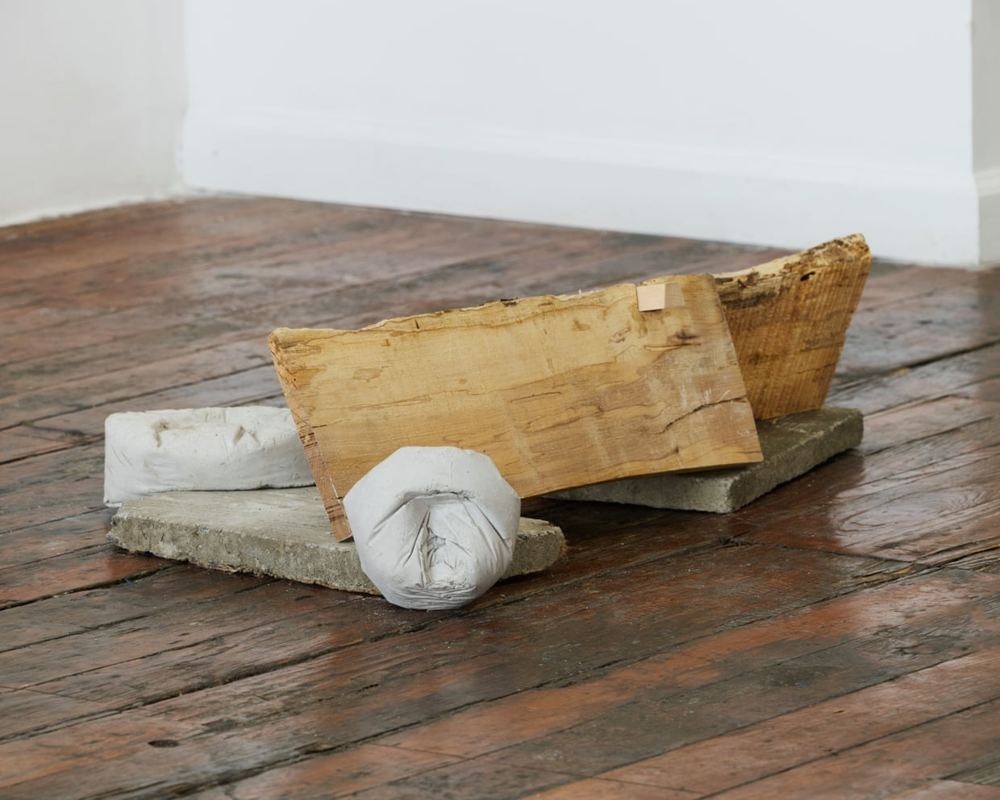
In a minivan rented by Raza for much of the summer, I accompanied the team on one of their regular nightly routes, watching as they fished sculptural components made of concrete, wood and burlap out of the trunk to arrange in various configurations beside garbage cans, next to sewers and under bushes. Doing so meant “going across all of these social boundaries that the human world of New York has” Raza observed, that “this world of the rats doesn’t have”.
That night alone, the team trekked from Seward Park and a public housing complex on the Lower East Side to the riverside walkways under construction beneath the Brooklyn and Manhattan Bridges, all the way to the landscaped flowerbeds in front of the Natural History Museum and the litter-filled medians of Times Square.
At most locations along the way, they also zip-tied trail cams to pipes, gates and benches, so as to capture footage of the rats’ interactions with the sculptures. After retrieving an SD Card with the previous night’s documentation, Huang would stay behind in the van downloading it on to a laptop so that the crew could see what they had captured. As each rat sniffed, rubbed and scampered over or through the “public art” that had newly appeared outside their veritable front doors, everyone exclaimed.
“I was interested in doing something that wouldn’t simply be fun or entertaining for rats,” Raza explains, when asked how he determined what “public art” for rats would look like, “because to me, a key part of art is that it’s not exactly for anything. It doesn’t necessarily have a clear purpose other than as an expression of its own form.”
So when considering whether or not it would be “possible for the idea of art to cross the species boundary” Raza recognized that he had to “think about another species’ way of perceiving the world in a way that would allow us to create a similar kind of experience for them”. This line of inquiry lead him to consult Michael Parsons, an animal behaviorist, as well as architects Mara Jovanović and Zaynab Eltaib of the Massachusetts Institute of Technology (MIT), advised by Jaffer Kolb, regarding what kinds of structures, forms, materials and textures would be most sensorially captivating for rats.
“If we want to take them seriously as beings with their own preferences and ways of navigating the world,” Raza said, “I’m not going to make tiny Cartesian modernist villas.” Instead, rats particularly enjoy chaotic spaces with lots of entries, exits, and places to hide. “Think,” Parsons wrote in an email to Raza, “shattered bits of rubble.” This phrase stuck with the artist and has been clearly reflected in the resulting sculptures which could (like so much contemporary art) easily be mistaken for trash or debris.
To make the sculptural components, Raza worked with Jovanovic and Eltaib at MIT casting different objects, usually items found in urban environments, such as plastic bags, styrofoam and boxes, to create molds for concrete structures. The formal language that developed was one of textured concrete surfaces punctured by balloon forms that create navigable passageways, and augmented with wooden and burlap components that hold scents well.
These material choices were largely informed by thigmotaxis, which is a keen sense that rats have of being in contact with a solid surface by rubbing alongside walls or structures. As night-time and semi-subterranean creatures, they use this sense to find their way and stay out of trouble, as they have poor vision but a good sense of smell.
In learning more about rats, their needs, behaviors and desires over the last few months, Raza said he had come to “think about them much more as animals living their own independent lives, rather than something that makes me sick or that I don’t want to see”.
“Once you get over the culturally indoctrinated, visceral fear of rats,” he added, he began to “see them as much less threatening, and more [as] curious and circumspect creatures”.
The project began when Raza was invited to create an exhibition for times, an alternative art space downtown. As an artist who normally produces site-specific, multi-sensory, often haptic installations, such as diverting a river through a gallery (Portikus Frankfurt, Germany), filling an exhibition space with soil created from local waste products (Carriageworks, Australia), conducting electricity through various encounters and materials in a reactivated power station (currently on view at E-WERK Luckenwalde , Germany), Raza started by looking beyond the white cube of the exhibition space to the broader, non-human ecosystem of New York.
Given that the city is not just home to nearly 9 million humans, but undoubtedly rife with countless other creatures big, small and most famously (to many New Yorkers’ displeasure) approximately 3 million rats, it is not altogether surprising that Raza began to wonder: “What would it mean to make art for rats?”
Artifacts and documentation from the city-wide public art installations that resulted (ie the true exhibition which took place in August for our nocturnal neighbors) is now on view. Titled thigmotaxis (the rat show), this presentation features a selection of the sculptures arranged across the floor, a human-sized textured wall-work that visitors can rub against to experience thigmotaxis themselves, and a video of the rats’ nocturnal encounters with the sculptures throughout the city. “It’s a little bit of a love letter to New York,” Raza said.
Asad Raza: Thigmotaxis (the rat show) is on view at times, New York until 12 December