Nathan Fielder’s You Can See Everything Is a Reality-Splitting Masterpiece: Review
Directed by Fielder and Lance Oppenheim, the surprise-filled documentary about Elizabeth Holmes is really about the impossibility of truth. Nathan Fielder’s You Can See Everything Is a Reality-Splitting Masterpiece: Review Liz Shannon Miller
You Can See Everything , from directors Nathan Fielder and Lance Oppenheim, is an incredible challenge to pin down, a movie where truth feels impossible to believe, and the camera isn’t afraid to lie. The film is more than an extension of Fielder’s blending comedy and documentary with shows like The Rehearsal, it’s an evolution upon it. It asks everyone involved to look at themselves, and face the difference between perception and reality. And it is also, quite frequently, so funny that I literally slapped my knee at one point.
This is the rare documentary where spoilers are a real concern (versus, say, a true crime story where the ending can be looked up on Wikipedia). However, the basic facts are pretty simple: On May 30th, 2023, Theranos founder and convicted felon Elizabeth Holmes surrendered to Federal Prison Camp, Bryan, where she is currently serving a years-long sentence for fraud. For the month prior to that, Fielder and Oppenheim followed her and her family with cameras, documenting this pivotal period of time.
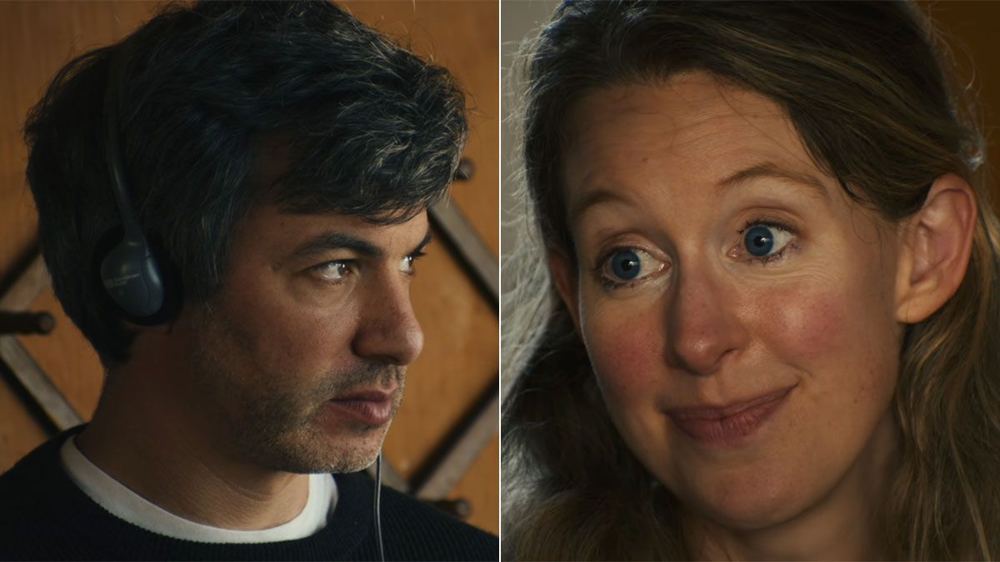
Initially, only Holmes, her fiancé Billy Evans, and their two young children are featured on camera. Then, the movie’s first major laugh arrives with the reveal of a lurking Fielder, headphones on as he monitors the scenes playing out in front of him. (A very familiar sight to any viewers of The Rehearsal .)
Soon, Fielder is living in their vacation house and interviewing Holmes and Evans on camera about their future plans, which include continuing the work Holmes began with Theranos, even after she goes to prison. Fielder initially expresses a concern that he won’t be well-equipped to understand the science behind Holmes’ work, due to his lack of knowledge in this arena. However, what he is uncannily good at is asking questions, and continuing to ask questions when he doesn’t understand the answers he gets.
This leads to exchanges with Holmes and Evans that become so twisted up in misunderstandings and misstatements that they inspire comparisons to the classic Abbott and Costello comedy routine “Who’s on First?” Fielder emphasizes this point by actually making Holmes and Evans watch “Who’s on First?”, hoping it might help them understand why he’s been finding his conversations with them so frustrating. This then leads to the awkward hilarity of watching Fielder try to explain why one of the most famous comedy routines of all time is funny. Holmes just stares and smiles, as she so often does.
Oppenheim (who also just released the Robert Pattinson-starring Primetime ) and Fielder made the movie together, but Fielder is its star. This was an unintentional choice according to a post-screening Q&A, when the directors said that the early days of filming naturally evolved to start capturing Fielder’s reactions to what was going on. Deliberate or not, he ends up being the perfect face for this project because of his well-established track record for making the audience sit not just with discomfort, but with uncertainty.
Plus, his natural inquisitiveness won’t let things go. In one key early scene, Holmes is whisking some eggs in the kitchen, then, Evans takes the bowl from her and starts doing it himself. Fielder makes a point of asking why Evans did that, and what comes out of that exchange ends up becoming a touchpoint for the film; a moment we think explains a lot, until maybe it doesn’t.
You Can See Everything , appropriately enough considering the title, is 174 minutes long, but the movie is proof that length is relative when you’re actually sitting in the theater. In a way, these three hours fly by on the same level that The Rehearsal can be a fascinating series to binge-watch, forcing you to really marinate in the ideas being explored. Plus, the twists and shifts don’t stop coming; there’s no opportunity to get bored, as the story evolves and grows deeper and deeper.
It also happens to be one of the most gorgeously shot documentaries I’ve ever seen, as cinematographer David Bolen uses the available light to compose striking images that remain startlingly clear, even as he plays with shadow and silhouette. From the very first shot, every angle feels deliberately designed to draw you in closer as your discomfort grows; the aspect ratio is also effectively chosen, the square framing making sure the movie’s frequent close-ups are that much more claustrophobic.
The degree of access Fielder and Oppenheim had throughout the making of the film, establishing a real comfort level with their subjects, brings out some shocking moments of intimacy (including a dash of unexpected full-frontal male nudity). Central to the film is Holmes’ claim that she has never lied about anything, a statement that… well, feels like it has to be a lie. Yet somehow, the more this movie plays with layers of reality, the more authentic it feels. There’s at least one person featured in the story who seems to have a pretty clear perspective on what’s going on, but even their judgment can’t be trusted as completely objective. And even after you feel like you understand who the villain of the piece is, really understand it, that idea accumulates new layers of complexity.
Speaking as someone who’s seen both The Inventor: Out for Blood in Silicon Valley and The Dropout more than once, I was well aware that Holmes is a fascinating figure with a fascinating story behind her. What’s most impressive about You Can See Everything is the way that it transcends becoming just another addition to the Elizabeth Holmes gossip mill. In exploring this next chapter of the inventor-turned-felon’s life, Fielder and Oppenheim crack open the uncomfortable idea that no matter how many questions you ask, how much time you spend with a person, there remains an ocean of mystery that can never fully be explored.
What can you really see when you look into another person’s eyes? In the case of Elizabeth Holmes, the answer ends up being only as much as they want you to see. No matter how long you stare.
You Can See Everything gazes into the abyss in theaters beginning October 16th, 2026.