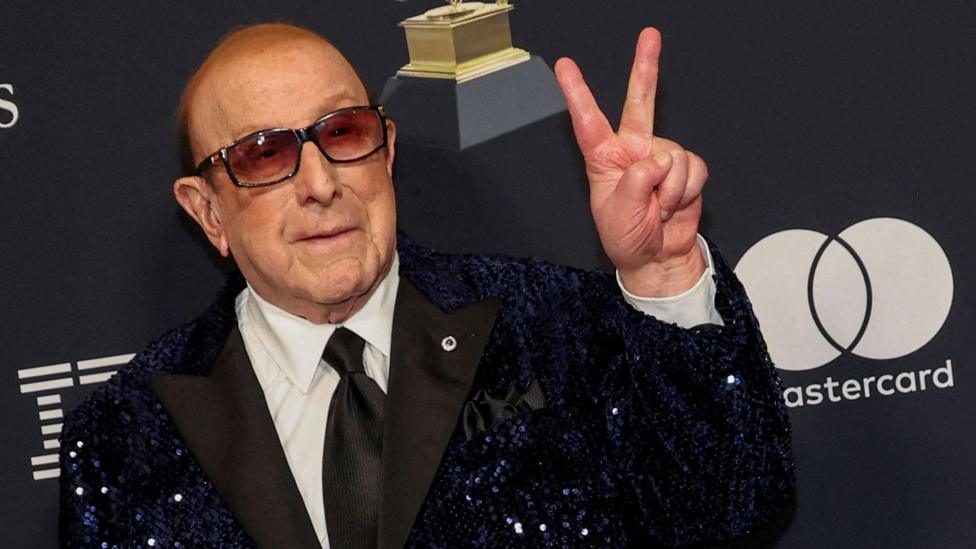
Clive Davis, music mogul behind Whitney Houston and Bruce Springsteen, dies aged 94
The record company executive also worked with Billy Joel, Pink Floyd, Alicia Keys and Aerosmith.
Clive Davis, one of the most influential music executives in the history of rock and pop, has died at the age of 94.
A former head of Columbia and Arista Records, he signed and shaped the careers of artists including Aretha Franklin, Bruce Springsteen, Billy Joel, Whitney Houston, Santana, Janis Joplin, Christina Aguilera, Alicia Keys and many others.
He had recently been in hospital with respiratory problems and was recovering at home in Manhattan, New York, when he died, his family said.
"To the world, our father was the iconic music legend whose vision, instincts, and relentless pursuit of excellence shaped the soundtrack of countless lives," they said in a statement.
"He discovered, mentored, and championed the greatest artists in modern music history, leaving an indelible mark on culture that will endure for generations.
"To his family, Clive was Dad and Granddaddy, the steady presence at the centre of our lives, the source of wisdom, strength, encouragement, and unconditional love."
In a post on Instagram , the Born in the USA singer said that he was mourning the death of "the great record man" and a "close friend".
"At 22 years old, he changed my life when he signed me to Columbia Records," Springsteen wrote. "He treated me with the same respect and kindness as a 22-year-old nobody as he did after all my success. A great man."
Another former client and rock iconoclast Patti Smith also posted on Instagram following news of his death.
"Thanking Clive Davis for transforming music, and on a very personal note, for believing in me, shepherding my efforts and a half century of your love and support."
Born in Brooklyn on 4 April, 1932, he grew up in the Crown Heights neighbourhood.
Davis used that knowledge to help defeat a federal antitrust suit over Columbia's mail-order record club; and successfully persuaded Bob Dylan to remain with the label, after his original deal became void when the singer turned 21.
He was promoted to vice-president of the record label in 1965 and shortly after became president. Among the acts he signed were Santana, Aerosmith, Pink Floyd and Springsteen, giving the label a new lease of life.
"I didn't necessarily have an ear, but I think I developed one," he later said.
"Whether there was a natural ear that was triggered, I don't know the answer to that. But when you see a Joplin or a Springsteen, you know."
Davis had a reputation for supporting artists, but his decisions could sometimes ruffle feathers.
After a playback for Simon and Garfunkel's fifth album in 1970, he told the "aghast" artists that Cecilia shouldn't be the first single.
"I felt Cecilia would be a hit but Bridge [Over Troubled Water] was something more," he later told Simon's biographer Robert Hilburn.
"Yes, it was a ballad; yes, it was lengthy," he added, in a separate interview with the New York Times.
"But you've got to know when you have a home run. You can't play everything by the rules."
Two years later, he provided invaluable career advice to Bruce Springsteen, who had recently signed to Columbia for the princely sum of $25,000.
Watching the musician perform an early showcase, Davis noted that he rarely stepped away from the microphone, and offered a suggestion.
"I said, 'Don't do it if it's not natural for you, but I know that the potential of the songs would lend itself to more physical movement on your part,'" Davis later recalled to People magazine.
A couple of weeks later, he went back to watch Springsteen at a club in Greenwhich.
"I was flabbergasted," he said. "He jumped on every table... He was a whirling dervish.
"It was not just the movement, it was the spirit of it. It was electrifying."
"I got to the dressing room. I remember opening the door and him looking up saying, 'Clive, did I move around enough for you tonight?'"
Despite the success, he was ousted from Columbia when the company accused him of using company funds to pay for personal expenses, including his son's bar mitzvah.
Davis was charged with six counts of tax evasion. He pleaded guilty on one count and was otherwise exonerated.
Within months, Davis had set up his own label, Arista. He immediately achieved commercial success by signing Barry Manilow; and critical acclaim for releasing Patti Smith's influential debut album, Horses.
That midas touch continued throughout his career - but it was often fuelled by hard work.
Davis signed Whitney Houston in 1983, when she was just 19 years old, then spent years hunting for producers and writers who could make the most of her voice.
When her self-titled debut album was finally released in 1985, it contained three US number one singles - Saving All My Love for You, How Will I Know and Greatest Love of All.
According to Sony, it sold more than 25 million copies worldwide.
His instincts paid off again, when Houston released her cover of Dolly Parton's I Will Always Love You.
Davis insisted that the song should start with a 40-second a capella, against the wishes of producer David Foster, who worried the decision would harm its chances of radio play.
It subsequently became her biggest-selling song, topping the US singles chart for 14 weeks and the UK chart for another 10.
Houston remained close with Davis throughout her life, and the mogul said he had attempted an intervention after she took a non-fatal overdose in 1997.
Stanley Tucci played Davis in the 2022 Houston biopic I Wanna Dance With Somebody.
Although Davis once admitted that he'd ''never get rap music", Arista made inroads into hip-hop and urban music, thanks to a deal with producers Babyface and LA Reid, who brought acts like Outkast, Usher and TLC to the offshoot label LaFace Records.