Tanks vs. drones battle exposes lie in Russia’s map of territorial gains, as Ukraine once again bombs Yandex data centres (Ukraine Battlefield update, day 1,691)
Drones are now deciding who survives on the battlefield — and even which side's maps or propaganda can still be believed.
They looked like Russian “porcupines” and fought where the Kremlin considers Russian rear territory. They were protected by their own drone. Both the Russian and Ukrainian armies are continuing their efforts to return tanks and combat vehicles to the battlefield.
Russia recently attacked near Dobropillia with tanks fitted with upgraded Arena-M active protection systems.
The system itself proved effective, but was ultimately unable to withstand the flood of drones, and the attack ended in defeat and the destruction of the tanks deployed.
Last week, we also wrote about a successful operation by Ukrainian tanks from the 475th Assault Regiment.
And the same Ukrainian unit, also known as CODE 9.2, demonstrated a new use of heavy armoured equipment over the weekend.
Compared with the first case, this one revealed an important detail about the operation of accompanying drones and, thanks to geolocation, can also be used to verify the accuracy of Russian maps.
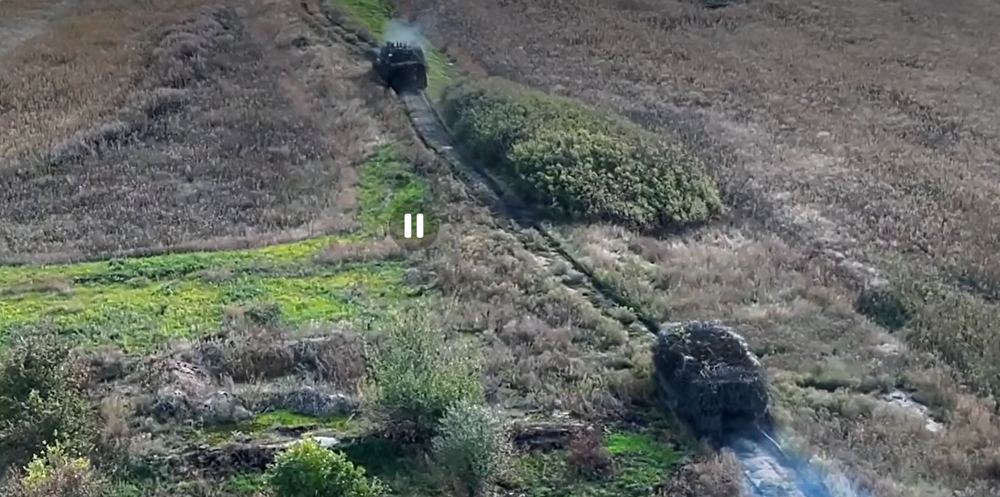
The battle took place in the Kharkiv region and involved a US-made Bradley combat vehicle as well as a tank. According to one source, it was an Abrams of Australian origin, although the appearance of its gun barrel does not suggest this.
In a video released by the unit, the Bradley advances first towards Russian positions and begins laying down covering fire. The tank joins it later, firing directly at the target.
While the Bradley’s turret has retained its mobility, the tank has effectively become an assault gun of the type known from the Second World War.
Its turret does not appear to be capable of moving, and the crew must aim the entire tank at the target. This reduces the effectiveness and speed of firing, while increasing its chances of survival.
A tank modified in this way is virtually indistinguishable from similar Russian adaptations. What distinguishes these attempts is, once again, the involvement of accompanying drones.
Aside from the heavy Vampire, first seen at 1:30, this primarily includes an FPV drone which, at 1:58, neutralises in an aerial duel the same type of Russian weapon that had attempted to strike the tank.
This is another example of how heavy equipment must be accompanied by drones at this stage of the war if it is to remain combat-capable.
Despite air support, another drone strikes it at 2:16, after another had narrowly missed earlier. The tank remained mobile and withdrew successfully.
Beyond the operation itself, its location is also noteworthy: near the village of Anishchyne in the north-eastern part of the Kharkiv region, on the axis Russia calls the Velykyi Burluk direction.
The Ukrainian Telegram account Petrenko, which also provided the map below, precisely identified the site of the battle.
“The video reveals a discrepancy between reality and Russian claims of an alleged massive advance, the encirclement of Ukrainian units and the capture of more than 65 settlements,” the author wrote.
He noted that both vehicles operated in territory that most Russian maps mark in red, as a “Russian” zone.
This is the same area about which we have written repeatedly. For comparison, below is a map by the Russian state agency Ria Novosti. The village of Anishchyne does not appear on it, but the settlement of Vilkhuvatka, Olkhovatka in Russian, serves as a reference point in the centre-right.
The tank and Bradley were fighting around five km north of a location that Russia marks as securely captured.
Drones also struck Yandex’s third data centre. Graphs circulated online, particularly on Sunday, suggesting that Ukrainian attacks on Russia’s largest internet provider had restricted the operations of Russian bots around the world.
However, this has not yet been objectively proven. Russia has indeed reported outages affecting various internet-based services after each attack, but that is so far the only confirmed effect.
On this occasion, French analyst Clément Molin pointed out that the Russian Varyag drone brigade had attacked data centres in Ukraine in recent weeks and had boasted, among other things, of damaging Kyivstar, Ukraine’s largest operator.
The situation has now been reversed, as it was previously with attacks on ships and warehouses. This time, however, to Russia’s disadvantage.
Russia 🇷🇺 bombed multiple data centers in Kyiv, Dnipro or Odesa these last few weeks and proudly showed footage about it Now, Ukraine is bombing Yandex data centers and causing much more harm to Russia than Russia did to Ukraine. This is another example of symmetrical war. In… pic.twitter.com/yAXzcUN3FQ
The first centre hit was in Sasovo, in the Ryazan region, followed by a second in Kaluga, in the Kaluga region. On Sunday, the third of Yandex’s four largest centres was struck, this time in Vladimir, in the Vladimir region.
“This complex houses one of the company’s Galushkin supercomputers, which is among the most powerful in Russia,” Kommersant wrote , adding that the facility had been taken out of service, affecting 10 core Yandex services, including its email service.
The situation is serious enough that, according to digital development minister Maksut Shadayev , “Yandex is facing an unprecedented attack on its data centres”.
The defence ministry is also working on the issue in an effort to protect the company’s remaining facilities. Citing its sources, Kommersant said replacing the damaged capacity could take up to six months.
The battle for Dobropillia on a new type of map. As the war evolves, so do the ways it is mapped. This Ukrainian OSINT profile, for example, has depicted the fighting for the important Donbas town, which protects the Sloviansk-Kramatorsk agglomeration from the south-west, on a dynamic map.
Among other things, it shows that Russian forces are infiltrating the town through the village of Hanivka from the Nove Shakhove area.
Mashovets Dobropillia Russia wants Kramatorsk, to the north-east. Its strongest attack here heads west, into Dobropillia: up to 40 men a day along the Byk river. If Dobropillia and Druzhkivka hold to late December, Russia would have to replan the offensive. pic.twitter.com/OXg8F1WYXy
For a clearer picture, we are also including a static DeepStateUA map , as the previous one is rotated and does not follow the usual compass orientation.
The two maps are rotated by around 90 degrees in relation to each other. On the following one, Dobropillia is in the centre-left. Nove Shakhove, from where Russian infiltrators are advancing, is almost at the centre, exactly 10 km to the east as the crow flies. A small arrow directly next to the settlement’s name indicates the direction of Russian attacks.
The green area in the upper part of the map is the so-called Dobropillia salient, which was fought over a year ago.
Russia reported nothing significant concerning Dobropillia after the weekend. “On the Dobropillia axis, our forces continue to push forward, but Ukrainian units retain the ability to counterattack. Heavy fighting is under way,” the Two Majors wrote , for example.
The Ukrainian Telegram channel Petrenko published a map over the weekend showing sites of new infiltrations. Its interpretation differs considerably from DeepStateUA’s version. Russian forces are shown closer to the town, but the direction of their advance is the same as in the two previous sources.
The sites of the recorded incursions were established on the basis of videos showing drones killing Russian soldiers attempting to advance further west.
Storm Shadow missiles caused the largest single massacre of senior Russian officers in August. On Friday (9 October), a joint project by Russian exile newspaper Meduza and the BBC’s Russian service added another 17,124 names to its list of Russian war casualties. This was the number it had counted since 21 September. In total, 276,113 Russian soldiers killed in the war are now known by name.
On the same day, the project’s authors published a detailed analysis of events in Donetsk on 26 August. The Ukrainian air force had attacked a building in Donetsk with Storm Shadow/SCALP-EG missiles.