Mangroves and mud: Inside the Army jungle school’s notorious ‘Green Mile’
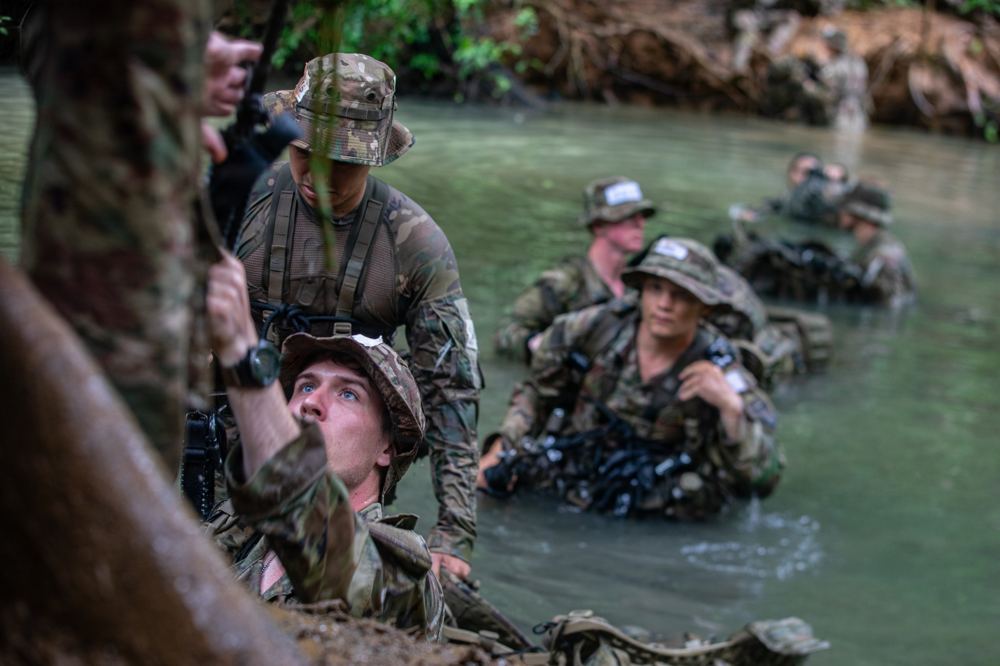
Soldiers slog through punishing terrain in the Green Mile, the grueling finale of the Army's jungle school in Panama.
Aeronaval Base Cristóbal Colón, Panama, A howler monkey looked down from his perch atop the lush canopy before unleashing a bellow so guttural that it seemed to temporarily swallow up the jungle’s hum.
To his likely irritation, hordes of uniformed soldiers had gathered beneath the petite primate, filling his muddy underbrush with the heaving sound of heavy rucksacks and the smell of body odor that had been brewing in the moist terrain for days.
The soldiers, some wearing days-old green face paint, had congregated amongst the moist fauna to complete their final task in the U.S. Army’s Jungle Operations Training Course in Panama: The Green Mile.
The notorious event, in the thick of Panama’s “Green Hell”, is the 18-day course’s culminating exercise, testing participants’ newly learned jungle maneuver techniques, survival measures and fighting skills.
By that point in the course, the soldiers had run a days-long jungle reconnaissance and attack operation. That portion of the field exercise was complete, and perhaps to the howler monkey’s dismay, so were the soldiers’ attempts to stay quiet.
The course in 2025 returned to Panama at Base Aeronaval Cristóbal Colón, formerly known as the U.S. Army’s Fort Sherman, decades after it was originally shuttered.
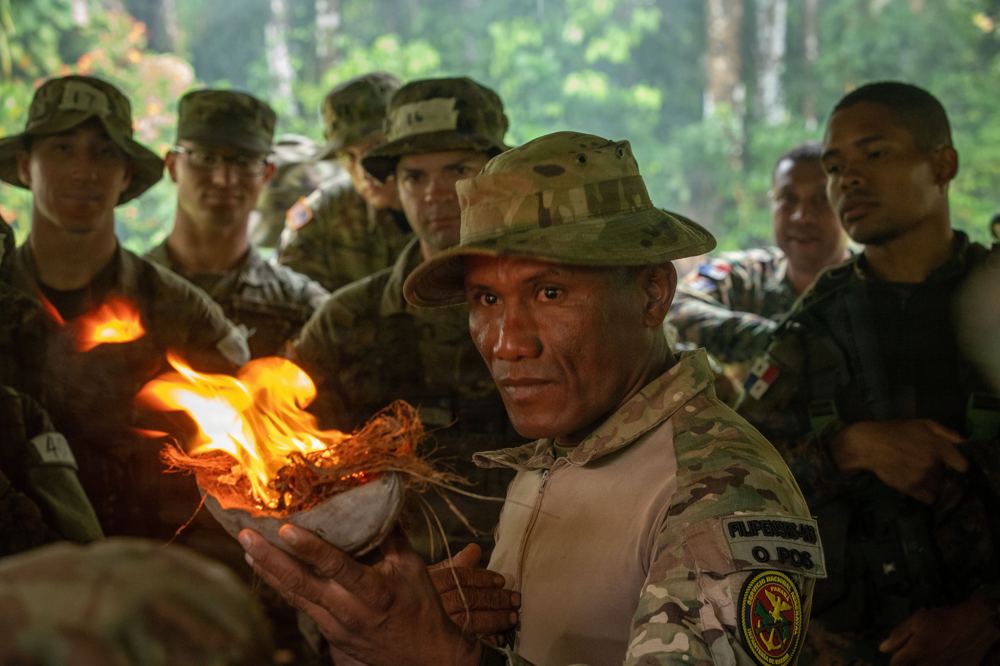
The new course is a joint U.S.-Panamanian partnership, with Panamanian instructors leading lessons on jungle survival.
With staggered start times, each squad took off running down a soggy, uneven path. Squads in the September course had participants from across the U.S. force, including those from the Army, Marine Corps and Space Force.
Some squads had Panamanian soldiers. Other countries, such as Colombia, have expressed interest in sending soldiers in the near future.
In classes with Panamanian students, instruction is given in English and Spanish. When the course is English-only, the duration shrinks to 12 days, but without partners, officials say U.S. students can miss out on opportunities to connect with other forces.
Spc. Duncan Vaupel, a member of September’s jungle school course, said he talked with and learned from Panamanian troops who described treating soldiers who had lost legs and fighting gun battles in the jungle that stretched into the night.
“These guys not only teach it, but they live and breathe it, too,” he said.
The squad’s first major Green Mile task was to carry some of the service members’ rucks in a litter made from whatever they could find. Logs or long branches coupled with issued wet weather equipment, a poncho, did the trick.
During the course, participants are provided instructions on jungle first aid. They also practice with medical evacuation helicopters, transporting a casualty to some sliver of open sky where a medical team can send a rappel line down to hoist the injured soldier up. Jungle landing zones are few and far between.
Sgt. 1st Class Timothy Reeves, a combat medic and an instructor at the school, said that heat injuries are common because of the oppressive humidity and temperature.
Animal-related injuries are also widespread, he said. Wild, territorial bees are sensitive to loud noises and will defend their hives by attacking the camouflaged intruders.
“We do have wild bees down here that tend to get a lot of the students as they move throughout the jungle,” Reeves said. “I know we’ve had to evac a handful of students before to the aid station for bee stings, scorpion stings and a variety of insect bites.”
Once the section of muddy pathway came to an end, there was the sea to deal with.
Muddy boot after muddy boot sank into the swirling sand beneath unforgiving waves. Soldiers were instructed to file one behind the other, sometimes sinking waist-deep into the water as they skirted rocky outgrowths and navigated dense mangroves.
Fewer troop formations work in a jungle environment, said Lt. Col. Andrew Eagan, who oversees the Jungle Operations Training Center. Wedge formations, for example, do not work, he said.
“Here you fight in a column, you fight in a line, and the reason for that is the environment,” Eagan said. “The environment is so punishing.”
When the Green Mile took the service members back inland, the soldiers traded the wet coastline for brutal terrain.
Their next challenge? A hill so steep that it required crawling on hands and knees. With a grade impossible to climb with waterlogged rucks, the scrappier soldiers scaled ahead, breathlessly anchoring a rope bridge from the top so other soldiers could cling to it as they ascended while lugging the squad’s wet gear.
Soldiers slipped, ripping pants and filling scraggly fingernails with brown mud. Weapons became caked with slippery earth as they reached the peak.
During Eagen’s interview, he said Panama’s environment was the part of jungle school that U.S. students underestimated most. During The Green Mile, the true magnitude of the jungle’s hazards was revealed, relentlessly.
There was no walking down the other side of the hill, for instance. Course participants scooted or slid down on their rears, praying that their nether regions would not cross the path of a black palm, one of the treacherous plants students learn about in the jungle, in addition to the school’s flora and fauna blocks of instruction.
With pointy spikes that can reach up to 8 inches long, flaring from every inch of its trunk, soft flesh is no match for nature’s black needles.
Other plants, students learn, are edible and can help them survive in such harsh environs. Some of nature’s bounty, however, keeps the jungle students’ digestive systems unusually active.
2nd Sgt. Rubén Rodríguez, a Panamanian instructor for the course, said American students are often particularly hungry. They love to pick and eat coconuts for extra nourishment, he said.
Though delicious and healthy in moderation, coconuts can be laxatives in large quantities. The Americans’ frequent snacks, Rodríguez said, send them straight to the jungle bathroom.
As the troops progressed through the course, lanewalkers added full water jugs and ammo cans to soldiers’ loads. The extra weight pushed boots even deeper into the muddy ground.
Red-faced and exhausted, the squad hoisted the extra weight over and under the first leg of an obstacle course that represents the final, brutal stretch of the Green Mile.
The squad dragged themselves, and their equipment, through sticky, brown goop as they low-crawled beneath barbed wire. Soldiers tossed gear over a high wall before hurling their own bodies over after the dumped equipment.
Before the finish line, the squad trekked up another uneven hill, even more slowly than any hill they had summited before.
Once they hit concrete, and the familiar terrain near the schoolhouse’s campus, the jungle-battered squad had just minutes to sprint the last stretch of what was actually a four-plus-mile endeavor.
The instructors imposed a time cap on the event (because what is Army training without the addition of some artificial stress?).
As the afternoon sun beat down on the squad, the sprint slowed to a heavy shuffle.
One participant, who had been carrying extra weight, stifled a gag as he trod onwards.
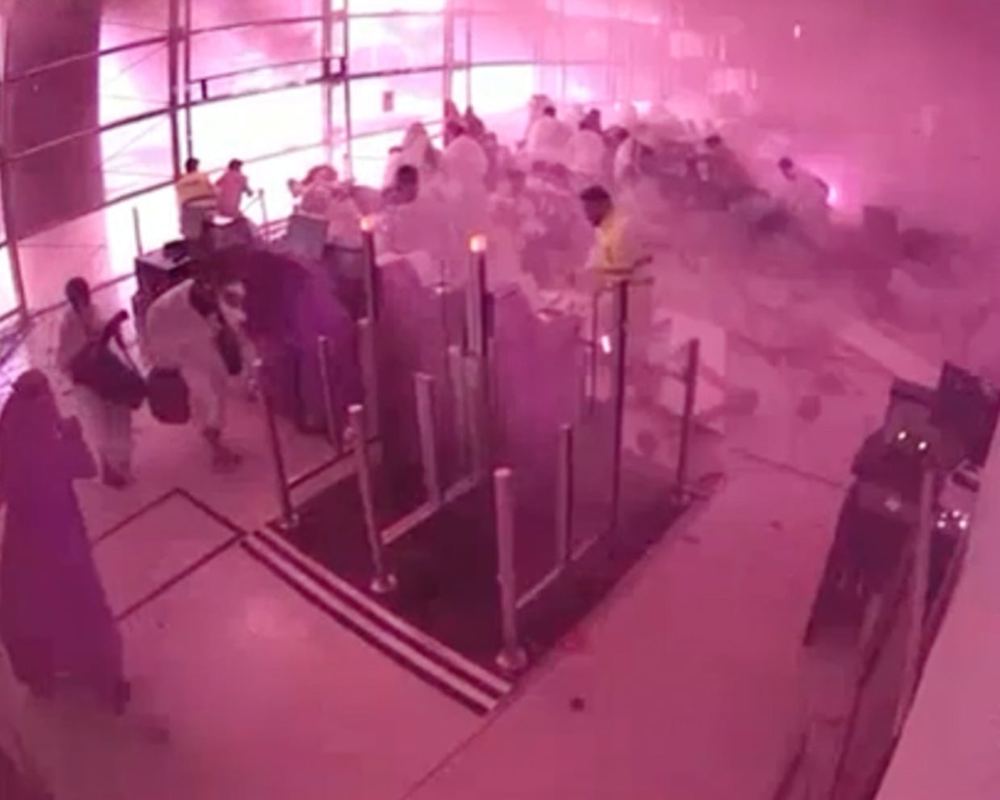
In a haze of instructor-cracked purple smoke, the squad finished, collapsing in a heap under the shade of a cluster of trees.
Some soldiers emptied the water jugs over each other’s heads. Others lay spread-eagled in a lukewarm puddle of mud.