After struggles v Spain, the USWNT’s midfield puzzle won’t be easily solved
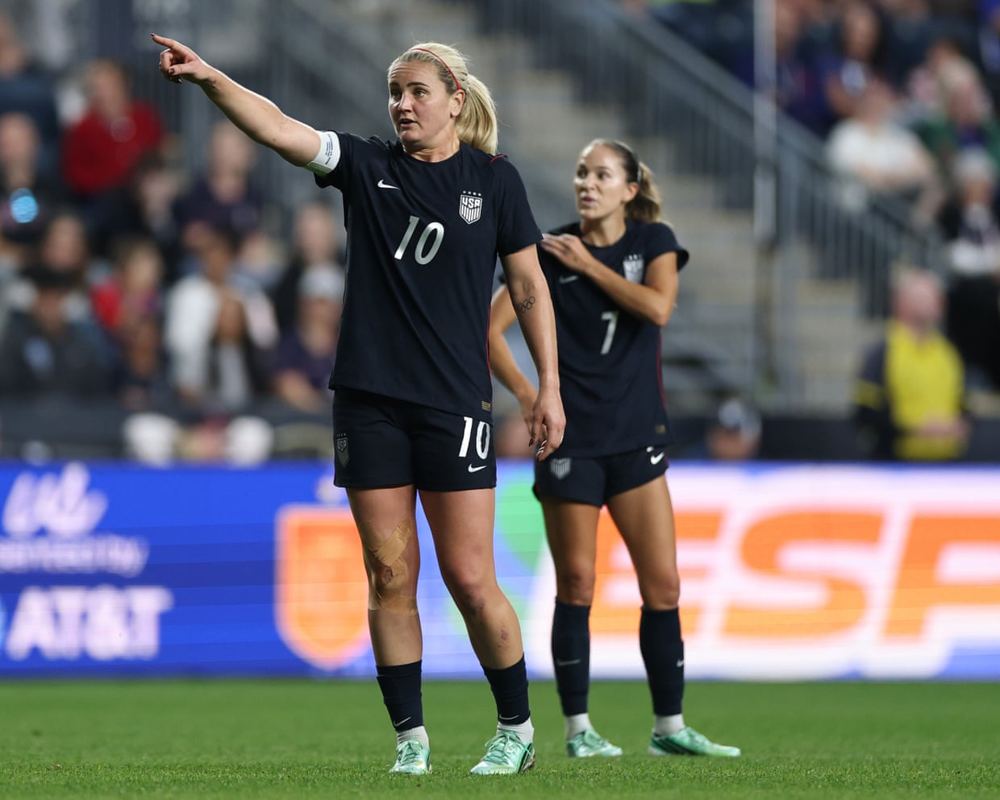
The lack of cohesion in the center of the park is evident for the US, with Emma Hayes continuing to try different combinations The discourse around the US women’s national team may have been a harsh one if not for a fourth-half surge against Spain. In the latest of their back-to-back bookings, where Emma Hayes’ team plays the same opponent twice, Spain looked far more confident and effective than the four-time champions. Both teams were missing a handful of crucial players; Naomi Girma and Sam Coffey headlining the US’s absentees, while Aitana Bonmatí, Mariona Caldentey and Clàudia Pina were a
The lack of cohesion in the center of the park is evident for the US, with Emma Hayes continuing to try different combinations
The discourse around the US women’s national team may have been a harsh one if not for a fourth-half surge against Spain.
In the latest of their back-to-back bookings, where Emma Hayes’ team plays the same opponent twice, Spain looked far more confident and effective than the four-time champions. Both teams were missing a handful of crucial players; Naomi Girma and Sam Coffey headlining the US’s absentees, while Aitana Bonmatí, Mariona Caldentey and Clàudia Pina were among Spain’s.
Nonetheless, Spain controlled the game and forced the US to settle for scraps in the final third. The first game saw Spain rush to a 2-0 lead inside 15 minutes and maintain that margin for the rest of the match. On Tuesday, the US once again entered half-time facing an identical deficit.
It wasn’t until Hayes made five changes in unison that they regained a foothold in the latter match and clawed back two goals from direct, incisive attacks. That’s hardly a title-winning blueprint, and not just because a World Cup limits teams to five substitutions instead of the eight the teams agreed to for these games.
This month, Spain’s alternates slotted into the lineup and executed the game model because of holistic familiarity. Each player understood what their role was after meticulous refinement, and the team around them continued to operate as expected as a result. This kind of synergy can be enough to beat a more talented team, and long gone are the days where the United States can expect to beat another top women’s national team on talent alone.
Hayes has not, at any point, implied otherwise. And so, her staff has been immensely thorough in working towards building the best 26-player roster they can.
This year, like 2025, was a year of deep talent evaluation. The October window saw four players included without previous caps, as well as returns to the pitch for longtime absentees Mallory Swanson and Ashley Sanchez, whose goals earned the US their draw on Tuesday. Kate Del Fava and Pietra Tordin became the 33rd and 34th players to debut since Hayes assumed her post in mid-2024. The efforts have made the pool deeper, but the duration and density of this search may be coming at the cost of that crucial synergy.
A well-organized midfield is borderline mandatory to win a World Cup. Spain dominated in 2023 with awe-inspiring play in the heart of the park. So, too, did the United States during their successful repeat bid in 2019. Megan Rapinoe and Alex Morgan’s exploits were made possible by one of the most balanced midfield trios in recent memory: Sam Mewis as an ideal all-around central midfielder, Julie Ertz as a hard-nosed defensive midfielder and Rose Lavelle’s facilitation to link with the attack.
After injuries forced Mewis into an early retirement and Ertz called time on her career after 2023, Hayes has had the tall task of crafting a worthy sequel. Her best Chelsea sides were built with midfielders whose technical acumen were bolstered by their tireless commitment to tracking back and pressing. Consistently doing so requires second-nature understanding of your teammates and how they operate, on the ball and especially without it. That synergy can’t be rushed, and Hayes tried giving herself a deadline of sorts to begin doing that work.
“I want to get to the end of June where I have a really strong sense of a core group of players that will form part of the build towards the World Cup,” Hayes told CBS , “but also know that we need to get some consistency in relationships, connections on the pitch, and we have to forego that for now while we’re still evaluating players at an individual level.”
That stated aim came before the April friendly window in 2025, hoping to pave a two-year runway to refine partnerships before the big games in Brazil. Injuries can partly be to blame for the delay, and more recent first-time call-ups (like this window’s) have been made with an eye toward the 2028 Olympics . But the US still sufferers from a specific lack of clarity in the middle of the park.
Tuesday’s friendly was the United States’ 27th match since the start of 2025, and seven midfielders have made at least three starting lineups in this span. Coffey and Claire Hutton have been the preferred defensive midfielders; Lindsey Heaps, Lily Yohannes, and the injured Olivia Moultrie as central midfielders; and Rose Lavelle and Jaedyn Shaw in attacking midfield. Heaps has regularly floated between all three roles, the only player to start in each spot. While six of her 12 starts have come as the more all-around No 8, her other six have been evenly split between defensive midfield and attacking midfield.
Despite this consistency of personnel, Hayes has used 17 different combinations of three midfielders in that span. Tuesday was just the second time that Hutton, Heaps, and Lavelle opened a match together. The consensus “first-choice” trio of Coffey, Heaps and Lavelle has also started together just twice in 20 months. The most common combination has been Lavelle playing in front of a Coffey-Hutton double pivot on four occasions.
Unfortunately, testing either of those trios against Spain was impossible once Coffey withdrew from camp with an injured left ankle. The perceived drawbacks of that setup is that both Coffey and Hutton thrive in more withdrawn deployment, which can increase gaps between the defensive block and the attack. It’s possible that the full-backs (Emily Fox on the right and, increasingly often, Gisele Thompson on the left) can provide enough progression to mitigate for that, but it’s why that No 8 role is still one Hayes wants to incorporate.
It’s also a factor that makes Moultrie’s torn ACL in August even more impactful. While Heaps remains Hayes’s captain and Yohannes has earned regular starts with her improving skill set, Moultrie was arguably the most natural complement to Coffey , alongside whom she partnered in Portland for four seasons. And yet, she made just three starts since January 2025, and none alongside Coffey.
Injuries are impartial and no individual can be assumed to arrive to World Cup camp at peak health. But continuous recalibration in midfield, for reasons of circumstance and experimentation alike, and a corresponding lack of system clarity in all phases threatens to keep a viable contender from maximizing its potential against fellow heavyweights like Spain.