How Slovakia’s Fico became Putin’s top ally inside the EU
A Putin-friendly Slovakia aims to use its V4 presidency to push back against EU emissions-trading rules at this week's summit.
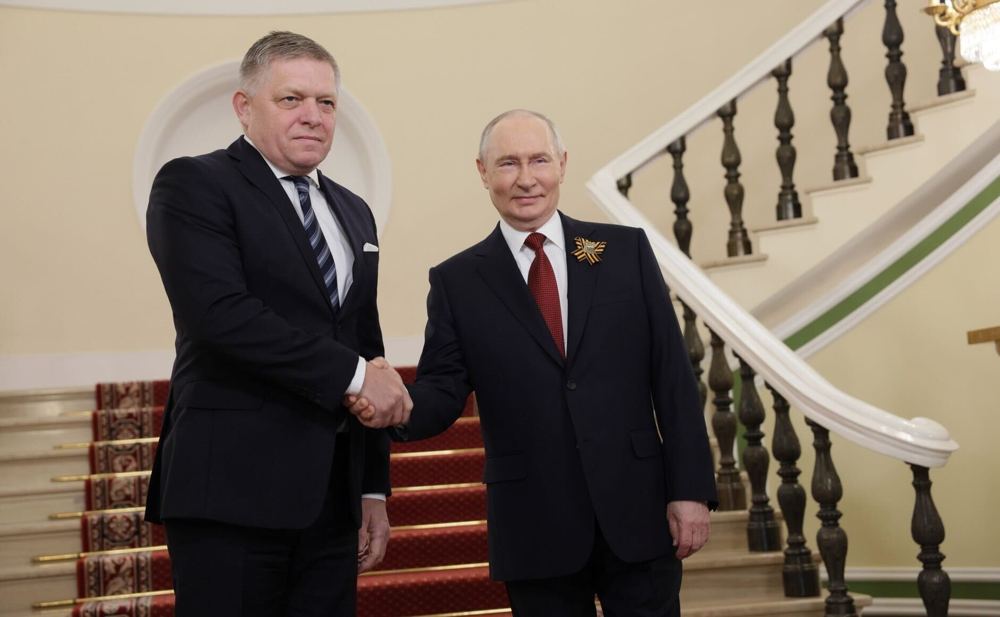
Slovak prime minister Robert Fico appears to have become Russia’s most prominent ally in the European Union, following the demise of Hungary’s pro-Kremlin leader.
Juraj Blanár, Slovakia’s foreign minister, announced controversial plans to revive a joint committee with Russia back in August, just a day before the anniversary of the Soviets occupying Czechoslovakia in 1968.
His announcement also came before Fico headed off to meet his counterparts at a summit in Brussels on Thursday (15 October).
And “so that there are no surprises, on the 25th [of October] there will … be a meeting of the joint economic commission with the Russian Federation,” Fico told the European affairs committee in Slovakia’s parliament on Wednesday.
The central European leader announced the closer ties with his aggressive neighbour immediately after planning a trip to Lviv in Ukraine early next month.
But if Fico does actually go to Lviv, just over the border from Poland, it would be the deepest he has travelled in the war-torn country so far.
And while he has not visited Kyiv in three years since returning to power, Fico has made plenty of time to go to Moscow during this time.
Many factors point to Slovakia now openly supporting the Kremlin, even as Russian attacks on Ukrainian civilians intensify, killing dozens of people.
The Institute for European Security Studies (IESS), a Kyiv-based think tank, noted, in its analysis , that a recent statement by Slovak defence minister Robert Kaliňák did not consider Russia a threat, despite Russian intelligence services having been linked to attacks in Slovakia including, potentially, a drone attack on a manufacturer near Prešov.
The IESS also highlighted the renewed Slovak-Russian cooperation at the level of military attachés, with two Slovak military personnel sent to the Russian capital while a Russian officer went to Bratislava.
This swap of soldiers was promised by Fico to Putin when they met in the Kremlin on 9 May.
And to make matters worse, a Russian military attaché was captured on video handing cash to an associate of the Slovak fake news site Hlavné správy.
The Ukraine think-tank warned that Slovakia's magnetism towards Russia should not be ignored.
“In the end, by lowering Nato's guard and reopening the doors to Russian intelligence, Slovakia is doing exactly what Moscow needs: disabling the West's defences from the inside out,” it said.
Meanwhile, a Russian government file dated 10 September set the date of the Russian-Slovak government meeting for 26 to 27 October.
The document, obtained by Politico, says the meeting will cover Russian oil and gas, nuclear fuel, and the treatment of Russian athletes.
The Slovak foreign ministry responded to the report by recalling Blanár's statement on 20 August, where he said: “The Slovak government’s foreign policy is consistent, we pursue a policy in all directions and maintain dialogue with all countries interested in pragmatic cooperation with us for the benefit of the national and state interests of the Slovak Republic, the Slovak economy and Slovak citizens, and we will continue to do so.”
Beyond any historical parallel with the anniversary of the occupation of Czechoslovakia, the Russia-meeting announcement came on a day when Russians killed 13 people in Ukraine.
Slovakia has opposed the phase-out of Russian gas imports into the EU and asked for gas supplies to be discussed at the upcoming Moscow meeting.
The Russian document’s authenticity showing all of this could not be verified, but it had the tell-tale signs of an authentic Russian government file.
According to the text, Slovak representatives also stressed the importance of continued supplies of Russian oil through the Druzhba pipeline and welcomed regular deliveries of nuclear fuel for Slovakia's Bohunice and Mochovce power plants.
When Fico met the Russian president in Moscow on 9 May, Vladimir Putin said Russia would do everything possible to meet Slovakia’s energy needs.
The Kremlin’s efforts to forge closer ties with Fico show how Moscow uses energy supplies to draw individual EU countries away from a united position on Ukraine.
But it remains to be seen if Moscow can deliver on all its energy promises to Bratislava.
US president Donald Trump, who faces mid-term elections in November, recently agreed with Putin on supplies of Russian diesel fuel to the US and global markets, which would lower fuel prices.
This agreement could bring Moscow billions of dollars, while also undermining efforts to maintain a united Western stance against the Kremlin.
But at the same time, Ukraine is intensifying drone attacks on Russian refineries, in an effort to disrupt fuel supplies and reduce the income Moscow uses to finance its war effort.
Kyiv has said that its attacks have already taken 51 percent of Russia’s oil-refining capacity offline.
Also according to the leaked Russian file, the agenda of the Slovak-Russian commission meeting goes beyond energy.
Both sides plan to explore establishing working groups on culture, tourism, agriculture, and environmental protection, and to discuss the status of the Russian-government operated Russian Centre for Science and Culture in Bratislava.
The Russian ministry also recorded Blanár’s opposition to what the document described as discrimination against Russian athletes in international competitions, which was to be discussed at the intergovernmental commission meeting.
In July, the International Olympic Committee lifted the suspension of the Russian Olympic Committee’s membership and said its previous recommendations limiting the participation of Russian athletes no longer applied.
In August, the World Archery Federation lifted restrictions on Russian athletes and officials.
And Fifa president Gianni Infantino has called for Russia to be allowed to return to international football.
Fico’s last visit to Moscow, on 9 May, was to meet Putin on the occasion of WW2 Victory Day celebrations.
And his overtures to the Russian leader follow Viktor Orbán’s defeat in Hungary’s April election, as a result of which Putin lost one of his closest partners in Europe.
Several months before Orbán lost the election to Péter Magyar, he had also revived a Russian-Hungarian intergovernmental panel for economic cooperation, which had been suspended for several years after Russia's 2022 invasion of Ukraine.
Magyar’s government has not confirmed whether the commission will meet next year.
Moscow and Budapest - still led by Orbán at the time - had agreed in December 2025 on a 12-point plan to expand cooperation in areas such as energy, trade, and culture.
The blueprint was signed in Moscow in December, following talks between Hungary’s then foreign minister Péter Szijjártó and Russian health minister Mikhail Murashko.