In pictures: boundary-pushing works in Frieze London’s Focus section
Our pick of the works from the fair’s section dedicated to solo presentations by young galleries
As is so often the case, the Focus section, for solo stands by galleries that are less than 12 years old, is the most vibrant and dynamic section at this year’s Frieze London. Where risk seems somewhat absent elsewhere, Focus retains the capacity for surprise and discovery, and the six stands that have been selected here reflect the section’s material and intellectual breadth.
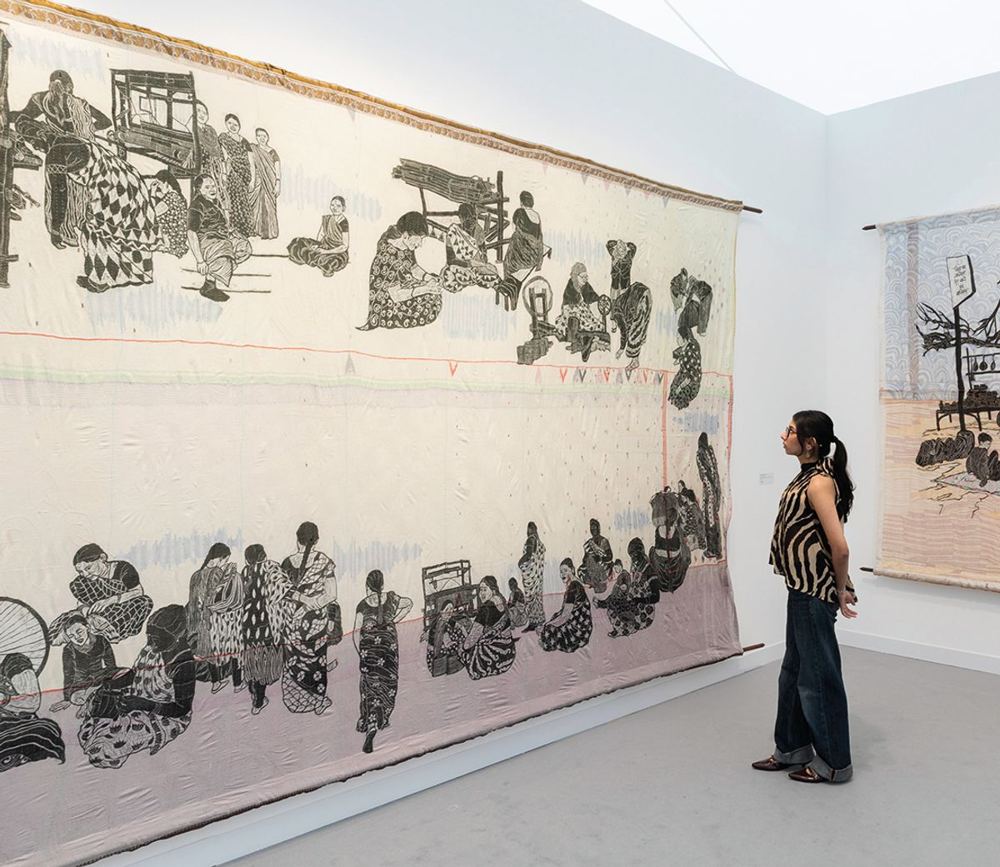
Through large textile pieces and a group of woodcut prints, Chatterjee, who is based in Bengaluru but grew up in West Bengal, explores women’s labour both in the materials she uses and in her imagery. Chatterjee combines the printmaking in which she trained with a traditional but now disappearing quilting technique called nakshi kantha . She prints her figurative designs depicting women at work (including on textile production) onto used saris owned by the people she depicts. Chatterjee’s work also documents the women’s lives through photography and audio, and in the midst of The Infinite Weft (2026) what initially appear to be decorative patterns suddenly come into focus as waveforms: evocations of Chatterjee’s conversations with her subjects.
Davis shows three pieces, all of which address the Black body, and how its vulnerabilities are mediated by our social and political environment. He deliberately plays with the loaded materiality and the expressive potential of his medium: welded steel. The centrepiece of the stand is Undertow (2026), a sculpture with triangulated I-beams on wheels, which bear words, “Token gets spent”, and names: Don, Jeff and Sean (Trump, Epstein and Coombs, or P-Diddy). From the wheeled object emerges a chain which is fixed to the wall, its form resembling (for me, at least) a rib-cage. As well as evoking slavery the sculptures also take on broader meanings, resembling fetish objects and reliquaries: in Vesselhood (2026), a penis appears through a rectangular aperture, while Gayer Secrets (2026) is part chastity belt, part sacred heart.
Amanda Moström sources her objects through markets and then repurposes them, via the application of goat hide, for presentation in a more rarefied market: the art fair. Her installation, which will change each day, includes an array of objects transformed by the animal skins from ordinariness, an umbrella, a tissue box, an office chair, into sensuality. In a found photo album a woman poses, often undressed, whether for personal gratification or more complicated motivations. But care is another subject of Moström’s work, and she transforms these humdrum things to a new potency or significance, whose value she tests by placing them in the fair. Her glitter ball, its mirrored tesserae occasionally interrupted by goat-hide swatches, projects a constellation onto the stand’s wall.
Among the creepiest of the stands at this year’s fair, Yuli Serfaty’s installation is called Who’s a Good Girl? . Two sculptures represent a headless hybrid being with multiple breasts, part dog, part human, part digital being. A CGI video at the centre shows a training environment in which the being at first barely functions, before developing agency that allows her to escape the drones that surveil her through tricking the system with glitches. Serfaty’s references are broad and fascinating, everything from feminist technoscience to the sculpture of Louise Bourgeois and the Capitoline Wolf in Rome, and her work here is laden with metaphors for our age, including the climate catastrophe and AI autonomy.
Tom Hardwick-Allan’s multi-part work is intricate in form and meaning. On the wall appears to be a thin cross-section of an ancient tree, actually formed from nine interlocking sections of plywood, whose principal image is a baby in a womb. Up close, though, it teems with imagery that relates to Hardwick-Allan’s cornucopian enquiry: his interest in imprinting (the formation of perception and social understanding) in humans and animals, numerology, alchemy and augury. He thinks of his activities as expanded printmaking, and as if to embody this, he also shows a “staircase”, more like an edifice, of printed matter: his own book collection, wrapped in cloudily translucent glassine paper and manipulated with blobs and stains of oil and iron paste.