Buildings burn and tear gas thrown during French education and cost of living rallies
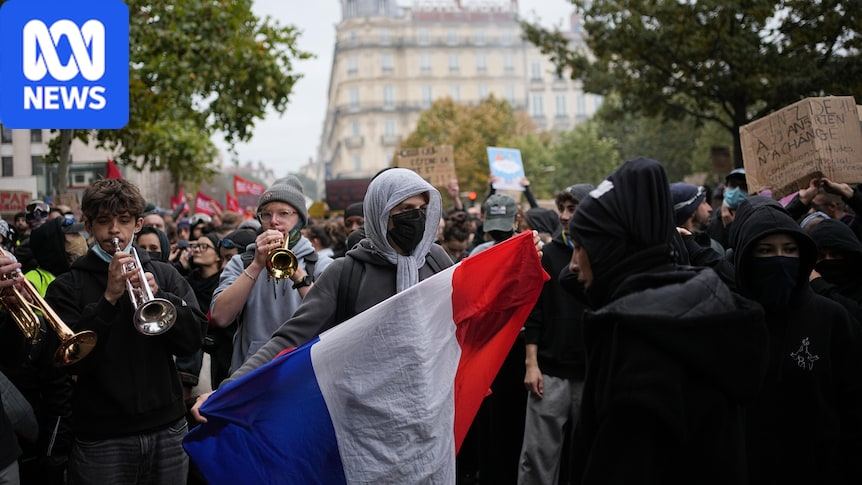
The tourism building in Lyon was set ablaze, and tear gas deployed by police as nationwide rallies over declining public services in France continue.
Protesters have clashed with police across France during continued nationwide rallies over education and the cost of living.
A government building stormed in Marseille had the anarchy symbol spray painted on walls, while buildings were set alight in Limoges and Lyon.
The clashes come in the lead-up to France's presidential election in April next year.
Protesters have clashed with police across France during nationwide rallies over education and the cost of living, as the country heads towards a presidential election.
While hundreds of thousands protested peacefully in street marches in scores of cities, violent fringe groups targeted public buildings, looted luxury boutiques and supermarkets and attacked police vehicles and officers.
President Emmanuel Macron vowed to prosecute and punish people who had performed attacks.
"We will all stand united against the sowers of chaos, who only seek to undermine our institutions and prevent those who peacefully express their demands from doing so," he wrote in a post on X.
French Prime Minister Sebastien Lecornu said the government would not be "intimidated" by violence, and blamed the unrest on the "far-left" and criminals just months before a presidential election next April.
About 1,200 people had been arrested as part of the protests, Mr Lecornu said.
In Paris, police fired a water cannon and tear gas after hundreds of protesters, most wearing face masks and some setting off fireworks, confronted them at several locations on Saturday.
Rioters tried to break into the Galeries Lafayette department store, smashed up banks, ransacked a Lacoste store as well as other boutiques and looted an SFR mobile phone shop.
In Limoges, the City Hall was set ablaze, in Marseille black-clad protesters broke into City Hall and defaced the building with anarchic graffiti and in Lyon protesters torched the city's tourism office.
"We're taking the Bastille," one demonstrator shouted in Marseille as masked protesters rammed the door of the mayor's offices with security barriers.
The cry is a reference to the 1789 storming of a fortress during the French Revolution.
Several then entered the town hall, one spray painting an anarchist "A" symbol on an inside wall, before police intervened.
The protests are piling pressure on Mr Macron's government after weeks of student demonstrations turned violent.
The country's Yellow Vest movement, which staged street protests against the government eight years ago over planned fuel tax hikes, had called for the "yellow and youth" demonstrations.
More than 600 demonstrations were planned across France, according to a website set up by organisers.
One of France's largest trade union centres, CGT, told Agence France-Presse news agency 800,000 people across France had taken part in Saturday's protests.
Interior Minister Laurent Nunez told reporters about 550,000 people had participated in the demonstrations.
Franck, a civil servant in his forties who would not give his surname, was protesting in the central town of Gueret with about 300 people, a quarter of them high school students.
"At the end of the month, I have nothing left. Prices are going up but wages aren't," he said.
There has been public criticism over the police's perceived disproportionate response.
In the western city of Rennes, about 20 people set up a barricade using trash bins and large pallets on the outskirts of a shopping mall.
Christophe, a 47-year-old carpenter and former Yellow Vest protester who did not give his surname, said he was indignant after seeing what he viewed as police brutality against teenagers in recent weeks.
"We've reached the point where the repression is targeting our own children," he told AFP.
The police watchdog is investigating at least two dozen allegations of police violence.
Mr Lecornu said more than 150 police officers had been injured in Saturday's protests, but did not say whether any protesters had been hurt.
About 45 per cent of French people are worried about the cost of living and inflation, according to a survey of 2,000 people published earlier this month.
Purchasing power in France has dwindled since 2024, while the price of fuel has soared since the start of the US-Iran war earlier this year.
The eurozone's second-largest economy is struggling to reign in its public debt, projected next year to reach more than 120 per cent of GDP, which is double the EU limit of 60 per cent.
Economists say significant debt reduction will come only with major reforms, such as sharply curtailing France's generous pension system.
Mr Macron on Friday evening called "for calm and respect", adding the right to protest went hand in hand with "respect for people and property".
France's far-left and far-right parties have both capitalised upon the unrest.
Jean-Luc Melenchon, leader of the far-left France Unbowed party, has backed the student protests and marched in one demonstration.
Marine Le Pen, who leads in opinion polls for the presidential race, has positioned her National Rally party on the side of the police.
Belgium, Portugal and Italy also faced smaller-scale protests on Saturday as living costs rise in Europe, while protesters in Albania again rallied against perceived government corruption, a lack of jobs and poor education standards.