The Experiment review, easily the most disturbing thing on TV
As members of the public tour a fake ‘residential home’ for disabled people riddled with Nazi ideology, you desperately hope someone will speak up. Prepare for the most excruciating viewing of your life I have never had to pause a programme halfway through before to catch my breath. That is until The Experiment – Channel 4’s highly controversial social exercise designed to find out “how susceptible the British public are” to Nazi ideology about disabled people. This is a show so disturbing, timely and surreal that within 90 seconds of viewing it alone, I am looking around for confirmation from
As members of the public tour a fake ‘residential home’ for disabled people riddled with Nazi ideology, you desperately hope someone will speak up. Prepare for the most excruciating viewing of your life
I have never had to pause a programme halfway through before to catch my breath. That is until The Experiment, Channel 4’s highly controversial social exercise designed to find out “how susceptible the British public are” to Nazi ideology about disabled people. This is a show so disturbing, timely and surreal that within 90 seconds of viewing it alone, I am looking around for confirmation from an empty room that any of this is happening.
We start with a clip of Hitler. Against a backdrop of growing anti-benefits and ableist rhetoric, presenters Mat Fraser and Sophie Morgan fear the disabled community globally are once again being framed as a financial burden. Their question is: can the British public be persuaded that disabled people should live in “money saving” segregated institutions and be given low-skilled jobs to be productive?
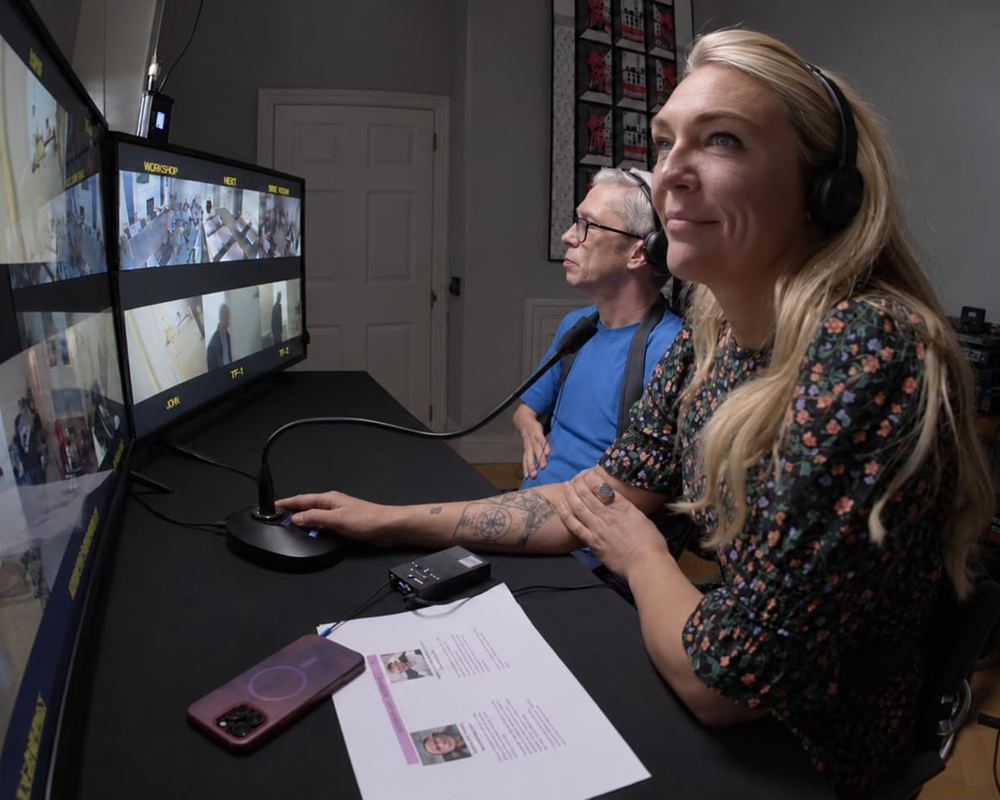
Cue “Segrilife”, a residential home for disabled people that members of the public are invited to tour. In fact, every resident is a disabled actor, and the creepily jovial corporate films and posters are made using AI. Fraser and Morgan are watching events unfold on monitors in another room.
Each part of the tour is based on a different piece of Nazi ideology, much of which has a menacingly clear link to some modern-day ideas. First off, the group are shown “the workshop”, where disabled people are placing beads on to string to earn an allowance. “I used to be in marketing. I don’t know why I’m in this room now,” a character called Sonia says, threading monotonously in her wheelchair.
Soon, we are touring a dormitory (or “the nest”), a room with threadbare beds lined up in a row for disabled people to use as a communal bedroom, with cameras placed on the walls to monitor them. “It’s safe,” one woman in the tour group says, approvingly. “That’s what the people we’ve just met need.”
On the walls are posters repackaging 1930s fascist concepts with a glossy contemporary face, the price tag of a disabled person’s care package in bold font next to their smiling photo, with mantras such as: “Normal life isn’t for everyone.”
It is excruciating and sinister and there is little letup, the producers building the tension methodically as viewers witness dehumanisation being normalised in real time.
Few TV moments this year have been more disturbing than when three members of the public and a manager (an actor) discuss the “cost” of a young disabled woman as she sits silently in the same room, with the “savings” the state has made by putting her in an institution glowing on an iPad.
You are, of course, waiting desperately for someone, anyone, to speak up. It’s a long wait. There are a couple of women who show some concern but it’s all rather tame given what they’re seeing. By the time one man on the tour finally declares, “This is hell on earth,” I don’t know whether to cheer or cry.
Threaded between these scenes is a harrowing history of “Aktion T4”, the Nazi’s programme to systematically segregate and murder disabled people. Fraser, visibly distressed, and Morgan visit Hartheim Castle in Austria, one of six facilities in which tens of thousands of so-called “mercy killings” of disabled people occurred in gas chambers from 1939.
You could argue that the programme-makers controversially pairing Nazi killings with 2026 rhetoric is counterproductive to winning over hard-to-reach critics. That the horrors of the past are of such unique depravity that discussing them in a modern context will let the Daily Mail et al dismiss the whole thing as woke hysteria. And yet you could also claim that’s the point: it is comforting to tell ourselves fascism and democratic ideas are always neatly defined, that the beliefs strangers held 80 years ago bear no relation to what our relatives post on Facebook today.
There is the standard reassuring reveal at the end of the programme, in which the participants discover the truth and make all the right noises to suggest they have learned something. But it is hard to shake off what we’ve seen: most of the public who take part are convinced it is quite rational to treat disabled people as less than human, and with remarkable ease.
Some excuse it for the strain on the taxpayer. Others say institutionalisation is for disabled people’s own sake. As one woman concludes, it’s “incredible” they are being looked after and “kept occupied”.
That’s the thing about prejudice towards disabled people. It is not always violent or cruel. Much of the time, it is an almost well-meaning belief that disabled people are not quite like other people. Not as complex. More infantile. Of less value.
There is a moment when Morgan covers her eyes with her open fingers, barely able to watch through the monitors what has been unleashed. Viewers would be forgiven for doing the same. But acknowledging that these attitudes still exist is the only way we might begin to rid society of them. None of us should look away.