Unitree is building AI that lets its humanoid robots improve themselves
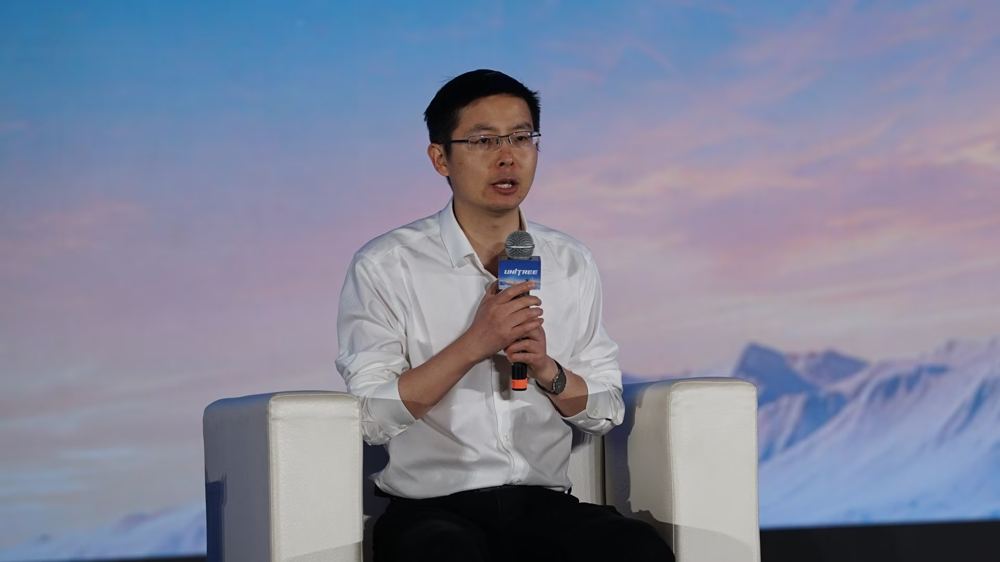
Unitree Robotics is building a system that lets its humanoid robots improve themselves, founder Wang Xingxing said on Thursday. He calls it Unitree Rehearsal. He named it the company’s most important project of the year, Minxiao Chang reported for the South China Morning Post. Wang spoke at a physical AI conference that Unitree hosted in […] This story continues at The Next Web
Unitree Robotics is building a system that lets its humanoid robots improve themselves, founder Wang Xingxing said on Thursday. He calls it Unitree Rehearsal. He named it the company’s most important project of the year, Minxiao Chang reported for the South China Morning Post . Wang spoke at a physical AI conference that Unitree hosted in Hangzhou.
Under the plan, AI would search research papers, write code and test it in simulation before trials on real robots, according to the SCMP. Unitree already uses AI this way and then collects feedback from real tests to adjust its models, Bloomberg reported.
Wang also moved his timeline forward. He now expects humanoids to complete 80% of tasks set by voice as soon as 2028, Bloomberg reported. That covers work in factories or homes, according to a transcript Unitree shared with Bloomberg. Wang calls that point the “aha” moment for practical robots. TNW has not seen the transcript.
In August, at the World Robot Conference in Beijing, Wang said robots were nearing a “ChatGPT moment” . At the same event he said mass use in factories and homes could take 10 years, according to Bloomberg.
“If you take a humanoid home now and ask it to clean the room, honestly I don’t think it can complete that task,” Wang said in the transcript.
He said recent advances in AI models such as OpenAI’s GPT-6 changed his mind.
“I had some skepticism about AI model developers last year,” he said.
This year, he said, the most advanced developers have begun letting their models improve themselves.
“As long as you give a frontier model data and time, it will undoubtedly surpass humans in many areas,” he said.
This week, Recursive released a coding model that was largely built by AI .
Wang said Unitree’s humanoids running GPT-6 can now paint, changing colours and rinsing the palette, and play Go. Unitree plans to expand production to meet possible demand for tens of millions of robots. It makes tens of thousands a year today, Bloomberg reported. Wang said Unitree is building its own models while working with AI labs in China and abroad.
On Wednesday, Unitree posted a one-minute video of the H2-X Kung Fu Legend Guardian. In it, the humanoid punches and knees cars in a scrapyard. It also confronts an intruder holding a knife and lifts a car to free a trapped person.
The robot runs for approximately eight hours, Unitree said in its post on X . It can jump from a four-metre platform, according to Mark Wilson at TechRadar . Unitree has given no price or release date. It builds on the H2, which costs $29,900. TechRadar wrote that the H2-X would struggle to pass the safety certification needed to sell as a personal bodyguard.
The video labels the scenes “extreme testing” and warns against imitating them, Mike Pearl reported for Gizmodo . Unitree’s post asks people to use the robot “safely and in a friendly manner.”
Unitree’s shares rose five-fold on their Shanghai debut in August and are now about a quarter below their August peak, Bloomberg reported. Chinese venture and state funds have put more than 100bn yuan ($15bn) into robotics startups this year, according to the tracker ITjuzi. China has also reportedly slowed humanoid IPOs since then. For now, humanoids sell mainly to researchers and enthusiasts, Bloomberg noted.