It’s not a coup: Tusk is right to reclaim Poland’s Constitutional Tribunal, but wrong in how he does it
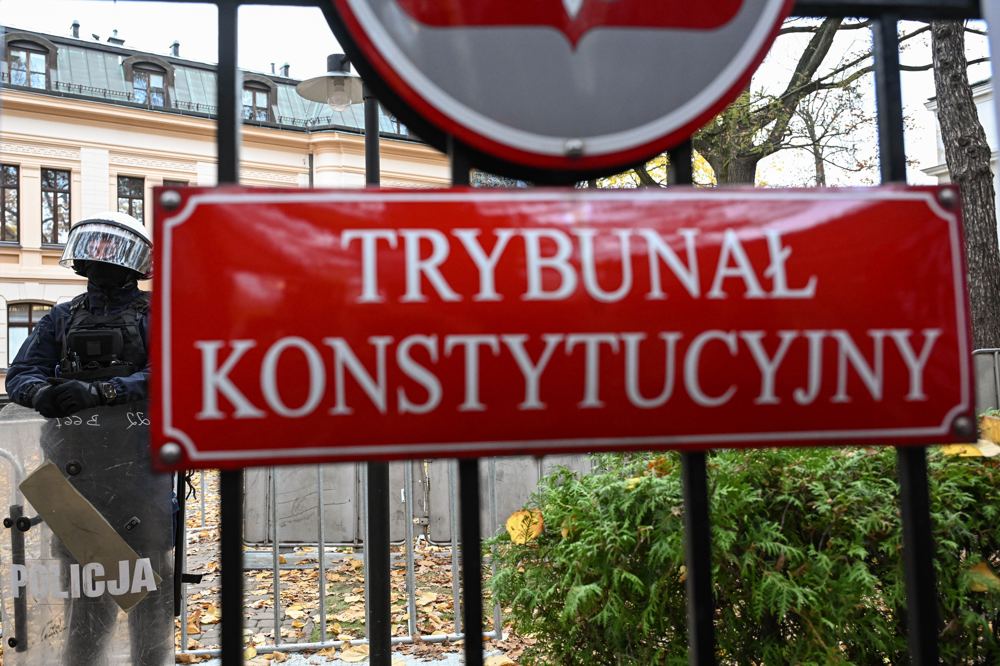
Donald Tusk has a legal duty to rebuild Poland’s captured Constitutional Tribunal. But the government’s handling of the latest confrontation and its own appointments risks turning a victory for the rule of law into a political defeat, writes Alberto Alemanno.
Poland’s Constitutional Tribunal is at the centre of an unprecedented rule-of-law confrontation.
Last Friday (30 October), seven judges elected by parliament entered the court in a highly-contentious operation, escorted by the state protection service.
After more than six months of president Karol Nawrocki refusing to accept their oaths, one of them, Anna Korwin-Piotrowska, announced she was assuming leadership of the tribunal.
Nawrocki cut short his official visit to Senegal and rushed back to Warsaw. Cameras filmed the scuffles at the entrance.
The images prompted two opposing interpretations: a legitimate effort to restore the rule of law, or a coup?
Whatever the images suggested, Friday’s operation was not a coup. It aimed to restore a lawful court, not to capture it.
Yet the circumstances surrounding Friday’s intervention made that accusation easier to spread, as hard-right leaders from Marine Le Pen to Nigel Farage quickly showed.
The crisis began in December 2015, when Poland’s then-governing Law and Justice party (PiS) appointed three judges to seats that had already been filled.
What followed was a sustained effort to bring the country’s constitutional watchdog under political control. Its leadership became increasingly aligned with the political interests of the former ruling party, with its president, Julia Przyłębska, described as an ally of PiS leader Jarosław Kaczyński. Its rulings helped dismantle constitutional safeguards, most consequentially through its October 2020 decision restricting access to abortion.
European courts have also ruled on the Tribunal’s compromised composition and lack of independence.
In December 2025, the European Union’s highest court ruled that Poland’s Constitutional Tribunal could not be considered an independent and impartial court established by law, citing irregularities in the appointment of some of its judges and its president.
The European Court of Human Rights had reached a similar conclusion in 2021. In May this year, it ordered Poland not to obstruct judges elected by parliament. The Council of Europe’s legal experts also made clear in October that the president cannot simply refuse to swear in judges chosen by the legislature.
On Saturday, the European Commission confirmed that the appointment of constitutional judges falls within parliament’s powers.
The law is clear: Poland must have an independent Constitutional Tribunal. By refusing to swear in judges elected by parliament, the country’s president is abusing his office to block their appointments and effectively claiming a veto power he does not have.
This constitutes a breach of, not a defence, of the rule of law. Yet the president's obstruction does not give the government unlimited discretion in how it restores the tribunal. Its response must also comply with the law.
Alberto Alemanno is an academic, author and one of the leading voices on the democratisation of the EU. He is Democracy Fellow at Harvard University, Jean Monnet Professor at HEC Paris and founder of The Good Lobby.