Israel’s anti-Netanyahu bloc needs Europe’s help to stabilise Middle East
The recent elections in Israel and the US create a narrow geopolitical opening for de-escalation in the Middle East, which Europe should seize upon instead of playing wait and see.
The electoral outcomes in Israel and the US, characterised by many as the most consequential of the last 20 years, have the potential for altering the geopolitical landscape of the Middle East.
The confluence of new power formations in Tel Aviv and Washington might present a new, if fragile, avenue towards stability and de-escalation.
Yet the tale of these elections contains a harsh lesson for Europe’s leaders: the era of “wait and see” is over.
The one thing Europe can no longer afford is the luxury of remaining on the sidelines, hoping that political actors in Israel and the US will resolve the region’s crises on their own.
Continuing to relegate itself to a secondary stakeholder would not only be a diplomatic failing but worse, a strategic error that threatens to leave Europe unable to influence policy decisions in the Middle East that directly impact on its own security and prosperity.
By maintaining its current posture of inaction, Europe risks bearing the political and economic fallout from developments it had the power to shape but chose to ignore.
The ousting of prime minister Benjamin Netanyahu’s extremist, right-wing coalition on 27 October marked a shift in Israeli politics.
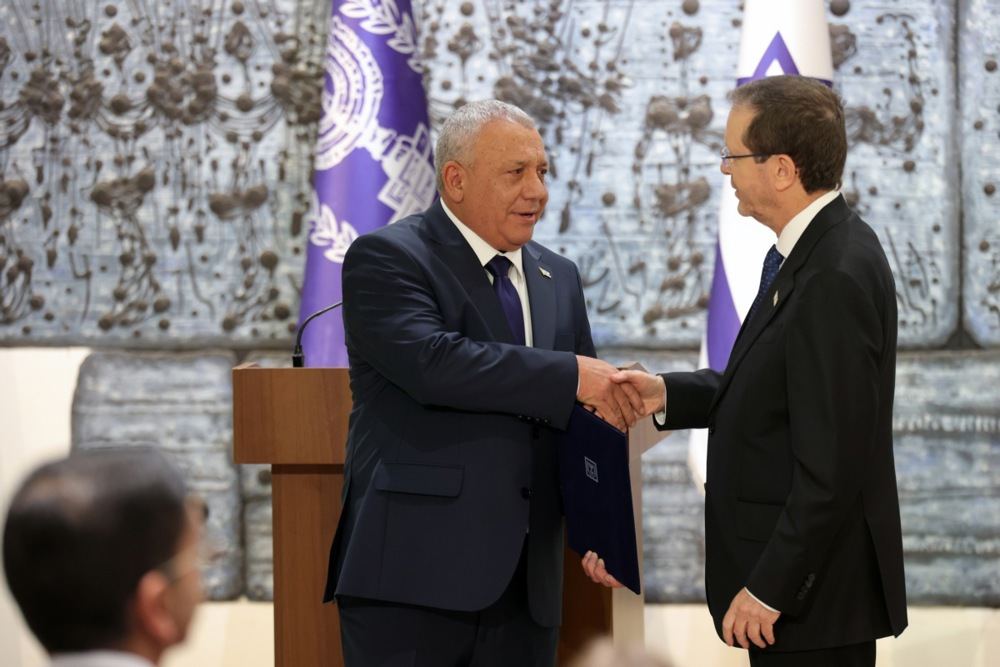
The mandate given by president Isaac Herzog to opposition leader Gadi Eisenkot to form a government represents a chance to step away from aggressive annexation and the systematic undermining of democratic norms.
However, the path ahead is precarious. The potential coalition, while united in its opposition to Netanyahu, is ideologically diverse and faces the immediate and difficult task of securing a solid majority.
Netanyahu, who remains head of the caretaker government until a new prime minister is sworn in, will most certainly attempt to spoil these efforts.
For a stable anti-Netanyahu government to emerge or to be tolerated, the inclusion of Arab parties is indispensable.
The centre-right Zionist anti-Netanyahu coalition of Eisenkot, Naftali Bennett and Avigdor Lieberman, in concert with the 27 seats held by the Arab parties and Yair Golan’s Democrats, possesses the numerical potential to rein in the ideological excesses and extremist policies of the previous years.
However, Eisenkot’s requirement for all potential coalition partners to confirm Israel’s status as a Jewish State, is a difficult pill to swallow for the Arab parties.
For the Arab Joint List in particular, this means compromising on fundamental principles to prevent the return of Netanyahu and his racist and supremacist allies, Itamar Ben Gvir and Bezalel Smotrich.
The only other way for Eisenkot to get to 61 seats in the Knesset would require both ultra-orthodox parties to join him in the government.
This, however, means Lieberman reneging on his electoral pledge not to exempt Haredi men from military service.
For the center-right allies led by Eisenkot, most of whom also share an ethno-nationalist world view, the central challenge remains the management of the occupied territory.
The Zionist anti-Netanyahu bloc will likely pivot from the outgoing government’s policy of open annexation and ethnic cleansing to a policy of managing the conflict under the sole lens of national security.
Make no mistake, ending the occupation, championing Palestinian self-determination and prioritising a two-state solution, is not on the menu.
When it comes to Gaza, an Eisenkot-led government might be more open to supporting the implementation of the UN Security Council-approved Gaza peace plan, but it will condition its cooperation and the Israeli Defence Forces’ withdrawal from most of the Strip on full disarmament of [Palestinian militant group] Hamas.
These caveats notwithstanding, and as a result of external pressure, agreement may eventually be found to reverse the most egregious policies of the Netanyahu era in the West Bank, notably by curbing unscrupulous settlement expansion, halting the 'E1' settlement project , dismantling illegal settler outposts in Area C, holding terrorist settlers to account and ending the punitive withholding of clearance revenues from the Palestinian Authority, estimated to be between $4.6bn [€4.1bn] and $6bn.
However, it is far from clear whether Eisenkot and his hawkish allies on the center-right will want to pursue a different approach towards Iran and Lebanon.
While they have criticised Netanyahu for starting the war against Teheran without political exit strategy they full-heartedly support aggressive military action against the Mullah regime [in Iran] and [the Lebanese paramilitary force] Hezbollah.
Netanyahu knows this as well and might resume military strikes on Iran and its allies in the region while still in power.
Predicting the trajectory of US Middle East policy under president Donal Trump, now constrained by a Democrat-dominated Congress, remains complex. While Trump retains broad constitutional prerogatives in foreign policy, the new Congress holds significant leverage through budgetary legislation.
The announced phase-out of the nearly $4bn in annual US military aid to Israel by Trump is a clear indicator of shifting domestic political winds.
Given the increasingly negative image of Israel among Democratic voters and politicians, it is improbable that the new Congress will approve further unconditional multi-annual, large-scale military aid.
The conflict with Tehran introduces a more volatile variable. While the US Constitution demands congressional approval for a declaration of war, Trump might argue that strikes against Iran constitute independent defensive actions necessary to protect American lives and interests, thereby bypassing congressional oversight.
With no further electoral hurdles until November 2028, Trump faces limited political restraint at home, short of an unlikely impeachment proceeding.
Should Trump initiate massive military action the Iranian regime will, in all likelihood, respond by triggering a retaliatory cycle that would inevitably target Gulf states harboring US military assets, including civilian energy infrastructure and desalination plants.
As witnessed in the past six months, collateral damage reverberates far beyond the region.
The economic impact is felt globally, hitting US households and European economies alike. Tehran’s strategic calculus remains rooted in the belief that substantial financial and economic costs will compel US partners worldwide to exert pressure on the Trump administration to seek a political, rather than military, solution.
Furthermore, domestic pressure within the US will likely grow. The non-interventionist MAGA wing, recognising the potential impact on future electoral bids, such as US vice-president JD Vance’s potential 2028 presidential campaign, is increasingly wary of the costs associated with prolonged conflict.
This also implies revisiting the special relationship with Israel, increasingly seen as a liability for US interests in the region and beyond.
When combined with the nearly unified opposition from the Democratic party, the political sustainability of massive military intervention in the Gulf is questionable.
How can Europe meaningfully impact policy decisions in Tel Aviv, Washington, and the Gulf capitals? The answer requires a twofold, simultaneous approach.
First, Europe must abandon its muted, reactive diplomacy. It is entirely appropriate to wait until a new government in Tel Aviv is sworn in and congressional races are validated before initiating formal, high-level engagement.
However, nothing prevents European politicians, parliamentarians and senior officials from pro-actively reaching out to the forces in Israel, the US, and the Gulf that are seeking an end to military conflicts and sustainable political solutions.
This engagement must emphasize, above all, the imperative of respecting international law as the foundation for any lasting resolution, particularly in the longest-entrenched conflict theatre: occupied Palestine.
Also, on Iran and the contentious issue of its nuclear programme, the EU has much to offer, having played a critical role in the negotiations that led to the landmark JCPOA agreement with Iran in 2015 on non nuclear non-proliferation.