The Big Review: Krasner and Pollock: Past Continuous ★★★★½
A gorgeous and largely convincing exhibition that reveals a clear codependency between the two artists
He was Jack the Dripper. She was The Wife. That is how it went for artist couples in gender-coded mid-century America (and elsewhere). Yet, Lee Krasner (1908-84) played more than a supporting role in her decade-long marriage to Jackson Pollock (1912-56). When his work eclipsed hers, she remained as committed to her own painting as she was to every aspect of his life, except his infidelity and the alcoholism that in 1956 drove him to his death. Even then, she put her devotion to consequential use in securing his legacy. Now the time has come to fully appreciate hers.
That is the organising principle behind Krasner and Pollock: Past Continuous , the gorgeous and largely convincing blockbuster at the Metropolitan Museum of Art. While other US museums have previously surveyed the artists separately and in tandem, for the Met curators David Breslin and Brinda Kumar, none gave Krasner, a first-generation Abstract Expressionist, a fair shake.
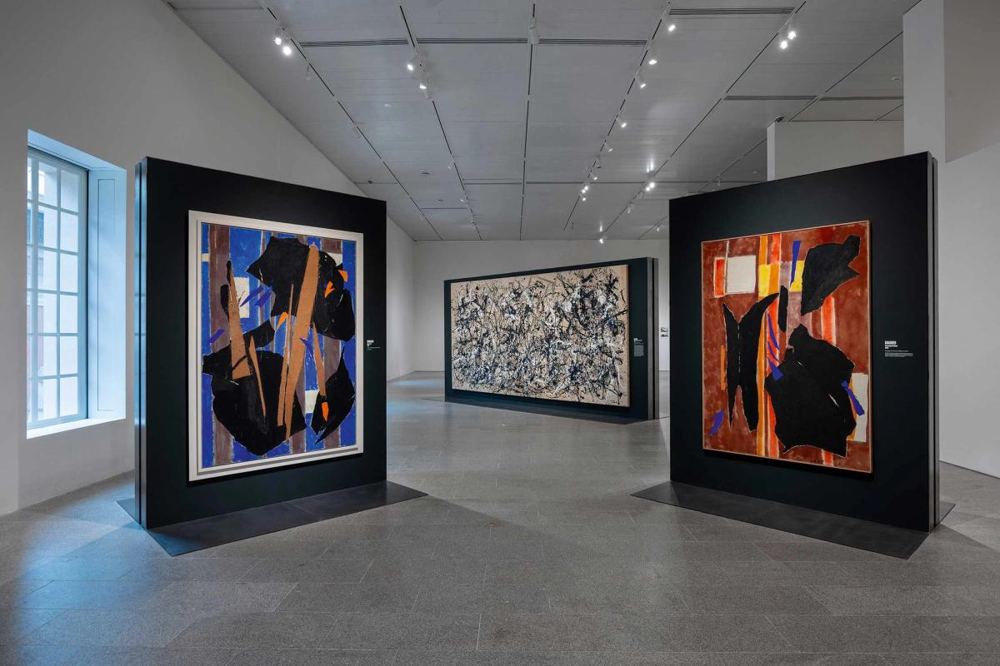
Their exhibition strives to give a primacy to Krasner’s work that parallels Pollock’s. Note whose name comes first in the show’s title. Its subtitle likewise derives from a Krasner at the she-who-laughs-last finale. What’s more, a dramatically lit, black box of a gallery starts it off with a bracing presentation of six vertical abstractions that Krasner made in the 1950s by collaging cuttings from her unsold paintings with pieces of canvas and bits of Pollock’s drawings punctuated by slashes of pink and orange.
Nonetheless, the eye keeps moving to a window-like opening that functions as a proscenium for the theatre of Pollock’s Convergence: No. 10 (1952), an immense and riveting painting of black paint skeins shot with explosions of colour. Mounted on an angled, freestanding wall in another room, the sight offers viewers a taste of what is in store: signature Pollocks ricocheting off shape-shifting Krasners, and vice-versa.
If only the curators did not show Krasner still riding his coattails. Pollock’s name remains the bigger draw. Ultimately, he still comes off as the bigger trailblazer, and she, his foremost champion, more willing to risk failure to experiment and invent. As Breslin speculated during the press preview: “I don’t think we would have a Jackson Pollock if it weren’t for what Krasner did to support his work.”
There is no way to test that theory, but if Krasner and Pollock proves anything, it is that the artists’ relationship was so codependent that the reverse may be just as true. Yet, today her influence and market value pale before his. Krasner’s auction record, set at Sotheby’s in 2019, is $11.7m for The Eye is the First Circle (1960), one of her larger canvases in the show. That is not chump change, but this year Christie’s sold Pollock’s Number 7A (1948) for $181.2m, an eye-watering price but still short of the reported $200m that financier Ken Griffin paid David Geffen, in 2016, for Number 17A (also 1948).
Krasner and Pollock met in 1942, when she was better-known to the Abstract Expressionist crowd in New York and Pollock the only unfamiliar name in a show of American and European Modernists (partially recreated at the Met) that the painter John Graham organised and included works by both. By linking their small, vibrant abstractions with works by Pablo Picasso, Joan Miró, Henri Matisse, Amadeo Modigliani, Giorgio de Chirico and Willem de Kooning, the show virtually jumpstarted their careers. It also made them a couple.
Krasner introduced herself in a spontaneous visit to Pollock’s studio and was so dazzled that she hit a creative block. That did not stop them from dating. He was a Midwestern former student of Thomas Hart Benton in thrall to Picasso and Mexican muralists. She was inspired by Arshile Gorky’s abstractions and Matisse’s cut-outs. Soon he was importing a Matissean palette to his painting and showing at Peggy Guggenheim’s Art of this Century gallery. Sales were not brisk. Pollock’s drinking was more prodigious. Krasner insisted they marry and move to Springs, in East Hampton, to protect him from himself, and persuaded Guggenheim to cover the downpayment.
Relocating did the trick for three unusually sober years, long enough for Pollock to produce his breakthrough drip paintings and achieve lasting fame, before settling, intermittently, into new bouts of alcoholism and depression; a creative paralysis set in. Krasner’s career took off, with a confident 1955 solo show at New York’s Stable Gallery.
Breslin and Kumar take care not to place the artists’ works close together, so Krasner’s modestly-scaled paintings can hook the eye without being overwhelmed by Pollock’s volatile monumentalism. Until she was widowed and took over Pollock’s now-famous barn, Krasner worked in their kitchen and he in an upstairs bedroom. Two contiguous galleries, both painted black, approximate the size of the artists’ studios and distill the show’s thesis with luminous economy, leading viewers from the lyrical, early choreography of his pours, drips and stains to her smaller but exquisite Little Images, mosaic-like geometries painted with a palette knife.
From these sepulchral chambers the show opens to a large, high-ceilinged gallery flooded with daylight from newly revealed windows on Central Park. Here, Convergence hangs, backed with the Met’s prize Pollock, Autumn Rhythm: Number 30 (1950). The operatic shift in tone and scale drives home the outsize renown Pollock achieved after a 1949 feature in Life magazine posed the question, “Jackson Pollock: Is he the greatest living painter in the United States?”
In the same gallery, tellingly, the eight collage paintings Krasner showed at Stable Gallery turn from the Pollocks to face each other like the stones of Stonehenge and look just as ritualistic, if more elated. After that, it’s back to black for a segment titled Re:Echo (after a Krasner), where Pollock’s arabesque, later works hang near her Robert Motherwell-like abstractions of the same period.
The rest of the show is all Krasner, but she outlived Pollock by 28 years. The swirling, abstracted floral landscapes became monumental, but appear in a few too many galleries, homogenizing their visual impact. The point, that no full understanding of one artist can come without the other, has already been made, capped by the one side-by-side juxtaposition: The Deep (1953), a chilling canvas where Pollock nearly obliterated a dark biomorph in clouds of white, and Birth (1956), an image of interlocking pink and black forms that Krasner painted the year he died. That pairing said it all.
Will this show correct a historic imbalance? Probably not market-wise, but a reputational correction seems both necessary and likely.
The New York Times ’s Holland Cotter describes the exhibition as an “exercise of art-historical reset” , and calls its installation of Pollocks “an entrancing sight” , while exulting in the “distinctive impression of personal joy” in Krasner’s post-Pollock work. In The Wall Street Journal , Karen Wilkin applauds the curators for encouraging “concentration on their work, rather than the mythology attached to both painters” , and on her Instagram, Jasper Johns’s biographer Deborah Solomon raves: “It’s like holding two opposed thoughts in your brain at the same time and wondering if your head will explode from the exhilaration of it all.”