Nine Songs: Asha Puthli
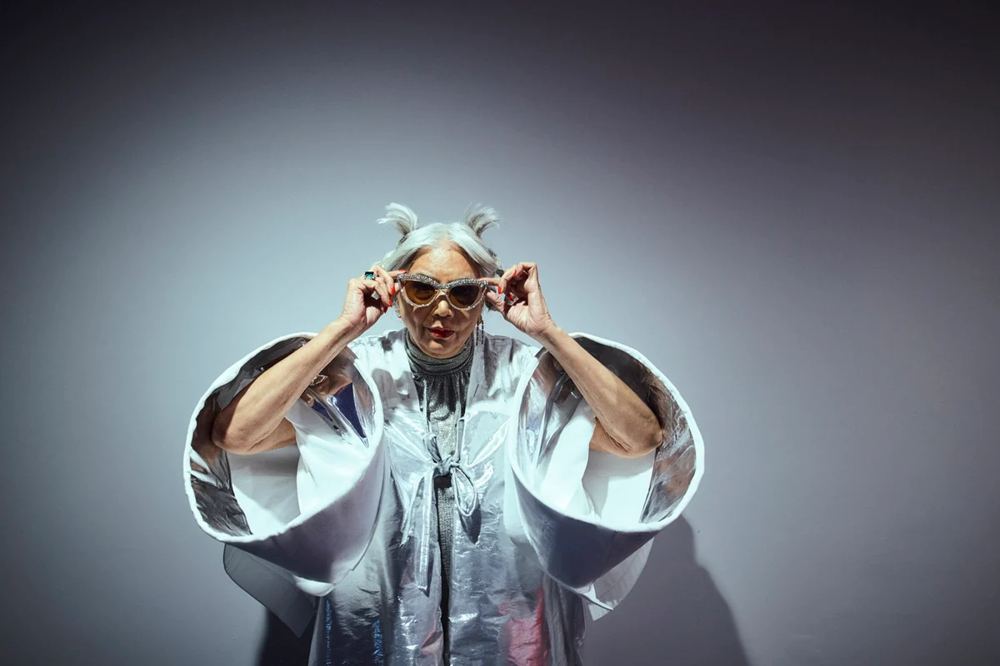
Ahead of her performance at The Barbican this weekend, as part of the the EFG London Jazz Festival, Asha Puthli talks Alan Pedder through the songs that shaped her life.
“I do have a tendency to go overboard,” Asha Puthli chuckles, an hour or so into our marathon call. “You should know that by now!”
Indeed I should, but I'm not complaining. Our conversation darts wildly all over the place, from her nighttime jazz odysseys as a young girl in Mumbai to unprintable anecdotes about her halcyon days in New York, via touching stories of her sister and mother and much more besides. “You’ve got to stop me, darling. I digress and then I digress on top of that,” she continues, laughing into the camera of her phone, held so close to her face that sometimes all I can see is her bright red lipstick and a beaming smile. “I can’t think linearly,” she tells me more than once, “horizontally or vertically!”
Puthli, now 81, is calling in from her retirement village in Miami, but she hasn’t hung up her silver suit just yet. She’s fresh off touring with Gorillaz, having guested on their 2026 album The Mountain , and is set to perform a show of her own this weekend at The Barbican, a rare UK headline performance where she'll be joined by Anoushka Shankar, Yazz Ahmed, Sarathy Korwar, and potentially some hush-hush other guests as part of this year's EFG London Jazz Festival.
Having only resumed touring in 2024 after a 40-year break, Puthli is gushing with the joys of the road. She describes meeting Damon Albarn and Jamie Hewlett as an immediate rush of chemistry ("like we'd known each other in a past life or something") and is excited to be reunited with Shankar ("my unicorn") at the Barbican.
Back in the '70s, Puthli and Shankar's father, sitar virtuoso Ravi Shankar, had plans to work together on an off-Broadway play about the Hindu mystic Mirabai, but it never came to pass for reasons she doesn't remember. "Our costumes did share a display in the Grammy Museum though," she says, before going on a diversion about how she would have loved to get a Grammy nomination but her music was never submitted. "My career has not been very consistent, but I'm very happy to continue the legacy of that friendship with Ravi."
Puthli's own legacy started as a story of being tugged in two very different directions: the Hindustani classical singing she was learning at school and the opera lessons she'd take after hours with a British woman named Hyacinth Brown, who would have examiners from England's most prestigious music schools travel out to India to hear her students. Puthli describes it as "colonial hangover," and herself as someone born close enough to 1947 to count as "one of those midnight's children."
Her early love for opera came from her dad, who could turn any daily interaction with her into a song, but Puthli presented a challenge to the teacher, who couldn't quite figure out where on the scale her voice belonged. Having started Puthli on an Agnus Dei, then shown her the ropes of composers like Bach and Christoph Willibald Gluck, Mrs. Brown moved her on, undaunted, to the French composer Georges Bizet. But that didn't seem to fit either, so then Puthli learned to sing high soprano instead, working on her coloratura with "The Bell Song" from Léo Delibes' 1883 opera Lakmé .
Ultimately, though, despite her teacher's grand plans, Puthli fell out of love with opera after she was given an ultimatum to choose between that and the Indian classical singing she so loved, in large part due to her older sister. "That was it for me," she says. "She was trying to put a restraint on me, but my other teacher, Guni Gandharva Pandit Laxman Prasad Jaipurwale, never asked me to give up opera. But I did, and continued on with him instead."
There are no opera songs among the nine tracks that Puthli has chosen to talk through as the songs that shaped her life. There's nothing either of the cosmic disco that she's most closely aligned with after the success of her 1976 album The Devil is Loose and its irresistibly slinky single "Space Talk". Instead we get a broader look at her tastes, from her sister's ghazals to a '90s karaoke favourite.
ASHA PUTHLI: Everything! All three. This song is very, very special to me because that’s my older sister who's singing. She was smarter than me and used a made-up name, a fragment of her husband’s name, rather than her real one. She wasn’t really serious about being a professional singer. She did it because she loved it, but she was so admired by everyone who knew her or had heard of her, including Lata Mangeshkar, the nightingale of India, who is also on this list.
My sister is my mentor, my hero. I was much younger than her and I was just besotted with her voice. I could sit and listen to her sing for hours. I just couldn’t stop. She had the most mellifluous voice. It’s very rare to have that kind of control, that kind of fluidity. The quality of her voice, the purity in it, the tone… I loved it all, and she inspired me to sing. I only studied Indian classical music because I heard her sing it.
“Mehr Ki Tujhse Tavvako” isn’t a classical piece though. Ghazals are semi-classical, sung in Urdu, and almost always about love and about longing. There’s a certain melancholy to them, and I love that. I love the whole album that this song appears on [1985’s Inaayat ]. It don’t think it matters if you don’t understand the words. The important thing is that this kind of music should move you, and that’s what it does for me every time.
No, I didn't. We spoke Hindi, as most Indians do as it's our national language. But I’d say that most Indians actually speak at least four Indian languages. Not everyone, but it’s not unusual. There’s Hindi, of course, but then there are other languages belonging to the state in which a person lives, which in my family’s case was Marathi, because we lived in Bombay. I learned to speak a little bit of Gujarati too, which is from the state of Gujarat, where I studied at the University of Baroda for four years.
My family’s own language, the one I was raised in, is one that’s much less well known, and used to be quite exclusive, only spoken by a small number of people. It’s called Konkani, but we used to speak a quite traditional, old form of Konkani, which has a lot of Sanskrit words in it. We would sing in Konkani too. Urdu is similar to Hindi, but the only Urdu I really learned was because of the ghazals that my sister would sing.
ASHA PUTHLI: This song is from a movie called Barsaat that came out in 1949, but I didn’t hear it until a few years later, when I was seven or eight.
Even though my parents had an arranged marriage, they had a few months to court each other. My mother always used to tell me that she and my dad used to go to the movies to hold hands and listen to Lata. So when she was older and starting to develop Alzheimer’s, I recorded some old Bollywood songs for her, in the hope of waking up her memories or just to make her feel better, of course there was no Bollywood back then, in the 1940s; the songs were known as filmi gaane , or film music, and this song from Barsaat was one of them.
What’s funny is that I made a whole album [1998’s The New Beat of Nostalgia ] trying to impress her and to get her memory working again, but when I put it on for her she said “Oh no Asha, what rubbish are you playing? Put Pandit Jasraj on.”
Now, Pandit Jasraj is an amazing classical singer, but let me get back to Lata Mangeshkar otherwise I’ll be hopping around topics like a crazy person, from one thing to another. My connection to Lata was really through my sister, because Lata really liked her voice. But the whole story of me moving to America, which was pretty difficult, has to do with Lata. If it hadn’t been for Lata introducing me to her brother, Hridaynath, who’s still alive, I don’t know how things would have turned out.
The story is that Lata had heard I was studying Indian classical and jazz, and she suggested to her brother that he take me to the studio and make a tape so that she could hear what I was doing, and so he did. We recorded a short piece that included just the fore-phrase and answer phrase of a melody, and I sang these notes in Indian classical that we call murki , which are these little flexible quaver notes that descend, and also gamak s, which are more staccato.
The tape didn’t go anywhere as such at first, but finally when I got an appointment with John Hammond Senior, which was the only producer whose name I knew when I left India, that’s the tape I played, and that’s the tape he was impressed by. It was the author Ved Mehta, who wrote about me in a book called Portrait of India, who opened the door to the appointment with John, but it was that little demo tape that convinced John to put me in the studio, so I’m very grateful to Lata and her brother for that.
When we went into the studio, John and I did this recording together called “Asha’s Thing”. Then he gave me the acetate and told me to be very careful with it, since it was the only one. But you know how musicians and artists can be. I used to hang around a lot with the Warhol crowd. My friend Holly Woodlawn, who was living with me at the time, used to drink a lot of Chardonnay, and one day she poured it right on the acetate, and that was that!
But anyway, it was the most non-commercial thing that no record label would touch. There was just no market for that kind of music at the time. I remember when John played it for Clive Davis. Clive just walked right out and said “No, this won’t sell.” I mean, he was pushing rock and roll those days. Rock and roll was king. So when that didn’t work, John said to me “I’m going to show everybody that you can sing anything you want. It doesn’t have to be this.” And that’s when he asked me to go in and sing for Ornette Coleman, who had been looking for a singer.
It was, and I feel that also with Damon Albarn. He's been so kind and generous as an artist, not only to me but to so many other people.
If you listen to the Gorillaz track, there’s very little of me on it. Two lines and that’s it. But when it came to sharing the stage on tour, he said to me that I could sing anything I wanted, wherever I wanted, and to just feel free to improvise. He had total confidence in me, and I was so touched by that. I’m so grateful for his graciousness, his generosity, and his belief in me, and I’ve learned a lot from watching him too.
Oh, I hope so! He mentioned it on a BBC show. Someone sent me a clip where he said he was planning to, but you know how busy he is. I hope that he can find the time to do it.
ASHA PUTHLI: Its brilliance, sheer brilliance. The quality is everything. It’s perfection. When I first discovered it, some years after it aired, I was just stunned. I wanted to keep watching it over and over again. Their mastery of their art is so exciting because it’s so free as well. For me, that’s what jazz is supposed to do. It’s supposed to give musicians the freedom to express themselves.
Living in Bombay, I first learnt about jazz through a radio station called Voice of America, which was broadcast to foreign countries in those days by the US State Department. That was the limit of my listening experience of jazz, and I felt so drawn to it because it seemed to have the same kind of improvisational freedom as Indian music, including Indian classical.
I just go with the flow and allow whatever comes to come. I will never be able to scat the way they can, nor would I attempt to. Few people can do what Ella and Mel did, to be honest. It’s just so impressive.
Oh, definitely. I was about 13 when I first started listening to jazz and I was so impressed by all of them. By Ella, by Sarah Vaughan, by Dinah Washington. I could go on and one with a string of names, all brilliant. Nina Simone! Oh, gosh. They were all unique.
It was so flattering for me when Gary Giddins, who was the jazz columnist at The Village Voice for a long, long time, wrote that my voice reminded him of Sarah Vaughan. There was someone else who said my voice reminded them of Ella Fitzgerald, so obviously she left a very big impression. And when I worked with Lionel Hampton, decades later, the first thing he said to me was “You remind me of Dinah.” I didn’t even know they had worked together before. Lionel was the one who gave Dinah her big break.
I did. I met Sarah, or Sassy as we called her. She was singing at The Blue Note in Greenwich Village and Billy Cobham, the drummer, invited me along. In those days The Blue Note and other jazz clubs were not very glam. We had to go up a dark and rickety staircase to her green room, but we didn’t talk that much. Bill Cosby and his wife were there with us, and they were quite the illustrious couple at the time, so they held most of the conversation. I just told her congratulations and that I loved the concert, that kind of thing.
ASHA PUTHLI: I love the way she dissects and reconstructs the songs she sings, and her phrasing. “Dat Dere” has always been a favourite song of mine, because it’s just so playful and fun.
I knew Oscar Brown Jr., who wrote the lyrics, and his wife, since they lived not far from me in New York City. We used to hang out together. I remember one night Oscar took me to meet Muhammad Ali because he was working on a Broadway musical called Buck White, which Ali was starring in. Oscar had a great sense of humour, and I love his compositions. I did record my own version of “Dat Dere” once, just for fun, but I don’t know where it is now.
I think Sheila was an exceptional singer, so skilled in her syncopation. She was just amazing. I don’t think she got her due credit. I almost didn’t put her on the list though. I was thinking of including something by Raye, who I think does a wonderful job of bringing elements of jazz and swing into her music. By then I thought, well, Raye has got her recognition, but almost no one talks about Sheila Jordan.
Well, the one that I hear all the time is, of course, the husband song . I guess I’m asking that question for myself, where is my husband at this age?
You know, I have been married twice. My first husband was gay, actually, and that’s why it worked so beautifully. I was, in those days, considered a total fag hag. My friends used to call me that because I just loved to be in the company of gay men. I love their sensitivity, their sense of humour, their sense of glamour.
My first husband, he has such a green thumb, he can grow anything. I love his sense of aesthetics, the way he dresses, and the way he’s loved by everything he touches: the plants, the trees, animals. We didn’t want to part company. We had such a wonderful arrangement between the two of us, and we’re still very, very close. I still consider him to be family, though I can’t say the same about the second one. You should never marry a fan.
[laughs] Yes, please do. I made a mistake, but my son came out of that relationship and he’s the best thing that has happened to me. I named him after a mountain peak in the Himalayas, actually, because he’s the highest peak of my life.
I didn’t want to call him Everest or Kangchenjunga, so I named him after the Jannu Peak, which is not as famous. So his name is Jannu.
ASHA PUTHLI: At the same time as I was finding out about Ella and all the American jazz singers I love from listening to the radio, I was also discovering singers from American movies that made their way to India.