Why have Man Utd only had two 'successful' managers?
“Who!?” “Never heard of him,” Butt said. Scholes was equally puzzled. Mangnall won United’s first two league titles, in 1907-08 and 1910-11. Sir Matt Busby added five, Sir Alex Ferguson 13. “F****** hell,” Scholes replied.
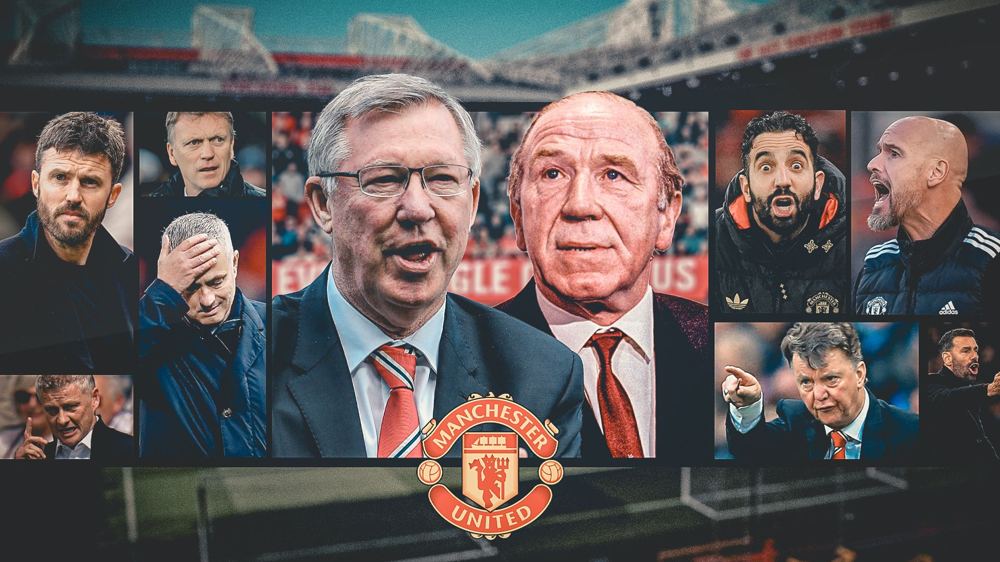
It is an understandable reaction. More than a century on, Mangnall’s achievements have faded from the conversation around United’s greatest managers. His two titles are often overlooked beside the five won by Busby and the 13 delivered by Ferguson. But the numbers tell an unusual story. United have won 20 league titles under just three managers. Liverpool have also won 20, but theirs have been shared between six: Bill Shankly, Bob Paisley, Joe Fagan, Kenny Dalglish, Jurgen Klopp and Arne Slot.
Busby and Ferguson account for 18 of United’s 20. Their influence went beyond trophies. They shaped teams, set standards and helped define the club’s identity. That raises a question beyond the familiar search for Ferguson’s successor. Have United become so accustomed to the leadership of two extraordinary individuals that it struggles to imagine success without one?
The messiah came, then United waited 17 years for the second coming. United are now praying for a third.
When Matt Busby arrived at Manchester United in 1945, the club was far from the institution we recognise today.
Old Trafford had been badly damaged during the Second World War and was unusable.
United were playing their home games at Maine Road, sharing Manchester City's ground while trying to recover from the financial and physical consequences of the war.
Busby had played for Manchester City and Liverpool, and had been offered the chance to manage the latter before taking the job at United. There was little in his background to suggest he would become the defining figure in the history of either club, let alone the man who would lay the foundations for modern Manchester United.
He arrived with a clear idea of what he wanted. Busby wanted to build something that would last. Young players needed a route into the first team, United had to play with ambition and the club should compete with the best in Europe.
His relationship with youth was particularly important. The Busby Babes became more than a football team. They represented an idea: that United could produce its own players, develop them and trust them to carry the club forward.
Munich threatened to destroy everything. Eight United players lost their lives in the air disaster of 1958, alongside other members of the travelling party. Busby was seriously injured. The tragedy could have ended the club's ambitions, but instead became part of the story of its eventual resurrection.
He rebuilt. George Best, Denis Law and Bobby Charlton helped take United back to the top. In 1968, they beat Benfica 4-1 at Wembley to win the European Cup, becoming the first English club to lift the trophy 10 years on from the tragedy.
For Aaron Burns, a former United academy player who now leads the Association of Former Manchester United Players, the significance of that history is still felt inside the club.
“Manchester United is aspiration and inspiration,” he told me.
“You walk into the building, you see the legends, but you also see the heartache. You see the Munich disaster, which is remembered and talked about all the time.”
Burns remembers being a young boy at Carrington, suddenly finding himself in the company of players he had previously only watched on television. Roy Keane and Ruud van Nistelrooy were around the training ground. Ferguson was there, too.
“You'd bump into Sir Alex and you're probably walking in ones or twos. And then he’d just stop you and be like, 'Aaron, how's your grandma?'”
Those encounters left an impression. History wasn’t just in pictures on walls; it was living, breathing, carried in the testimony of people who worked there, many of whom had witnessed different eras of the club.
Burns sees a direct connection between the two great managerial reigns.
“Ferguson built some core values, but he built it on top of Sir Matt Busby's principles,” he said.
Ferguson inherited a club with an established identity, but he did not spend his time trying to recreate Busby's teams. He took the foundations and made them his own.
Busby's departure, however, was not followed by an immediate continuation of his success. Wilf McGuinness, Frank O'Farrell, Tommy Docherty, Dave Sexton and Ron Atkinson all took charge before Ferguson arrived.
They won four major domestic cups between them, but no league title.
Alex Ferguson was born in Govan, Glasgow, less than 20 miles from Busby's birthplace in Orbiston, Bellshill.
There were obvious parallels between them. Both came from working-class Scottish backgrounds, valued youth development and attacking football, and saw management as more than picking a team on a Saturday afternoon.
Ferguson's route to Old Trafford was different, though. By the time he arrived in November 1986, his achievements at Aberdeen had established him as one of Britain's most respected managers. Beating Real Madrid in the 1983 European Cup Winners' Cup final had announced him on the European stage.
He was not walking into a club ready to dominate. United had not won the league since 1967 and were still living in the shadow of Liverpool's success.
Ferguson had to change the habits of the club before he could change its fortunes.
There was no instant transformation. The FA Cup arrived in 1990, followed by the European Cup Winners' Cup in 1991. The league title finally came in 1993, ending a 26-year wait.
By then, Ferguson had begun building something that would dominate English football for the next two decades.
The Class of '92 became the most obvious symbol of that work. David Beckham, Scholes, Butt, Gary Neville, Phil Neville and Ryan Giggs represented a system that gave young players a route into the first team and expected them to take responsibility when they got there.
Ferguson also understood that a successful team could not stand still. He rebuilt it repeatedly, moving on established players and bringing in new ones without allowing the standards to drop. The treble in 1999 was the high point of one generation. The title-winning teams of the mid-2000s and the side that won the Champions League in 2008 were built around another.
Gary Neville's autobiography, Red , offers a glimpse of how that culture operated from inside the dressing room.
Recalling United's comeback at Newcastle in March 1996, Neville describes how United overturned a 2-0 half-time deficit to win 3-2, with Eric Cantona scoring the winner.
“That second half was an occasion when I felt the Manchester United spirit course through the team,” he wrote.
“It relies on excellence from individuals, from Schmeichel and Bruce, who were immense that evening, and from Eric, who popped up to score the winner, but there is also something collective.
“It's unspoken but unmistakable: let's get this match won. It's our time.”
The word that stands out is collective. Ferguson's United were full of outstanding individuals, but everyone was expected to contribute to the team's cause.
Roy Keane's The Second Half provides another view of the dressing room. Keane describes a group in which senior players helped one another, particularly when new arrivals were struggling to settle.
He recalls the support given to Diego Forlan, who joined from Independiente in 2002 and scored just 17 goals in 98 appearances during his United spell.