Slade's Dave Hill on the early days, being the reason Kiss got together, and his debut solo album
Slade guitarist Dave Hill on the band’s early days, being the reasonKiss got together, his debut solo album, blanking Springsteen and more
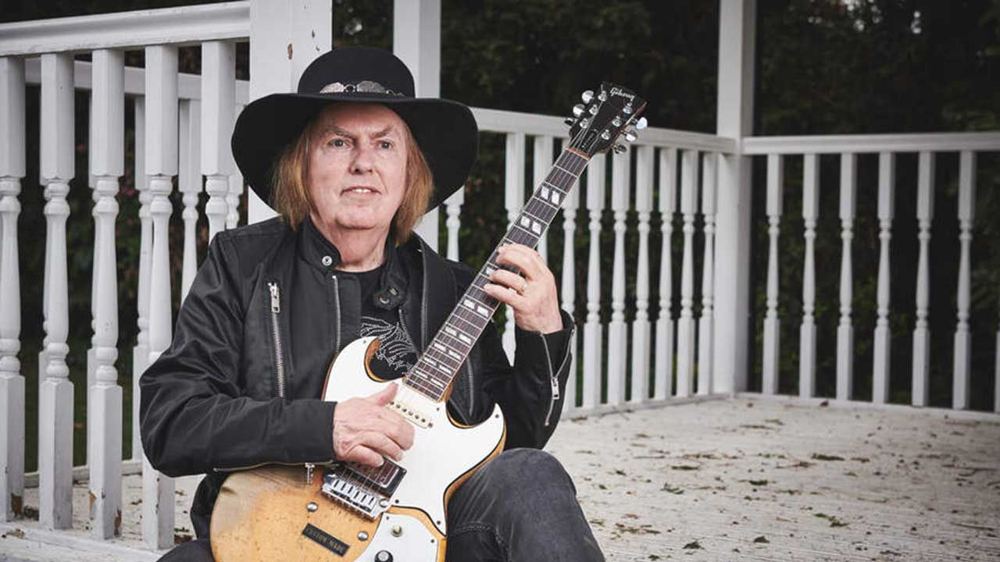
"There’s a various array of history behind me," enthuses Dave Hill, talking to Classic Rock at his home studio in Wolverhampton, backdropped by silver discs and banks of guitars. He’s proudly holding up a distinctive Gibson SG-like guitar. “But this is special,” he says. “I played this on every massive Slade hit. I don’t take it on the road any more, but I did use it for some of this new album.”
Hill is talking up solo debut, Dirty Foot Lane , a deeply reflective record that revisits his post-war childhood on a nearby council estate, plus family themes, mental health struggles, and his superstar 70s as the outrageously flamboyant lead guitarist with the all-conquering Slade . Wearing a white baseball cap and a loud shirt, he looks pretty good for an 80-year-old. And he’s irrepressibly chatty to boot.
Yeah. It’s a lifetime dream. Because I didn’t write in Slade. To be honest, I was wrapped up in my image and everything else. And Nod [Holder] and Jim [Lea] were like a Lennon and McCartney . They were great together, so why try and fix it? Nod actually encouraged me. He said: “You’ve been writing for quite a long time now. It’s time for somebody to hear it.”
I didn’t want to go down the cliché route of sounding like I was trying to do a Slade album, because that’s sewn up in history. Dirty Foot Lane is mostly autobiographical, about family. I write truth, I write emotional stuff.
How did Noddy Holder’s son Django come to be a key part of it?
I needed somebody special, somebody young, who was switched on. And Django’s a brilliant guitarist. I explained to Nod: “I’ve got one or two very sensitive songs.” He said: “Well, Django’s really great at that. So if there’s anything that might have a few tears in it…” And there are, especially She Had A Troubled Heart and Sweet And Tender , which are about my mother.
She was an amazing woman. A war cabinet minister’s secretary, sworn to secrecy. But she suffered depression, which I’ve suffered too, and it haunted her. Basically, her mental health killed her in the end. Fortunately, mum saw me make it, because she didn’t die until 1976.
She always believed in me. I’d been working for a tarmac company after leaving school, but by eighteen I couldn’t stand it any longer. I told my mum and dad that I wanted to leave to concentrate on playing guitar in my band. I told them: “This is my life.” And they agreed. That’s why I sing: ‘ You let me be how I wanted to be .’ Music saved me in many ways.
Drummer Don Powell was also in that band, which became Slade precursors The N’ Betweens with the addition of Noddy and Jim. Was it an instant chemistry?
Oh yeah. When we first got together, we went to a pub opposite Nod’s council house and played four or five songs. We were standing there looking at each other. I said: “Bloody hell! It sounds like we’ve been together for years!” It was really weird. All the parts just fitted.
You celebrate that classic line-up on Thanks For The Good Times , which includes the line: ‘ I loved it all, when we were four .’
When we started having number-one hits, we were everywhere. It was awesome. You never felt like your feet touched the ground, because you’re floating. So the song is a thank-you to the seventies fans, who are still with us now, and it’s a thank you to Chas [Chandler, former Slade manager]. He said to us: “You understand rock. You’ve got it naturally in you.” When I’m on stage, I really live it. He believed that we’d be the next big thing after The Beatles.
And in many ways he was right. Did you know that Slade Alive! sold more than The Beatles ’ Sgt. Pepper [in Australia]? Years later, Gene Simmons told me that album was the reason that Kiss got together.
They came to one of our gigs in New York City in the early seventies, before they made it. And of course I’m dressed up like a glitter ball, like I’d dropped out of the sky. I came on stage with the bloody big platforms, and fell over on my back. I couldn’t get back up, so I kicked my legs out as if it was part of the act. And Kiss bought it, because Gene said: “Man, you came down that walkway, went to the floor and kicked your legs. It was like: ‘Fuck you!’ How cool!” I thought: “I won’t spoil it for him.”
Kiss weren’t the only big Slade followers. As the saying goes: no Slade, no Oasis. And Kurt Cobain was one of many fans.
I believe so. I imagine most people were. American bands like Aerosmith were certainly listening. Bruce Springsteen too. He came to check us out in the early days, and nobody knew who he was. Afterwards, one of our roadies went: “There was some bloke named Bruce Springsteen who wanted to meet you. We told him to clear off.” Nod told me recently that he actually came to see us five more times.
I am a family man, but there is something undeniable in me that has to go onto the stage. I’m an adventurer, not as much concerned with age as being in the moment. And I’m a good storyteller; I make people laugh. I don’t force my songwriting, but somehow the more I do it the more it comes through. And I find it helps my mental state.
Django and I are actually going to make another two albums together. We’ll start the next one later this year. For me to be signed by a record company, at eighty, is remarkable. I feel like there’s a lot of love for me, and a lot of love for Slade, that people want to make it work. I never would’ve thought I’d ever be in this position.
Freelance writer for Classic Rock since 2008, and sister title Prog since its inception in 2009. Regular contributor to Uncut magazine for over 20 years. Other clients include Word magazine, Record Collector, The Guardian, Sunday Times, The Telegraph and When Saturday Comes . Alongside Marc Riley, co-presenter of long-running A-Z Of David Bowie podcast. Also appears twice a week on Riley’s BBC6 radio show, rifling through old copies of the NME and Melody Maker in the Parallel Universe slot. Designed Aston Villa’s kit during a previous life as a sportswear designer. Geezer Butler told him he loved the all-black away strip.
Please logout and then login again, you will then be prompted to enter your display name.