Paris Photo’s digital sector offers ‘soft photography’ and vital context
The digital presentations at the heart of the Grand Palais continue this year’s trend of situating digital art in art historical lineage
Press any key to continue is a monthly column about the ways technology is reshaping contemporary art, from non-fungible tokens and artificial intelligence to attention economies and new systems of distribution. Its author, Sarp Kerem Yavuz, is a visual artist, researcher and the artistic director of the Contemporary Istanbul Foundation.
Two weeks after an abbreviated edition of Art Basel Paris, the 29th edition of Paris Photo has taken over the Grand Palais (until 15 November), where digital art is enjoying a moment in the spotlight.
The world of fine art photography is no stranger to controversies involving digital art, and it is heartening to witness the leading photography fair’s commitment to technological excursions within the medium. Featuring 12 exhibitors this year, the fourth iteration of Paris Photo’s digital sector has been curated by Marco De Mutiis of the Fotomuseum Winterthur, taking over from Nina Roehrs, who had helmed the first three editions.
This year, the digital sector is accompanied by a pedagogical exhibition programme titled Soft Photography , organised by the École Cantonale d'Art de Lausanne in Switzerland and devoted to contextualising the place of AI and CGI within photography. Spanning an interactive exhibition and talks, Soft Photography aims to offer some much-needed dialogue between the medium’s analogue and digital wings.
The digital sector certainly contains some AI-generated imagery, such as New York- based Heft Gallery ’s presentation of Alkan Avcıoğlu’s Disreality series, which is an expansion of the surreal landscape aesthetic he first introduced in a collaboration with Edward Burtynsky . But there are also plenty of analogue images throughout the sector, even photograms, enough to make one wonder just how much of a separate section this really is. A similar dynamic played out in the Zero 10 sector of Art Basel’s Swiss fair last June, where the term “digital art” was used so broadly that it begged the question whether a separate area was really warranted.
Noteworthy presentations at Paris Photo include the Venezuelan gallery Carmen Araujo Arte , which is showcasing Alejandro Cartagena’s mosaic-cut collages. Created from found photographs, the series is a manual interpretation of how images are made by generative AI by gathering found pixels. The works ask timely questions about authorship while also, in a rather sweet, analog gesture, highlighting just how much our art-making inevitably differs from that of algorithmic processes. The results are genuinely magnetic and intimate.
Palo Gallery ’s installation of works from the artist duo Adrea Orejarena and Caleb Stein’s American Glitch series interrogates simulation theory as well as the nature of our screen-filled reality. Oscillating somewhere between the tone of David Lynch’s series Twin Peaks and surveillance footage, the presentation is a highlight, particularly Glitch Typologies (2020-24), the seven-channel sequence of floating images projected on the walls of a 3m-by-3m glass cube, the projectors hanging on a rod at its core, reminiscent of CCTV cameras. At a time of growing cultural cynicism, Orejarena and Stein offer a welcome reminder that the intersection of photography and technology can be whimsical, conspiratorial and surprising.
Yumo Wu’s solo stand with Licheng Ling Projects spans AI and darkroom analogue manipulation, with the images interspersed in such a manner that technique, though it inspires a certain sense of wonder, becomes secondary to the impact of the image. It is perhaps the best example at the fair of a presentation that moves beyond our fixation with what might be real and how it may have been created, with the artist instead asking her audience to quietly behold the images’ abstract textures. Wu is an emerging artist whose skill and willingness to experiment drowns out the noise, and the results are rather wonderful to behold. In addition to the stand marking her first solo presentation in Europe, one of her images is included in Paris Photo’s selection marking the bicentennial of the invention of photography.
Vincent Fournier’s Flora Incognita , presented by Au Cube , features large-scale portraits of speculative flowers derived from existing flora and manipulated to depict what may happen to them on another planet, exposed to different kinds of radiation or gravity. The photos may at first register as AI-generated images, but were in fact created with CGI using Houdini, a comparatively old-school software. Each image is presented in a wooden frame with a golden plaque on the bottom featuring the name of the plant, evoking the kind of 18th- or 19th-century botanical illustration that particularly benefits from the aesthetics of the Grand Palais, whose architecture harks back to a time of earnest scientific fascination and discovery.
The New York gallery Nguyen-Wahed ’s solo stand devoted to the Los Angeles-based photographer Summer Wagner contains unframed, romantic, large-scale photographs featuring grainy, densely-textured and coolly-lit portraits. The presentation, only digital insofar as the images were shot on a digital camera, deals with our relationship with reality as "we’ve collectively succumbed to the tsunami or cultural and technological changes that have thrown image-making into an existential crisis”, according to the artist.
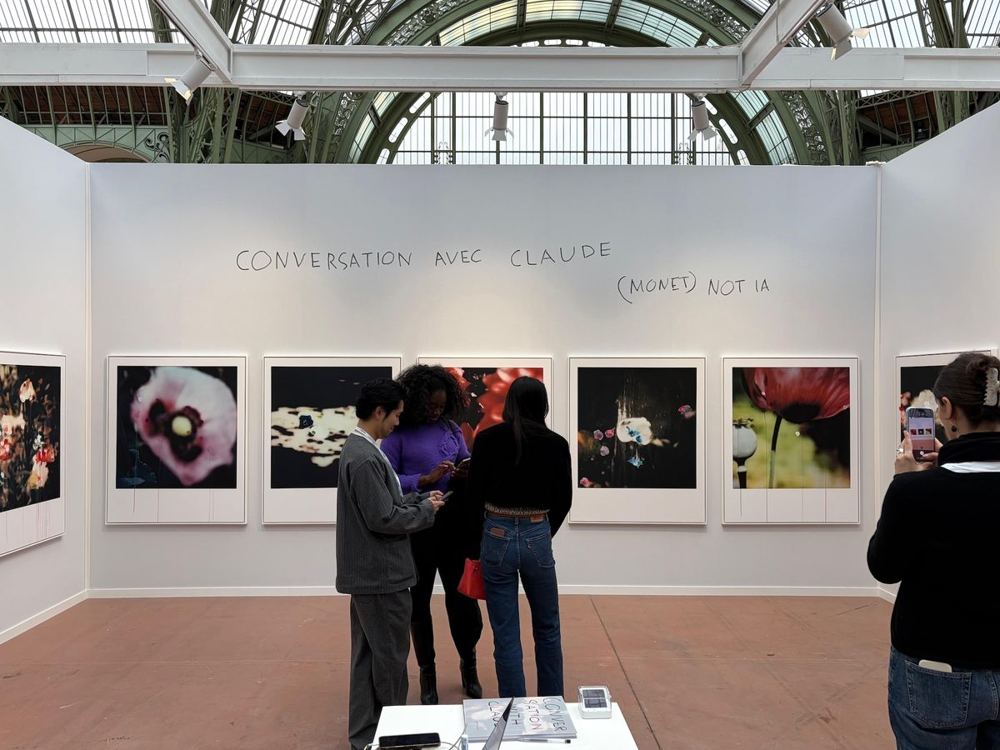
Meanwhile, facing the digital sector is Ruttkowski 68 ’s solo stand devoted to François Hallard’s large-scale Polaroid prints of flowers, with the title “Conversations avec Claude” written by the artist in bold letters at the top of the booth. On the second day of previews, Hallard added “(Monet) not IA” to the title, after countless visitors had presumed the works were related to AI. Evidently Anthropic’s AI engine has eclipsed one of the most consequential painters of the 20th century, at least in its claim to the first name Claude.
Given how much of an impact the nascent field of AI-generated photography has had on photography at large, it is unsurprising that we continue to add disclaimers and coin terms to differentiate the medium’s analogue lineage from its technological step-cousins. Several years ago, the dealer Howard Greenberg told me he favours the term “lens-based” to differentiate the two, and this seemed adequate at the time. But since then, plenty of artists (myself included) have incorporated photographic lenses, enlargers and other analogue tools and processes to experiment with and human-wash digital imagery, so “lens-based” may no longer be up to the task of distinguishing between an image taken with a camera and an image generated with a computer. “Synthetic photography” does have a nice ring to it, although the word itself makes one think of things like latex and carcinogenic sunscreen. Perhaps “soft photography” is the best term, for the moment.
Paris Photo’s digital sector and the Soft Photography programming deftly and quietly tackle the discipline’s ongoing existential crisis by demonstrating that digital art predates many of the technologies we are debating today, and its applications in contemporary photography today are legion.