The Mix 131: Mietze Conte
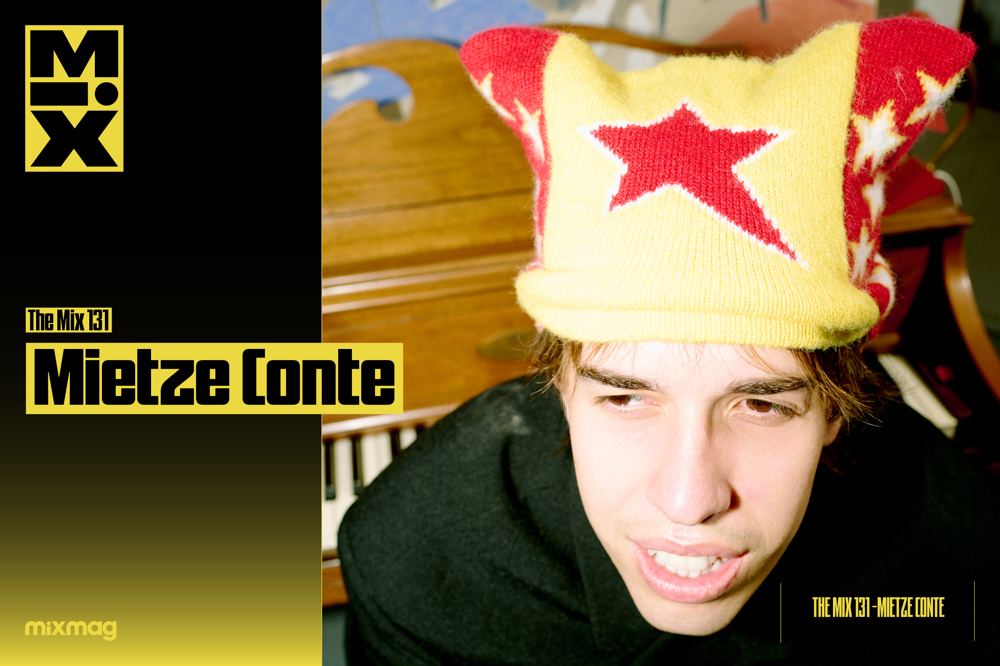
The Austrian artist shares a free-flowing mix that feels like levitating in a digital breeze for listeners, and speaks to Martyn Pepperell about the “magic” of discovering DAWs, surviving the LA songwriting system, and creating formative clubbing experiences for young people in Vienna Continue reading...
Over the last four years, Mietze Conte has captivated listeners from Vienna to Tokyo with his eclectic and hypercolourful vision for 2020s bubblegum dance-pop. Like a tear with a smile, his tracks play with the distance between what we show the external world and the realities of our inner lives, offering a brief respite without disengaging from the complexities of our emotional experiences.
Across his new album ‘(L)OVE (I)S (F)OR (E)VERYONE’ , the Austrian producer, singer-songwriter, DJ, and live electronica performer pulls together disparate influences. Wistful indie-pop melodies, sugary synthesisers, uptempo machine beats, big electro basslines, and hands-in-air rave euphoria dovetail with a lyrical specificity drawn from the small moments of everyday life. The results, songs like ‘painting on a monument’ and ‘origami’. feel expansive and personal in equal measure.
Hailing from the Austrian Alps, Mietze Conte had his first musical eureka moments as a teen in Vienna. Beginning with bass guitar, he familiarised himself with a range of instruments while playing in metal bands, before diving headfirst into electronic music production and DJing. As a young adult, he made his way to Los Angeles, where he got a taste of the commercial music industry and made some formative friendships, before refocusing his efforts towards a club-tempo blend of acoustic instrumentation and electronica under an earlier alias.
By 2022, he felt compelled to explore new music directions. One year and half a dozen singles and EPs later, he made his live debut as Mietze Conte at a Sumoclic x YAGIMADS party held at Tokyo's Enter Shibuya venue. It’s been a rollercoaster ride ever since.
Early in October, we talked on a video call while he was in the middle of an Australian tour. Bathed in clear, southern hemisphere light, he shared his memories of discovering deep house and techno in Vienna in the early 2010s, and offered up some lucid thoughts on the shifting states of music and culture.
As a DJ, Mietze Conte plays sets that reflect the creativity, freedom and flow that runs through his luminous productions. In his contribution to The Mix, he balances showcasing his production, songwriting and collaboration skills with giving us a window into some firm favourites from friends, peers and influences including 1tbsp, Otto Benson, Ninajirachi and Aphex Twin.
Opening with three ‘(L)OVE (I)S (F)OR (E)VERYONE’ album cuts that poignantly locate the melancholia that often lurks on the edge of joy, listening to his mix is like quickly levitating into the digital breeze, before being blown through a neon-lit dancefloor dreamscape that could only come from his brilliant mind. Listen to the mix and read the Q&A below.
You’re on tour in Australia for the third time, right now. Can you talk about your connection with the DJ community there?
With Mietze Conte, Australia is my second musical home, and I can tell you why. One of my oldest musical companions, Maxwell Byrne, aka 1tbsp , is from there. He started releasing my music on his label, which is now called dottidot . I feel super connected there. It's always so funny because it's the exact opposite end of the world from where I live.
What’s the difference between how you imagined Australia and your experiences there?
I thought a lot more people lived in Australia because it is so big. I was surprised by how tight-knit the community is. How well connected it feels is pretty mind-blowing.
We met eight years ago in Los Angeles when we were starting out making music. For both of us, it was our first time going to writing sessions. We bonded over that and being a similar age, 19 or 20 at the time. Since then, we’ve been on the same road. We always intertwine. We’ve made so many songs together.
So in a sense, you’re both survivors of the Los Angeles pop songwriting ecosystem?
Exactly [laughs]. I have to say, we never really fully participated. We only just took a peek. It didn’t really mix. It’s like oil and water. For some people who have their process down, it just works. You have to like doing the same things and following formulas. If you’re just about making music and having fun, it doesn’t make as much sense.
There’s also this underlying status thing. The idea of doing music in Los Angeles. Romantic notions of Hollywood, palm trees, etc. In my experience, it can make people feel quite crazy or depressed.
I 100% agree. It’s not sustainable. 90% of people who make music start because they love music. Living there, you might do three sessions a day. Suddenly, you have to work and make music to survive, not for pleasure. That’s heartbreaking.
Can you talk about your origin story before you went to Los Angeles?
I started playing bass when I was about 10. My first love in music was metal, especially Scandinavian metal. The first CD I ever bought was by Children of Bodom, a Finnish metal band. They’re still one of my favourites. Then I started playing guitar and playing in metal bands.
My passion really took off when my brother showed me Ableton. It was mind-blowing to me. I realised I didn’t need €10,000 to make an album. I didn’t need all this equipment to record. I could just sit at home and make a song. I couldn’t believe it .
Discovering electronic music production can be an amazing moment, especially if you’ve already had to negotiate things like band practice schedules.
Exactly. None of us had money. We all came from working-class families. We didn’t have any connections in music, so no one I knew could afford to make a record as a band, or even had the know-how. Ableton was like a miracle.
That happened really early. My brother started hosting deep house parties in Vienna because there wasn’t a lot going on. As the techno scene picked up across Europe in the early 2010s, I got really interested. The first time I went to one of my brother’s parties, I was 14. The clubs were 21-plus, but because he was the promoter, he could get me in. I was just chilling backstage, talking with the DJs. I was really interested in what they were doing and how they were doing it.
I had a similar experience in my mid-teens at the end of the '90s. I’m glad I got a glimpse of it.
Not to get all Ernest Hemingway on it, but it’s a moveable feast. I imagine you talk to younger people at your shows who wish they'd experienced 2010s club culture?
That’s true. It’s interesting how that happens. In hindsight, the 2010s were a really special time. Seeing what club culture has become now, and how clubs are struggling in Vienna, makes that period feel almost utopian.
In Austria, it feels like there's a huge gap now when it comes to subculture and alternative culture. When I was growing up, there were indie kids, emo kids, metal kids. There were skaters, ravers, techno kids, drum ‘n’ bass kids. There was a really big alternative subculture with so many different communities. Now it's just the extremes: super-mainstream events with a few super-big DJs, or illegal underground raves. The whole middle subculture has been hollowed out.
Whether we’re talking about music, culture or society in general, the middle tier was traditionally so important.
100%. That’s where the diversity and variety of music really comes from. That should be the biggest part. It was home to all kinds of people.
I think my main thing has been bringing the energy I feel in the studio to the stage. I want it to feel like I'm being creative, improvising, and free. What I love most is surprising the audience and myself. The best shows are the ones where I can let go, get into the flow, and really play in the moment. I can come up with things I wouldn’t have thought of beforehand. That’s always super exciting to me.
One of my biggest inspirations growing up was Skrillex . Seeing him DJ was always mind-blowing. He brought a rock attitude to DJing because of his metal background. I thought it was so cool.
As a selector, I love Björk . I love her DJ sets and the way she selects music. I was just blown away. Her selection is insane. It’s just so good. It’s amazing to see someone who’s always tapped into what’s happening in music right now.
One more: Khadija Al Hanafi . She’s a Tunisian DJ. I saw her DJ in Tokyo for the first time. It was one of the best sets I’ve ever seen. It was insane, just this really raw, out-of-this-world DJing. She picked up on the vibes so perfectly. I booked Khadija in Vienna too, and it was my favourite show I’ve ever seen there.
How involved are you in music at home in Austria these days?
I travel so much and play all over the world, so it’s very important to me to give back to the community in Vienna. When I started making music, I was really inspired by techno DJs and everything going on around me. I want young people in Vienna to have the same experiences.
I have a couple of things going on. I run a studio project where we rent out studios, and I do mentoring programmes for students and upcoming musicians. We’re also throwing a party series called club_bingg , focused on new and underground music, combining local and international artists.
Are there any producers or DJs from Vienna you’d like to mention?
There’s a really cool new alternative music scene in Vienna. There’s Beaks , who’s an indie artist, super cool. Then there’s kid on air . She just released a song featuring 1tbsp. She’d released songs before, but this was a really big thing for her. There’s a really cool EDM producer called Mac Fleasy , who’s awesome. EDM Shaman is super sick, too.
Part of why we’re talking today is that you have a new album, ‘(L)OVE (I)S (F)OR (E)VERYONE’. To me, it feels like a convergence between lo-fi pop, video game music and some of the more colourful strands of modern dance music. How does it look from your perspective?
I think all of the influences you just brought up are definitely there. Early video game music, for sure. When I make music now, I don’t really think about it. I just sit and play a keyboard, or I play a synthesiser, or I make something on my computer, and it’s self-expression. It comes from all my experiences and my love and passion for music. So there will be all of these things in there that I love. There will be metal music in there. There will be hyperpop. There will be SOPHIE in there. There will also be, I don’t know, Chopin in there; all the stuff I love.
You sing about things like latte art and a card game called Magic: The Gathering . There’s a lot of biographical details hiding in plain sight in your music.