Over Arepas and Cachitos, Venezuelans in Madrid Find a Sense of Home
With some 130,000 Venezuelans now living in Madrid, family-run restaurants, community-oriented cafés, and beloved empanada stalls keep the country's flavors close.
I make my way to the prepared-food stalls aisle, where the woman at Buda Bar Delicias Venezolanas draws me in by calling me amor and asking what I’d like to order, reina. The familiar warmth of Latin America, I lived in Mexico before moving to Spain, tears open a pang of nostalgia in my chest. Guests seated at the stainless-steel bar munch on empanadas de carne mechada, continuously reaching for the green, herby salsa guasacaca. “How can it be that they are pumping a million barrels of oil out a day but they cannot fix a single hospital in Caracas?” I overhear another diner say to a friend, discussing the latest spate of frustrations back home.
The Mercado de Las Maravillas is "where the Venezolanismo here in Madrid started,” restaurant owner Manuel Pérez Álvarez says.
Among Madrid’s 130,000-strong Venezuelan diaspora , these conversations are not uncommon. Spain’s Venezuelan population has swollen to almost 700,000 people , making it the largest community outside of the Americas, and a significant portion of the country’s nearly eight million citizens living abroad. Many have fled their homeland amid the economic and political instability that followed Hugo Chavez’s Bolivarian Revolution and continued under Nicolás Maduro’s rule. Ongoing uncertainty continues to drive migration. Unlike other diasporas, Madrid’s Venezuelan population isn’t concentrated in a single neighborhood. Instead, it stretches across the city and spans a broad socioeconomic spectrum, from delivery drivers and financiers to political exiles.
Manuel Pérez Álvarez and his wife Maira María Gómez can pinpoint the moment they decided to open a Venezuelan restaurant in Madrid. The two, who moved to Spain in 1997 after a lifetime in the coastal city of Puerto de La Cruz, had gone to meet friends for Venezuelan empanadas at one of the few spots in town at the time. After waiting 45 minutes for their order in a long line of people hankering for a taste of home, Pérez, a natural entrepreneur, saw opportunity.
Manuel Pérez Álvarez and his wife Maira María Gómez opened El Empanadazo in Madrid nearly a decade ago.
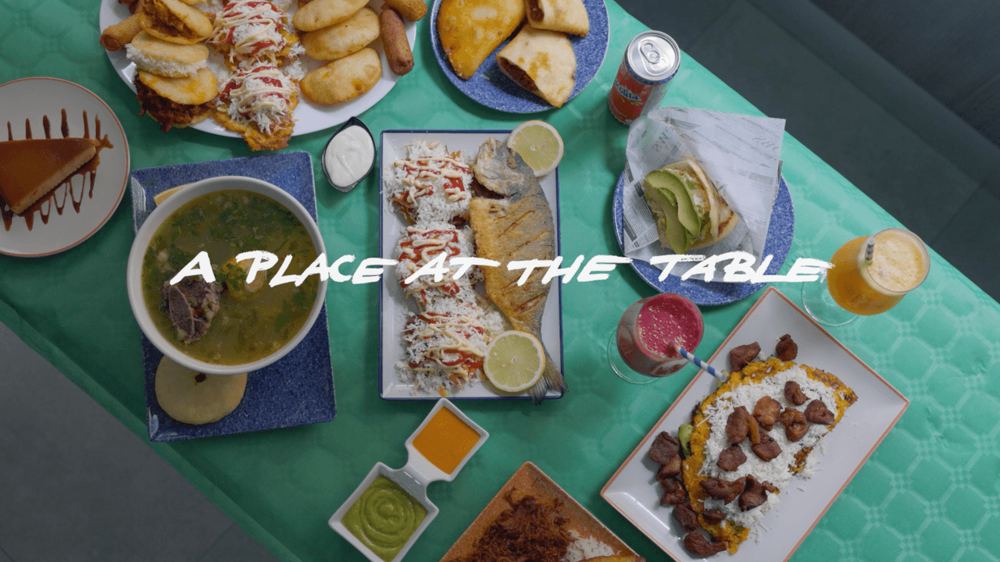
Venezuela's national dish, pabellon criollo, rice, beans, shredded beef, and plantains, is served alongside cachapas, arepas, fried fish, and more.
When they opened El Empanadazo nearly a decade ago, the couple joined the ranks of just a handful of other Venezuelan food joints. They chose to set up shop in the Mercado de Las Maravillas. “It was really where the Venezolanismo here in Madrid started,” Pérez Álvarez says of the market. In no time, they were serving hearty plates of Venezuela's national dish, pabellon criollo, rice, beans, shredded beef, and plantains, crispy fried whole fish, sweet corn griddled cachapas, arepas, and more.
“Our restaurant really became a gathering place for Venezuelans. I remember the early days when I was spending more time there, seeing people with tears in their eyes,” Pérez says. “When you’re an immigrant, little things like the taste of home really get to you.”
Maira María Gómez and her husband Manuel Pérez Álvarez opened El Empanadazo in Madrid nearly a decade ago, there were far fewer Venezuelan restaurants in the city.
At the time, Venezuelan food wasn’t as easy to find and people went out of their way for it. Today, a quick search for “arepa” on the delivery apps will turn up hundreds of options. “Now there are lots of spots, but we were really pioneers, and it wasn’t even all that long ago,” Pérez says.
Be it Arepa’s Coffee Shop nestled next to the hustle of the Moncloa train and bus station, or the four-location La Arepera , the Insta-famous El Chino Venezolano , or the fast-growing Guasacaca , the country’s gastronomic footprint continues to grow alongside its diaspora in Madrid. At the March 2026 Arepa Fest , a celebration of Venezuelan and Colombian food and culture, in the north edges of Madrid, more than 5,000 people gathered to snack on the region's signature split- and stuffed-cornmeal snack, while the sound system alternated between pumping Venezuelan Merengue and reggaeton.
At Panadería Torrerí, warm pastries like cachitos, a brioche-like crescent roll most typically filled with ham and cheese, and golfeados, spiral pastry dough filled with cheese, keep customers coming back.
A similar fervor can be felt at Panadería Torrerí . By mid-morning, the team is already replenishing their glass case of cachitos, a brioche-like crescent roll most typically filled with ham and cheese, and golfeados, spiral pastry dough filled with cheese, and brushed with panela (unrefined cane sugar) and anise. Regulars grab a table and owner Mara Azuaje, always poised with a “¿Cómo está usted?” quickly ferries over their order.
Azuaje opened her bakery in 2024 to bring traditional Venezuelan pastries to the neighborhood of Barrio de Salamanca. For years, there had been no Venezuelan bakery in the area, despite this upscale neighborhood being nicknamed “Little Caracas” for its substantial diaspora. Today, Panadería Torrerí attracts both affluent property owners alongside motorbike messengers, all looking for a taste of home.
Mara Azuaje opened Panadería Torrerí in the Barrio de Salamanca in 2024.
Azuaje, who came to Spain at 27, knows what they're after. She spent years working odd jobs to save the money needed to open her bakery. “I cleaned homes, worked as a delivery driver, took care of children. I did whatever, but I was always very ambitious,” Azuaje says. “I wanted to have my own business.”
She didn’t understand the exact shape it would take, but her grandmother’s lessons to her as a child around the importance of learning an oficio, a craft, stayed with her. “I was always baking with my grandmother who told me I needed to know how to do something, so I opened a bakery,” she says. Today, Azuaje is proud to be known across the neighborhood for her homemade bread and her hearty rolled-dough pastries.
Other Venezuelan restaurant owners transitioned into hospitality later in life. At Bea Castelló Castro and Luis Felipe Fossa’s Cafetín , the menu, arepas with chia seeds, shredded chicken, and avocado for breakfast, or creamed curry soup and sweet corn and hearty salads for lunch, carries traces of Venezuela while honoring the other places the couple has called home.
At Cafetín , the menu showcases Venezuelan flavors through a global lens.
Cafetín's arepas are stuffed with chia seeds, shredded chicken, and avocado
The married pair came to Madrid after a full life in Caracas. “By 2007 Chávez just kept winning and winning, and things were getting worse and worse. It really scared us,” Fossa says. That year was Chávez’s first attempt at constitutional reform to remove presidential term limits and expand state control of the economy. He lost his bid but remained in power and went on to secure reform in 2009. So, when the bank Fossa worked for offered him a job in Zurich , they didn’t hesitate. It was a decision that has led to many years of living abroad .
Bea Castelló Castro and Luis Felipe Fossa say that their Cafetín has become a hub for Venezuelans, who connect over coffee and arepas.
Their clientele reflects a similar worldliness, with Venezuelans who arrived directly from Caracas but also those who have made it here by way of a university in Boston, or lived for years in Miami, New York, or London. Cafetín is a meeting point where these Venezuelans intersect, creating a community within a community. As Castelló Castro put it, “empiezas a hacer nexo”, you start to make connections.
Recently, I'm told, a couple in a sunlit corner of the cafe started chatting with a man standing at the long bar after hearing him mention Caracas. They began tracing the routes through Miami and New York that had brought them to Madrid. Another day, a college sweatshirt prompted a conversation, and a new friendship. “It’s beautiful to see, especially in difficult moments in Venezuela,” says Castelló Castro.
Back at the Mercado de Las Maravillas, I sit at Buda Bar watching the lunch rush fade, as owner Rebeksa Mouzaber prepares me a sweet-corn crescent-shaped cachapa, its edges lacy from a bed of hot butter on the flattop griddle. A food courier accepts a freshly-made pocket-sized empanada while he scrolls and waits for his order.
Venezuelans like coming here because they feel at home, not just in the dishes that are served but also in the way they are asked for, Mouzaber tells me. “We know what it means when they ask for an ñapa (a top-up), just like we know how it feels to be so far away from home.”