The new migrant crisis frontline: This tiny island in the Canaries was left living in fear when 11,000 African asylum seekers arrived on 100 boats. Now many are heading to Britain...
It is a stark illustration of the latest twist in Europe's migration crisis, of how a tiny Spanish island was overwhelmed by 100 boats carrying nearly 11,000 West Africans within just a few weeks.
Published: 01:00 GMT, 21 November 2026 | Updated: 14:51 GMT, 21 November 2026
Dozens of brightly painted wooden boats lie piled up in a sprawling graveyard, their perilous journeys across the Atlantic finally at an end.
Some are enormous fishing vessels that were never intended to transport hundreds of passengers across the open ocean. Others are smaller, their weather-beaten sides a reminder of the horrendous conditions endured during voyages lasting up to 12 days.
They are a stark illustration of the latest twist in Europe’s migration crisis, of how a tiny Spanish island in the Canaries, population just 12,000, was overwhelmed by 100 boats carrying nearly 11,000 West Africans within just a few weeks.
The battered wooden vessels, known locally as cayucos, have been hauled away from the ports on the isle of El Hierro and dumped at a recycling site. The scene is reminiscent of the compounds in Kent full of abandoned rubber dinghies used by migrants to cross the Channel.
But the migration route to the Canaries from West African countries such as Senegal, The Gambia and Mauritania is much longer and far more dangerous.
For those who survive the journey, El Hierro is hardly ever the intended final destination. It is simply the first piece of European territory they have managed to reach, a staging post en route to the Continent and, for some, a passage in another small boat to reach Britain.
At a temporary migrant processing camp in San Andrés, high in the island’s interior, the next stage of the journey was playing out when the Daily Mail visited this week.
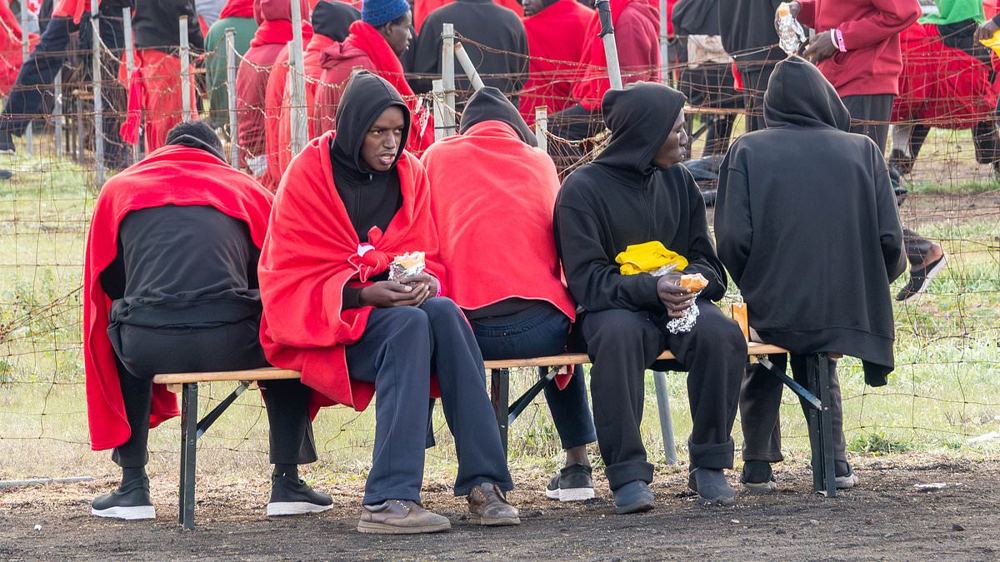
Groups of young men gathered outside the accommodation facilities, some sitting along a low wall with their mobile phones, taking photographs and making calls. Others passed the time playing football.
New arrivals on the isle of El Hierro, a tiny Spanish island in the Canaries, make calls and send messages on their mobile phones
Colourful boats used by migrants making the journey are now left abandoned on the island's shores
Among them were brothers Amarah, 22, and Abaraka, 17, who had travelled from The Gambia and were already thinking about what they would do once they reached mainland Europe.
‘I have come here to find a job. I can drive a car, I will be a delivery driver or a taxi driver. But he came for school, to study,’ Amarah said, gesturing towards his younger brother.
Asked where he was heading, he had little hesitation. ‘I want to go to France, we all want to go to France,’ he said. And could that journey eventually take him to Britain? ‘Yes, maybe,’ he replied. For others, the intended destination was Germany.
Yamusa, 24, from Guinea, spent eight days aboard a boat before reaching El Hierro. He has no family in Europe but has heard that Germany offers good opportunities for work.
Asked what the Atlantic crossing was like, he simply shook his head and said: ‘Never again.’
Another group of migrants sitting on a wall at the camp described the horrors of the gruelling journey.
Cheikh, 24, from Senegal, said he had paid $500 for his passage, only for the crossing to turn deadly when passengers were lost at sea.
Among them, he said, was a woman who had become so exhausted that she fell overboard and disappeared into the Atlantic. She was never seen again. El Hierro is the smallest of the Canary Islands, a place better known for its volcanic landscapes, fishing villages and spectacular diving than the international headlines it now finds itself making as the unlikely new frontline of Europe’s migrant crisis.
In the first half of November alone, almost 100 overcrowded wooden fishing boats carrying close to 11,000 people reached the island, compared with just 66 boats during the entire preceding ten months of the year.
The sudden surge in crossings from the west coast of Africa threatens to overwhelm El Hierro’s limited infrastructure. For such a tiny island, the scale of the arrivals is difficult to comprehend. At times, more people have been brought ashore in a matter of days than live in some of its villages.
And while most migrants are eventually transferred to larger islands or mainland Spain, the boats they arrive in, the emergency facilities erected to accommodate them and the growing pressure on local services, have left their mark.
The Canary Islands lie about 60 miles off the north-west coast of Africa, but the distances travelled to reach them can be far greater as migrants take longer routes to evade security forces. There are more crossings in the autumn when the seas are calmer.
Many of the boats reaching El Hierro have departed from ports in Senegal and Gambia, travelling up to 1,000 miles, leaving their passengers exposed to Atlantic swells, dehydration and exhaustion for days on end.
According to the United Nations refugee agency, the UNHCR, around 600 people died or disappeared attempting to reach the Canary Islands by sea between the start of the year and November 16.
The true toll is feared to be higher, with no reliable way of knowing how many vessels have vanished in the vast stretches of ocean between Africa and European territory.
Migrants from West Africa sit, wrapped in blankets, after arriving in the Canary Islands on wooden boats
Lettice Bromovsky reports from El Hierro, a piece of European territory which is used by migrants as a staging post en route to the Continent
The crisis escalated last weekend when 3,047 migrants arrived in the Canary Islands aboard 23 boats, with El Hierro bearing the brunt of the influx. On Sunday alone, 1,354 people were brought ashore on the island, including 1,030 at the small fishing harbour of La Restinga and another 324 at La Estaca, its main ferry port.
Local authorities said Spain’s Guardia Civil was still out searching for four boats that had gone missing. Tragically, their assumption was that they had missed the tiny island and were lost at sea.
With emergency accommodation already stretched to its limits, hundreds were left sleeping at the harbours as authorities scrambled to find somewhere to house them.
At one point the temporary processing centre in San Andrés, built to accommodate around 500 people, was sheltering approximately 1,300, while hundreds more were housed in a sports hall and a former convent. The centre, set among the rolling hills of El Hierro’s rural interior, was designed as a temporary holding facility where new arrivals could be processed before being transferred elsewhere. But the sheer volume of people reaching the island has repeatedly pushed it beyond capacity.
By Wednesday, the number at San Andrés had fallen to around 400 to 500 after approximately 1,000 were transferred off the island over two days, offering some respite to the overstretched authorities.
At the port of La Estaca, the Mail watched yesterday morning as hundreds of male migrants were marched aboard a passenger ferry bound for Tenerife.
The pressure has also been felt at El Hierro’s only hospital, Nuestra Señora de los Reyes, prompting the installation of a temporary field hospital at the centre this week. Additional doctors and nurses have also been drafted in from mainland Spain.
Canary Islands president Fernando Clavijo visited the camp on Thursday and warned that the flow of migrants was unlikely to stop, pointing to the geographical position of the islands, the wealth disparity between Africa and Europe and the instability in countries from which many of the boats depart.
He called for greater co-operation with African nations to prevent the departures in the first place, while acknowledging that the islands would need to prepare for continued arrivals. Spanish prime minister Pedro Sanchez is under pressure from the EU and increasingly frustrated voters to sort out the crisis as he faces a snap election on November 29.
Mr Sánchez has faced a huge backlash from Right-wing politicians to his controversial amnesty for as many as half a million undocumented immigrants already in the country.
The growing political anger was on display at La Restinga yesterday as Alberto Núñez Feijóo, leader of Spain’s opposition Popular Party, joined residents protesting against the influx.
Speaking at the port, he declared: ‘Spain is experiencing one of the greatest crises of illegal immigration in Europe.’