‘A fight to demand that humans are worth investing in’: Theaster Gates on taking over America’s last porcelain factory
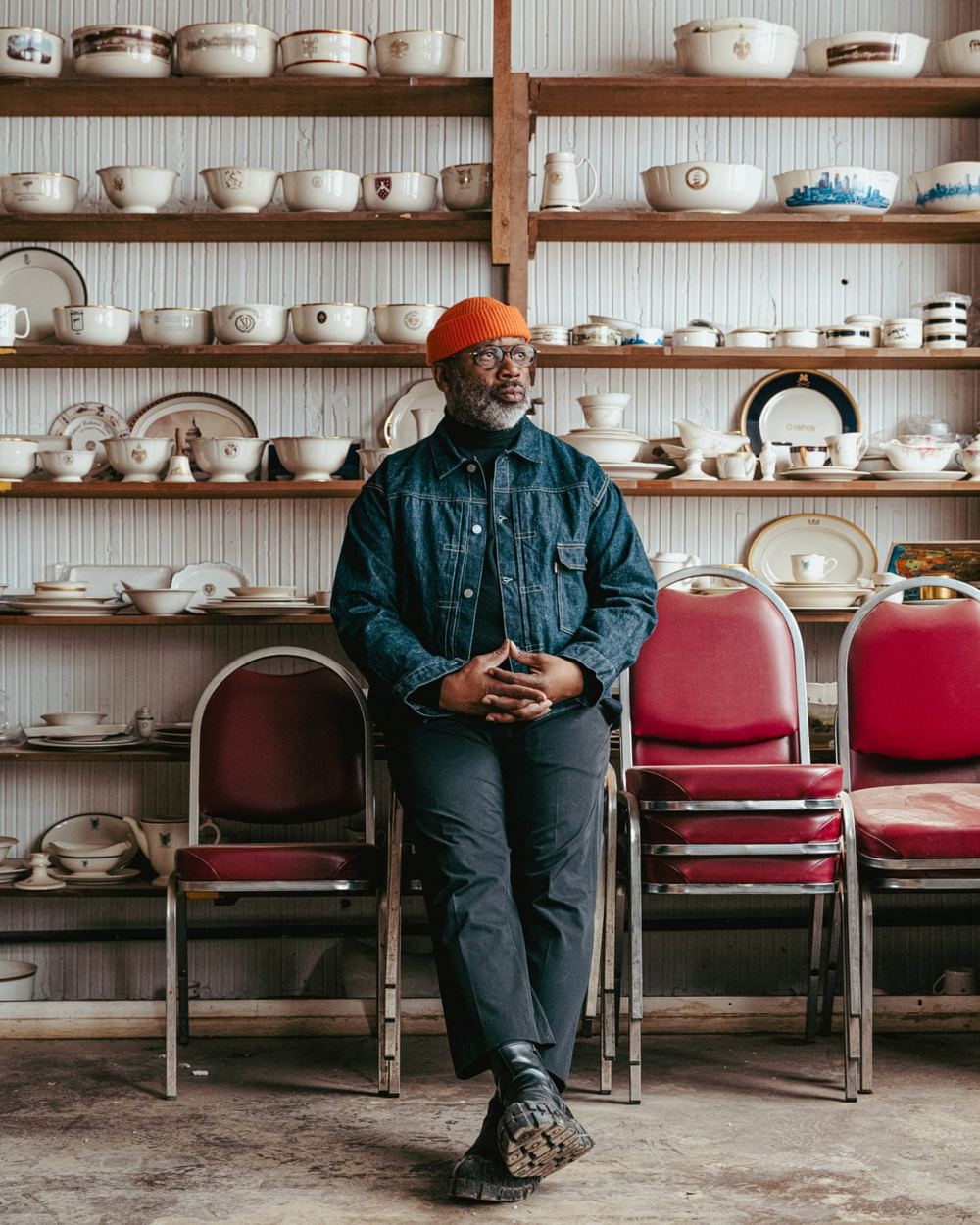
As he invests in 60,0000 sq ft of midwest real estate, the celebrated artist explains bringing ‘independent thinking’ back to fine china “The worth of hand-painted china depends mainly upon the hand ,” reads an advertisement dating from 1910 and displayed just inside the entrance of the Pickard China factory, a sprawling, 60,000 sq ft brick building just outside of Chicago. “Most of the large staff of artists at the Pickard studios have been trained in the great art centers of Europe, and each piece of Pickard is painted from start to finish by the same master craftsman.” Those statements are
As he invests in 60,0000 sq ft of midwest real estate, the celebrated artist explains bringing ‘independent thinking’ back to fine china
Those statements are a distant echo from another age. These days, Pickard, the last operational porcelain fine china factory in the US, is in a shocking state of disrepair, its 12 remaining employees struggling to fulfill longstanding orders for the White House (Pickard began producing official White House china in 2008 when the company was commissioned by Laura Bush), Williams Sonoma, US embassies, private golf clubs and anxious brides-to-be.
Inside the building, decommissioned machines the size of school buses remain frozen in their final moments of functionality, collecting dust, cobwebs and slip splatter. The roof is patched by a checkerboard of blue and green tarps strung from rafters and draped into makeshift troughs, water trickling into large commercial garbage cans. The doors to some rooms have remained locked for decades in an attempt to contain the toxic mold spreading inside. Thousands of pieces of porcelain plates, cups, pitchers and bowls sit stacked on ancient wood shelves, languishing in various stages of incompletion. Some lights are functional, most are not, casting the whole eerie scene into semi-darkness.
The lights are about to be flipped back on. In September, Theaster Gates , the celebrated artist and radical urban interventionist, became the new owner of Pickard China, its client roster, its design archive, and this massive, crumbling factory surrounded by cornfields in Antioch, Illinois, 50 miles north of Chicago.
I visited the factory on a damp, early fall morning, a few days after the staff had learned of the ownership change. Just five employees were on site, stamping, trimming and lining individual pieces among the battered machinery and crumbling walls. I was instantly struck by the magnitude of what the new owner was up against. “It feels like I was slowly building the muscle and aptitude to be ready for a project like Pickard,” says Gates, a ceramicist, sculptor and art world heavyweight who is best known for transforming sections of his South Side Chicago neighborhood by buying up abandoned buildings and deftly turning them into inspired spaces of community, art and learning. “It’s like I’ve been preparing for a decathlon for 20 years.”
Gates was formerly professor at the University of Chicago and an urban planner, but when his star began to rise in the art world he used his earnings to become something of a real estate Robin Hood, scooping up old buildings, businesses and archives on the brink of extinction. In 2013, he purchased the Stony Island Bank for $1 from the city of Chicago, transforming the derelict 113-year-old Neoclassical behemoth into a thriving cultural center that includes a cinema screening Black films, the personal vinyl collection of the pioneering DJ Frankie Knuckles, the full archive of Ebony and Jet magazines and a Korean-inspired tea salon. Just last year, Gates opened the doors to The Land School , a 40,000 sq ft former parochial elementary school that, following his $14m reimagining, now serves as a center for experimentation in art, music, and community engagement.
But Gates admits that this latest acquisition is on a completely different scale. While his other projects have been bought, renovated and run by his arts nonprofit, the Rebuild Foundation, his purchase of Pickard marks the first time Gates is taking over a floundering business and hoping to make it profitable. And he’s doing so at a moment when the sustainability of American manufacturing and the perceived value of human labor is in free fall. In other words, it is the quintessence of a Theaster Gates project.
“The way that I’m approaching this is that, first, you have to make the choice that the human hand is worth investing in,” says Gates, who has spent his artistic career examining entrenched, often exploitative systems and doggedly burrowing alternative routes, showing the world that another way is possible. “From the turn of the century, big business has been trying to figure out how to need humans less and how to make more money. AI is just the newest face to what has felt, for me, a very consistent ambition of a certain kind of business practice. So, on one level, this is a civil fight to demand that humans are necessary to creative and manufacturing acts.”
Which is why his first action item upon being named the new owner and president of Pickard was not to fix the leaks or start tinkering with the ancient kilns, but to shore up the emotional health of the skeleton crew of employees.
“We were left with a building that needed a lot of care, and a staff that needed to know that their jobs were important and that they were safe. The first thing I wanted to do was really work on the mental health of my staff, to show my humanity and my willingness to make the investments that were necessary,” says Gates, who has long been interested in the question of labor, studying thinkers from John Ruskin to John Calvin. “Those things are no longer theoretical or conceptual, they’re very, very practical right now, and I’m enjoying it.”
Gates purchased the company for an undisclosed sum from Andy Pickard Morgan, a fourth-generation Pickard family member who had been at the helm since 2006.
“I’m not on eBay looking for companies,” says Gates, when asked how he ends up with fixer-uppers that no one else will touch. “The first criteria is that it lands in my lap.”
Up against slumping sales and deteriorating infrastructure, Pickard Morgan was quietly preparing to sell or shutter the 130-year-old family business when Gates cold-called him, inquiring about partnering on a homewares project he was leading for Prada. Gates quickly discovered that Pickard, once the pride of Chicago and an employer of hundreds, including a cadre of plate painters imported from the Wedgwood factory in Stoke-on-Trent, was on life support.
“I’m really proud of the decorative legacy that Pickard’s had, but I have an opportunity to bring a new philosophical position to it,” says Gates, whose own ceramic practice references myriad cultural influences, from the ancient practices of Japanese pottery to the work of 19th century enslaved ceramicist David Drake. “First we assess deeply what we know how to do, and what we’ve done for the past 130 years, and then do a remix and an edit before we start throwing anything out. There has to first be a logic, a philosophy, a cultural root, before you touch a thing.”
Gates mentions the company’s two remaining line painters, who were brought over from Wedgwood more than 25 years ago, revered for their steady hands and the delicate, uniform gold circles they paint on china bound for Air Force One or the White House dining room.
“I’ve been thinking a lot about the possibilities. What if our liners made other lines besides edging a plate? What are the other kinds of lines that they might be interested in, or might know how to do? I don’t know if anyone’s ever asked them,” says Gates, who plans to host drawing workshops for employees where they can create more freely, perhaps inspiring the next generation of Pickard designs and motifs. “If they can move between skilled artisan to free independent thinking artist back to skilled artisan, can we grow what’s able to happen on a plate?”
As he is known to do, Gates is focused simultaneously on both the small details and the big ideas. Adroit and deeply experienced with restoration projects, he promises that if we return in a year, we will see a gorgeous building and a humming artisanal manufacturing business. He is also unboung in his artistic pursuit to conceive of a better world, with a hope that something grander will emerge.
“If we’re going to try to imagine some kind of scaled celebration of people’s labor and their efforts to make things, it’s going to have to be bigger than what I can produce in one little studio,” says Gates. “Why is it art? Because the factory will become a conceptual example of what’s possible. The plates and cups and bowls, that’s just the byproduct of trying to offer our humanity back. Not only does it feel like art, it feels like the biggest conceptual project I’ve ever done.”