Ancient chariot find in Spain reveals early Mediterranean trade networks
The discovery of a 2,500-year-old Etruscan bronze chariot in western Spain provides physical evidence of sophisticated, continent-spanning supply chains that predate modern European integration by millennia.
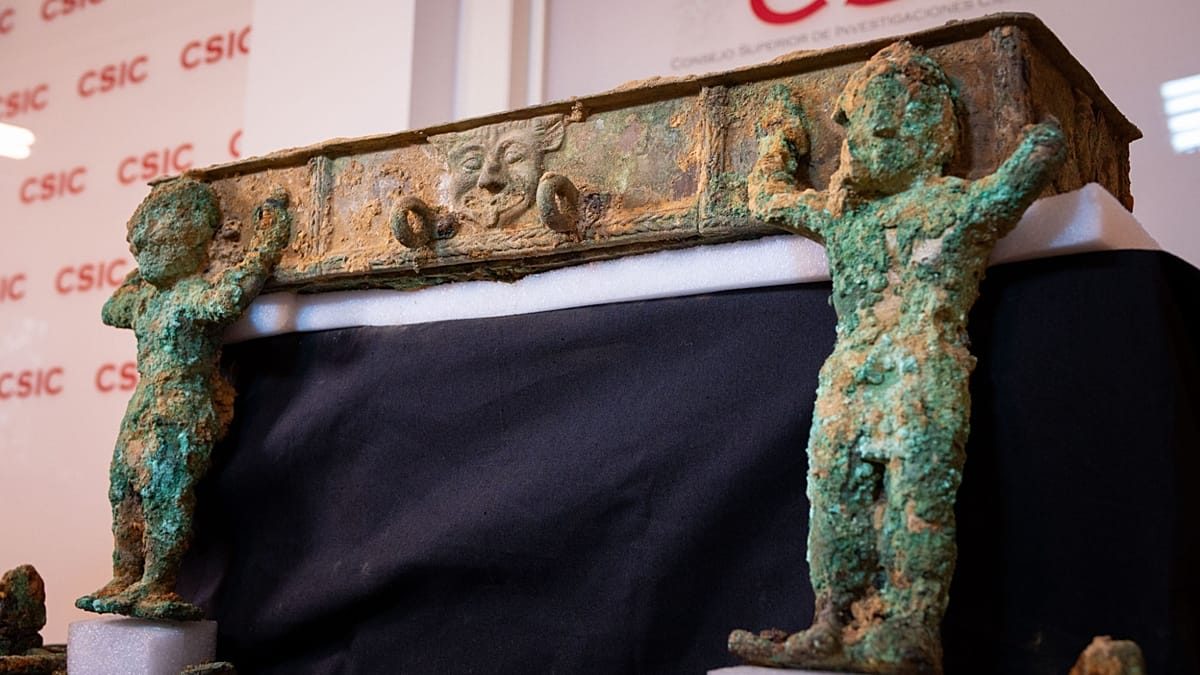
Archaeologists excavating the Casas del Turuñuelo burial mound in Guareña, Badajoz, have unearthed a bronze chariot unlike any previously found on the Iberian Peninsula. The 2,500-year-old artifact features a decorated box adorned with relief figures, including the river deity Achelous, griffins, and human figures supporting the structure on ornate wheels.
The chariot's design matches those produced by the Etruscan civilisation in central Italy. Its presence in Extremadura confirms that pre-Roman Iberia was not an isolated outpost but a well-connected terminus in a vast Mediterranean exchange network. "These materials are providing us with exceptional information to understand the trade relations between the East and the Iberian Peninsula," said Esther Rodríguez, co-director of the excavations.
The 2026 campaign, carried out in April and May, recovered additional imported goods alongside the chariot that map out a multi-regional supply chain. Researchers found pottery from Greek Attica, an Egyptian alabaster vessel, and eastern Mediterranean ivories decorated with warriors and plant motifs. These items demonstrate the movement of high-value luxury goods across three continents.
Co-director Sebastián Celestino suggested the chariot was tied to banquet rituals, noting it was found near a room where the community held a final feast before deliberately sealing the 90-metre-diameter building at the end of the 5th century BC. Recent work in the northern sector also uncovered two braziers and a bronze cauldron.
This find is the latest in a decade of work at the site that is reshaping understanding of the Tartessian economy. In 2017, excavations documented the largest animal sacrifice known in the western Mediterranean. Subsequent years yielded the first human representations of the culture, a slate plaque with warrior scenes and a southern Palaeohispanic alphabet, and in 2025, the oldest Greek marble altar in the western Mediterranean.
The scale of the research reflects significant institutional investment in cultural heritage. The Building Tartessos project involves around 100 researchers from 30 institutions, led by the Institute of Archaeology of Mérida. It is backed by the Spanish National Research Council, the regional government of Extremadura, the Provincial Council of Badajoz, and Guareña Town Council.
The artefacts have now been transferred to the Autonomous University of Madrid for laboratory analysis. "The second phase of any archaeological excavation is indispensable," Rodríguez noted, adding that this work will clarify trade relations. "It is one of the most significant finds made to date at this Tartessian site," she said.