How Trump, Vance and a ‘war room’ brought Jensen Huang back to Nvidia
President Donald Trump put Vice President JD Vance to work on Nvidia’s board before it brought Jensen Huang back as chief executive. Maggie Haberman, Jonathan Swan and Julian E. Barnes reported this for The New York Times. Trump returned from China at the end of last week and asked Vance to talk to Huang. Vance […] This story continues at The Next Web
President Donald Trump put Vice President JD Vance to work on Nvidia’s board before it brought Jensen Huang back as chief executive. Maggie Haberman, Jonathan Swan and Julian E. Barnes reported this for The New York Times . Trump returned from China at the end of last week and asked Vance to talk to Huang. Vance spoke privately with him over the weekend.
Vance worked to get the board two things, according to the Times. One was an assurance that the administration did not see Huang as a national security threat. The other was a statement that Huang was not facing criminal charges. Only a handful of top officials knew about the talks.
Trump told the Times he first checked with Attorney General Todd Blanche and intelligence chief Jay Clayton.
“I had to go to them before I recommended this,” Trump said. “Look, I can’t do this and then all of a sudden have somebody get indicted for, for whatever.”
Trump had already said he gave the board assurances . On the same CNBC interview on Monday, he said “J.D. Vance was great.” He would not say who spoke for him at the board meeting. He added that the fall in Nvidia’s stock made his task easier.
“It was a lot easier to convince them yesterday than it was a week and a half ago,” he said.
Representatives for Huang and Vance declined to comment to the Times.
Huang’s allies started lobbying within hours of his resignation on 12 November, the Financial Times reported. The group included Uber founder Travis Kalanick and Goldman Sachs executive John Underwood. Investors Gavin Baker, Brad Gerstner and Marc Andreessen were also part of it.
One of them arranged a 45-minute phone call between Huang and Vance last week, according to the FT. Huang defended his positions on export controls and remote access to chips. He also defended his dealings with Megaspeed, the Singapore company now on a US trade blacklist . Andreessen Horowitz declined to comment, and the others did not respond, the FT said.
Trump and Vance saw Huang as the sole protector of American open-weight AI models, people familiar with the matter told Reuters . Anyone can download and adapt such models. Nvidia agreed in August to buy Hugging Face, a platform that hosts them.
The talks were so secretive that even Colette Kress, Nvidia’s interim chief executive, did not take part, the FT reported. The Sunday board meeting included Trump but not Kress or anyone else from management, Dina Bass wrote for Bloomberg .
At that meeting, Huang told the board about more affairs than the two already public, The Wall Street Journal reported. The Journal cited people with knowledge of the discussion. The board reinstated Huang on Monday, citing his candour. Six days earlier, it had ruled out his return.
Kress has gone back to her job as chief financial officer. Trump was blunt about her on CNBC.
“She’s not a chip person. She doesn’t know. She knows less about chips than I do,” Trump said.
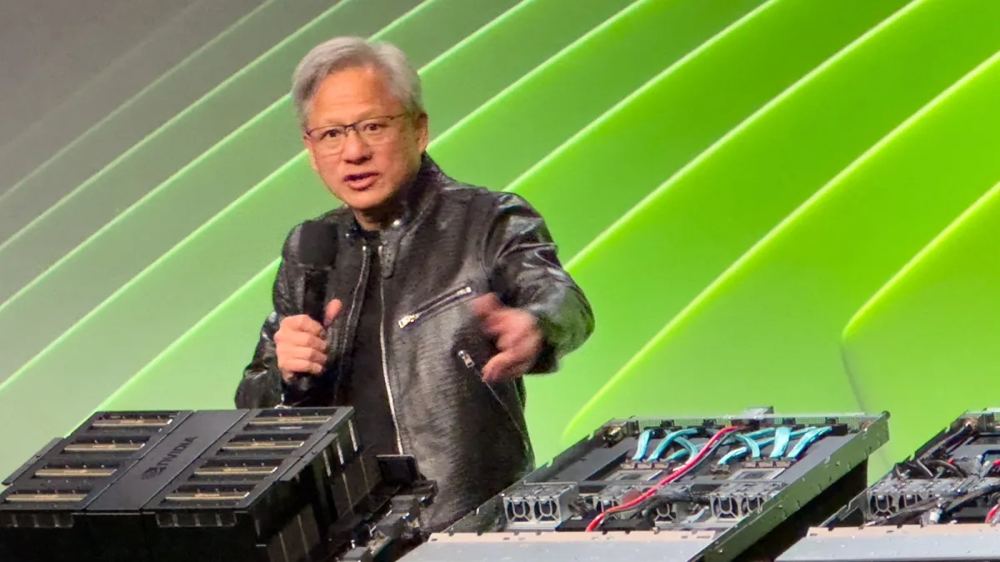
Huang walked back into Nvidia’s Santa Clara headquarters on Monday to chants of his name, Geoff Weiss reported for Business Insider . He wore a navy cotton coat rather than his usual black leather jacket.
“I’m terribly sorry for putting all of you through all of this,” Huang said in a video of the scene.
He promised to be “a better CEO the second time around,” a person in attendance told Business Insider. He also joked that IT would have to give him a new PC. Huang told staff he had “made some very terrible mistakes,” and that he would “work on coming back,” according to the FT.
Nvidia’s shares closed 31.5% higher on Monday, adding $952bn in market value, a record for any company, according to the FT . They were still about 5% below their level on 11 November, before Huang resigned. The S&P 500 rose 4.7% and the Nasdaq Composite 6.5%, each its best session since April 2025, CNBC reported. The jump also drew cheers from tech leaders .
Asian chip stocks followed on Tuesday. TSMC, which makes Nvidia’s chips, hit its 9.9% daily limit and added $158bn in value in a single day, Fortune reported. Taiwan’s Taiex rose 9%, a week after a 17.5% fall, its worst week since 1991. South Korea’s Kospi gained 6.2% and Japan’s Nikkei 3.9%, while Hong Kong’s Hang Seng slipped 0.6%.
In New York, the rally faded. Nvidia shares fell 5.1% in premarket trading by 7:41am ET, CNBC reported. Micron, Marvell, AMD and Arm were 4% to 6% lower. Anthropic fell as much as 7.3% to $81.28 before the open, below its $83 IPO price, according to Bloomberg.
“Reinstatement should not be confused with the end of scrutiny,” Bank of America analysts wrote in a note on Monday, CNBC reported.
Bernstein analysts said they were happy to have Huang back, but called the board’s “on-again, off-again” response “frankly, clown-like”, the FT reported. One fund missed the rebound: Cathie Wood’s Ark Investment Management sold about $107m of Nvidia shares between 16 and 20 November, the South China Morning Post reported, citing Ark’s trading disclosures.
Huang now faces closed-door interviews with three House committees on 1 December, then a public Senate hearing on 3 December. The board says its own investigation into him continues.