Jesus Christ Superstar revival relies on rotating celebrity cast
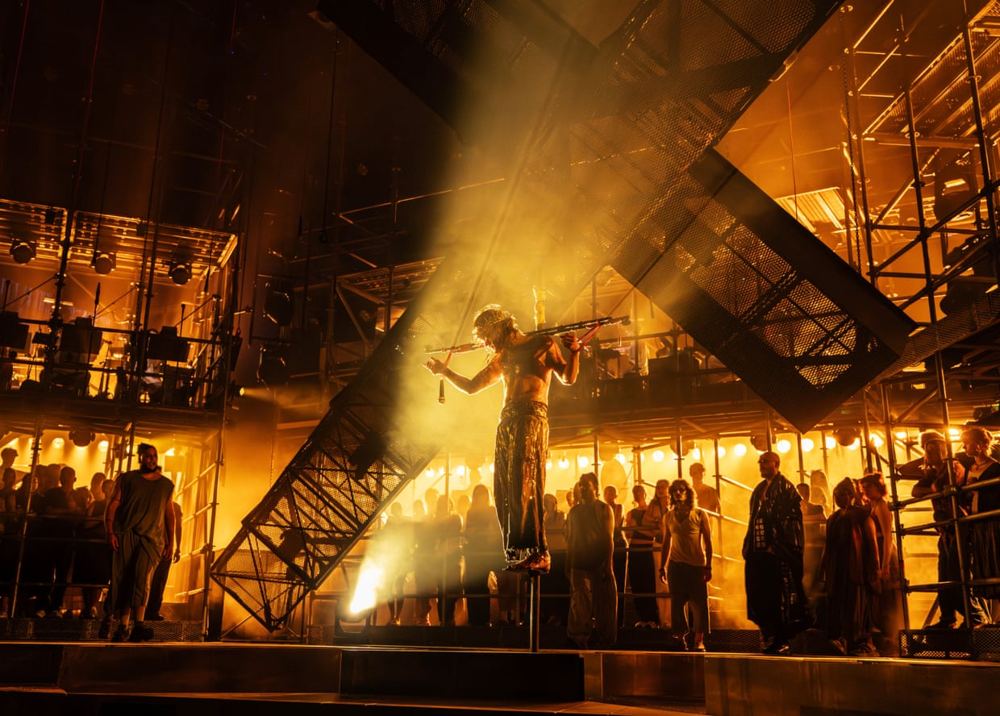
The London Palladium's revival of Jesus Christ Superstar leans heavily on a rotating cast of celebrities to drive ticket sales, prioritising volume and spectacle over narrative depth.
Jesus Christ Superstar has opened at the London Palladium, where it will run until 5 September. Eurovision star Sam Ryder leads the production as Jesus of Nazareth, backed by an aggressive commercial casting strategy designed to drive West End ticket sales.
The production relies on a rotating roster of established celebrities to sustain audience interest. Jesse Tyler Ferguson plays an initial run as a camped-up King Herod, adopting a gold-gown aesthetic, before handing the role over to Boy George, Layton Williams and Julian Clary. This stock crowd-pulling tactic ensures the show maintains a high public profile throughout its run.
It reunites the creative trio behind the 2016 revival. Director Tim Sheader, designer Tom Scutt and choreographer Drew McOnie have returned, with Scutt’s scaffold set now featuring standing audience members positioned around the structure. Despite this structural change, the staging never successfully implicates these on-stage spectators in the biblical crowds that betray or support Jesus.
The production’s primary commodity is volume. The sound mixes electric guitar and rock with choral church music, flecks of jazz and gospel, reaching a fever pitch. This relentless auditory assault, however, comes at an artistic cost. The volume frequently drowns out the lyrics, and when Ryder attempts to compensate, his delivery drops to an inaudible murmur.
Ryder’s performance is a study in the limits of star casting. He earns a standing ovation for Gethsemane, demonstrating undeniable vocal power. Yet his characterisation lacks the dangerous revolutionary edge that the temple High Priest Caiaphas, played by Bob Harms, perceives him to be. Rendered as a bland figure in a man-bun and floaty shirt, Ryder’s Jesus fails to clarify what he actually stands for.
This ambiguity damages the central dynamic with Judas, played by Tyrone Huntley reprising his Olivier award-nominated role from 2016. Huntley brings necessary emotional weight, suggesting Jesus has lost sight of Judea’s Roman occupation and surrounding poverty. Because Ryder’s portrayal is so vague, the exact nature of Judas’s grievance, whether Jesus has gone too far or not far enough, remains opaque.
The aesthetic choices compound these narrative issues. Inspired by the 1973 film’s psychedelia, the show leans heavily into 1970s flower power nostalgia. Mary Magdalene, played by Desmonda Cathabel, is reduced to an anodyne flower child, wasting the opportunity to present a transgressive biblical figure. Abstract choreography and a heavy reliance on glitter further prioritise visual spectacle over dramatic substance. For the West End economy, the production is a safe, highly marketable bet; for theatregoers, it is an exercise in sound over substance.